Science \& Exploration
Watch the total solar eclipse with ESA in León
23/07/2026
7 views
0 likes
Discover the science behind one of nature's most extraordinary phenomena and experience a total solar eclipse with the European Space Agency (ESA), the City of León and the University of León.
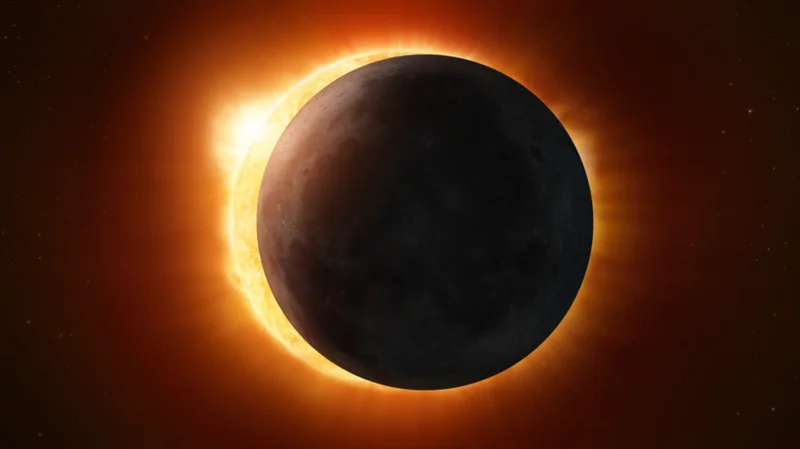
On 12 August, millions of people across Europe will look to the sky to witness one of nature's most spectacular phenomena: a total solar eclipse. For many, it will be their first opportunity to experience one.
Northern Spain will be one of the best places in the world to experience totality – when the Moon completely covers the Sun. Totality will only be visible from Greenland, Iceland, northern Spain and a small area of northeastern Portugal. To mark this extraordinary occasion, ESA, together with the City of León and the University of León, is organising a free public event at the Palacio de Exposiciones y Congresos de León.
The event will bring together scientists, engineers and astronomy experts, who will guide visitors through the science behind the eclipse with interactive activities, talks and live observations throughout the day. It will be a unique opportunity to experience totality alongside the people who study the Sun and our Universe every day.
The full programme is free of charge and open to all, with no registration required.
Total solar eclipse 12 August 2026 – Global map
A full day of space activities
From 10:00–14:00 CEST, visitors can explore a wide range of hands-on workshops, experiments and interactive activities designed for all ages.
From the science of the Sun and eclipses to Europe's space missions, aerospace engineering and the history of astronomy, the daytime programme offers something for families, space enthusiasts and anyone curious about how we explore and understand our Universe.
In the late afternoon, the programme moves outdoors. Gates open at 17:30 CEST, giving visitors plenty of time to find a place before the main stage programme begins at 18:30 CEST.
The evening programme combines science talks and expert commentary to guide visitors through every stage of the eclipse, explaining what is happening in the sky and why the 12 August 2026 eclipse is such a remarkable event.
Total solar eclipse 12 August 2026 – Map of totality in Spain
Programme
From family workshops and interactive demonstrations in the daytime to an evening of science and eclipse observation, here is what visitors can expect throughout the day:
A DAY OF SCIENCE FOR THE WHOLE FAMILY
Indoor area of the Palacio de Exposiciones y Congresos, León
10:00–14:00 CEST
Enjoy workshops, experiments and hands-on activities for all ages. Discover the science of the Sun and eclipses, explore space through play and experimentation, and learn how to observe the eclipse safely.
| | | | |
| --- | --- | --- | --- |
| Activity | Description | Time | Language |
| Discover ESA Organised by ESA | Learn about ESA missions and how space is part of our everyday lives. | 30 min | Spanish |
| Build your own pinhole camera! Organised by CESAR ESA | A fun and safe way to observe the Sun through projection using affordable materials. Ideal for curious children. | 30 min | Spanish and English |
| Inclusive eclipse Organised by CESAR ESA | Experience the eclipse through sound. Discover sonification tools and try LightSound, a device that converts changes in light into sound, making eclipse observation accessible to people with visual impairments. An engaging experience that combines science, inclusion and technology for everyone. | 30 min | Spanish and English |
| The Sun and the Moon Organised by ESA | Discover how our star and Earth's natural satellite work, why eclipses occur, and what they can teach us. | 30 min | Spanish |
| Astronauts and space exploration Organised by ESA | Discover what life is like for astronauts, how they live and work in space, and the challenges of exploring the Moon and Mars. | 30 min | Spanish |
| How hard is it to be a superstar! (or a star in general?) Organised by Universidad de León | A theatrical performance exploring how stars work. | 30 min | Spanish and English |
| Measuring time in times gone by Organised by Universidad de León | Travel back in time to discover how ancient civilisations observed the sky and measured the passage of time. | 60 min | Spanish |
| Water rockets Organised by Universidad de León | Build and launch your own water rocket while discovering some of the principles of aerospace engineering. | 30 min | Spanish and English |
| Mitchell: the mini genius who observed space Organised by Universidad de León | Discover constellations and the instruments we use to explore the night sky. | 20 min | Spanish and English |
| Alfonsine view of the cosmos Organised by Universidad de León | Card game exploring the Alfonsine view of the planetary cosmos in the Middle Ages. | 20 min | Spanish |
| What is a sundial? Organised by: León Astronomical Association | Learn how to build and use a sundial and know the time anywhere you travel. | 30 min | Spanish |
| Sun observation with telescopes Organised by León Astronomical Association | Observe the Sun safely and discover what it looks like on the day of the eclipse. | Ongoing | Spanish |
| Talks and workshops in English Organised by Southern Illinois University | A series of talks and educational workshops covering different aspects of solar eclipses, including eclipse chasing across multiple continents, sunspots, safe eclipse observation, and the most notable phenomena to watch for on the day of the eclipse. | 20 min | English |
| The radiation you can't see Organised by Federópticos San Agustín | Experiment with ultraviolet radiation and discover how to protect yourself during an eclipse. | 15 min | Spanish and English |
EXPERIENCE THE ECLIPSE WITH US
The outdoor area of the Palacio de Exposiciones y Congresos de León
17:30–21:45 CEST
| | |
| --- | --- |
| Time | Programme |
| 17:30 | Gates open |
| 18:30 | Welcome \| Opening of the programme |
| Exploring the Universe from Spain: Discover ESA's first mission to be led from Spain and learn how it will help solve one of the greatest mysteries of the Universe. Speakers: Carlos Corral Van Damme (ESA), Alicia Miró, Spanish Space Agency (AEE) |
| 18:50 | The Sun we can't see: What are solar storms? How can the Sun's activity affect satellites, communications, navigation and many of the technologies we rely on every day? Discover why understanding our star is more important than ever. Speakers: Rocío Guerra (ESA), Cristina Almaraz (ESA), Arianna Rigo (ESA) |
| 19:15 | Welcome José Antonio Diez, Mayor of León Nuria González, Rector of the University of León Mickäel Torrado, Head of Strategy, ESA Science Programme |
| 19:33 | The eclipse begins: Our experts will guide you through every stage of the eclipse, helping you understand everything happening in the sky as the event unfolds. |
| 19:35 | Discover the eclipse: Why do eclipses happen? What makes the 12 August eclipse so special? Everything you need to know to fully enjoy this extraordinary phenomenon. Speakers: Juan Ángel Vaquerizo (ESA), Jesús González (University of León), Xuasús González and José Vicente Gavilanes (León Astronomical Association) |
| 20:00 | How do we study the Sun when there isn't an eclipse?: How do scientists continue studying the Sun when there are no eclipses? Discover how ESA missions allow us to observe our star from space. Speakers: Esther Bastida (ESA), Pablo Gutiérrez Marqués (University of León) |
| 20:28–20:30 | TOTALITY The highlight of the day: for just over two minutes, day will turn into night. |
| 20:31–20:33 | Live connection with Teruel’s totality Continue the experience with ESA's live broadcast from Teruel, allowing you to witness totality twice. |
| 20:35 | One last look at the eclipse: The experience doesn't end when daylight returns. Together we'll look back at the most spectacular images from the eclipse and uncover some of the fascinating details that make a total solar eclipse one of nature's most extraordinary phenomena. |
| 21:22 | The eclipse ends |
| 21:45 | End of the event – gates close |
Practical information
- Date: Wednesday 12 August 2026
- Venue: Palacio de Exposiciones y Congresos de León, Spain
- Daytime activities: 10:00–14:00 CEST
- Gates open for evening programme: 17:30 CEST
- Evening stage programme: 18:30–21:45 CEST
- Free of charge. No registration required.
- Language: The stage programme will be conducted in Spanish. Some workshops will be available in Spanish and English (see Workshop table above).
- Free certified eclipse glasses will be available while stocks last.
Before you come
- Arrive early to make the most of the day's activities and secure a good viewing spot before the evening stage programme begins.
- Use certified eclipse glasses whenever any part of the Sun is visible. Only during totality, when the Moon completely covers the Sun, is it safe to look directly at the eclipse without eye protection.
- Bring water, suncream and a hat for the observation, as temperatures can be high.
- Check this page regularly for the latest programme updates and practical information.
Can’t join us in León?
If you are unable to join us in León, you can also follow the eclipse through ESA's live broadcast from the Observatorio Astrofísico de Javalambre in Teruel, Spain.
The broadcast will be available in English on ESA Web TV and YouTube from around 19:30 CEST on 12 August. More information will be published soon.
If you are a member of the media and would like to cover either event, please visit our media platform for registration details.
Like
Thank you for liking
You have already liked this page, you can only like it once!