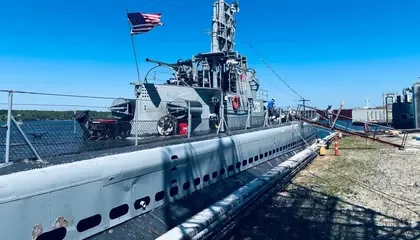
Restorers working on the World War II submarine USS Silversides have made an unexpected discovery: a flood valve that may be the only surviving component of the USS Trigger, another submarine that sank during the war.
The Silversides is undergoing renovations in Sturgeon Bay, Wisconsin, as part of a $3.5 million preservation project that will restore its steel hull, remove invasive zebra mussels, add protective coatings and apply a fresh coat of paint. During World War II, the 312-foot-long submarine patrolled the Pacific Ocean, sinking at least 23 enemy vessels. Since 1987, the decommissioned vessel has operated as a floating museum in Muskegon, Michigan.
While working on the Silversides, experts with Fincantieri Bay Shipbuilding discovered a piece of metal stamped “TRIGGER L-792-228, F [R or B] -47-STBD.” This component was once a flood valve, a hinged cover on one of the submarine’s ballast tanks that was used to take in or release seawater, reports Dan Basso for the* Lansing State Journal. *
This particular flood valve appears to have been destined for a different submarine altogether: the Trigger. For reasons still unknown, it ended up on the Silversides. Adding to the mystery, crews found it on the submarine’s port side, though it’s labeled as a starboard side component.
Museum leaders plan to remove and preserve the Trigger flood valve.
“Coolest find yet,” Scott Hardin, the museum’s vessel curator, says in a Facebook post. “This could be the only surviving Trigger submarine part.”
Did you know? Swapped parts
Rick Connole, whose father, David Connole, served as the Trigger’s final commanding officer, thinks he knows how the Trigger’s flood valve ended up on the Silversides. The two ships were built at the Mare Island Navy Yard in California, and workers “swapped parts all the time in construction,” Connole tells Popular Science’s Andrew Paul.
According to Hardin, the Trigger was the Silversides’ sister ship. Commissioned on January 30, 1942, less than two months after the attack on Pearl Harbor, the Trigger was named after the triggerfish, a group of fish known for the locking mechanism of their dorsal spines, which they can raise and lower like a trigger.
The Trigger sank in the East China Sea while making her 12th war patrol, the suspected victim of a two-hour combined aerial and surface attack by Japanese forces on March 28, 1945. The Silversides was one of the four nearby American submarines that heard the two-hour assault by Japanese planes and ships, according to the Submarine Force Library and Museum Association. The vessel went down with 89 men aboard.
The Trigger, which sank 27 enemy ships and damaged another 13, had a “long and illustrious” career, per the Naval History and Heritage Command. The ship received 11 battle stars and the Presidential Unit Citation for its contributions during the war.
The submarine’s many accomplishments were immortalized in a poem by Constantine Guinness, a motor machinist’s mate first class. It began: “I’m the galloping ghost of the Japanese coast / You don’t hear of me and my crew / But just ask any man off the coast of Japan / If he knows of the Trigger Maru.”