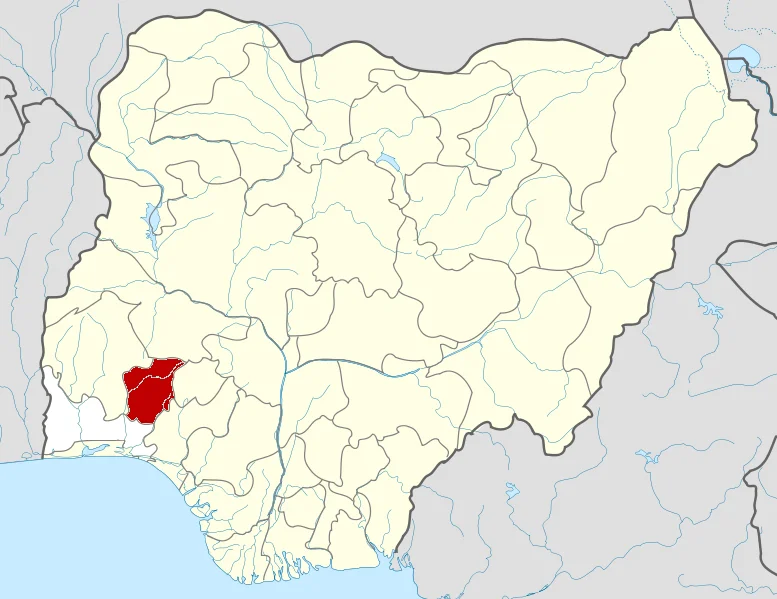
The Osun State governorship election is at hand, and tension is mounting across the state as political parties conclude their campaigns for the 15 August poll.
It will be the second off-cycle governorship election in Nigeria this year, after Ekiti State held its own in June.
The contest appears to have taken shape around three contenders, with some parties and political actors giving up their own ambition in support of the leading candidates, particularly the APC‘s Bola Oyebamiji.
Over the last few weeks, the election has been at the forefront of public discourse across Nigeria, and is likely to draw even more attention as voters go to the polling units.
| | |
|---|
Here are 20 things to know about the state.
-
Osun State was created on 27 August 1991 by the military administration of Ibrahim Babangida. It was carved out of Oyo State during one of Nigeria’s major state-creation exercises. That year, the number of Nigerian states rose from 21 to 30 after the military government created nine new states. The other states are: Abia, Anambra, Delta, Enugu, Jigawa, Kebbi, and Yobe. Osogbo, an important commercial town, is the capital of Osun State.
-
Osun is one of the six states in Nigeria’s South-west geopolitical zone. It shares boundaries with Ekiti and Ondo states to the east, Kwara State to the north, Ogun State to the south and Oyo State to the west.
-
The state’s official slogan is “Land of Virtue.” It is also popularly referred to as the “State of the Living Spring,” a phrase that references the Osun River, from which the state takes its name.
-
The state is governed by Ademola Adeleke of the Accord Party, who was sworn in on 27 November 2022 after defeating then-incumbent Gboyega Oyetola in a keenly contested election. Mr Adeleke, who won the 2022 election on the platform of the PDP, is seeking a second term in Saturday’s election as the candidate of the Accord party.
-
Presently, the figures on Osun’s population are largely projections. The 2006 national census put the state’s population at 3.4 million. However, the state government estimates put the population at roughly 4.7 million, based on a 2016 projection. It is the 9th-smallest state by area and the 19th most populous state in Nigeria.
-
Osun has 30 local government areas, grouped into three senatorial districts: Osun East, Osun Central and Osun West. The state also has 3,763 polling units located in 332 wards.
-
The first governor of the state was Leo Ajiborisha, an army colonel. He administered the state from August 1991 to January 1992 before handing over to the first democratically elected governor.
-
The first democratically elected governor of Osun State was Isiaka Adeleke, who served from 1992 to 1993. He was a member of the politically influential Adeleke family and was the elder brother of Mr Adeleke, the current governor.
-
Osun has had 10 people as governors, military and civilian, since its creation. They are Leo Ajiborisha, Isiaka Adeleke, Anthony Udofia, Anthony Obi, Theophilus Bamgboye, Bisi Akande, Olagunsoye Oyinlola, Rauf Aregbesola, Gboyega Oyetola and the incumbent, Ademola Adeleke.
-
Agriculture remains central to the state’s economy. Major crops include cocoa, cassava, yam, maize, kolanut, rice and oil palm. The state is in the country’s cocoa-producing belt, particularly around Ife and Ijeshaland. Similarly, Osogbo, the capital, has a textile industry, food processing, and a steel-rolling mill.
-
Osun is home to one of Nigeria’s two UNESCO World Heritage Sites: the Osun-Osogbo Sacred Grove. It was recognised by the United Nations Educational, Scientific and Cultural Organisation in 2005, mainly due to the efforts of Austrian-Nigerian artist Susanne Wenger. The grove is located on the banks of the Osun River on the outskirts of Osogbo. Several shrines, sculptures and artworks honouring the river goddess Osun and other Yoruba deities are present in the dense forest.
-
The part of the river that runs through the Osun grove has been preserved for 400 years and is believed to possess powers to give pregnancy and to heal generally.
-
In Yoruba cosmology, Osun is a goddess of love and sexuality. She is also one of several orisas or deities. In global pop culture, she is adored – and has been referenced by people like Dianne Reeves and Jennifer Lopez. American singer Beyoncé identified as the goddess in her 2016 album Lemonade and the viral photoshoot announcing her pregnancy a year later, wearing the signature yellow-gold colour associated with Osun.
-
An annual festival is held every August at the sacred grove. This is the Osun-Osogbo Festival. The festival spans two weeks and is attended by many worshippers from across Nigeria and the Black diaspora, including Cuba, Brazil, and Trinidad and Tobago. The activities include ritual cleansing of the town, lighting a centuries-old 16-point lamp, and a procession led by the Ataoja of Osogbo and the Arugba, a young ritual maiden.
-
Ile-Ife, in Osun State, is widely regarded by the Yoruba ethnic group as the cradle of their civilisation and the site from which humanity originated. It is the seat of the Ooni of Ife, one of the most prominent traditional rulers in Yorubaland. Some sub-Yoruba groups in Osun State are Ife, Ijesa, and Igbomina.
-
Osun is rich in mineral resources; from cassiterite, columbite and tourmaline to marble, and importantly, gold. Gold was discovered in the state in 1945, but mining did not commence until the 1980s. The erstwhile Nigerian Mining Corporation (NMC) established the state’s first industrial mining site. Later, Tropical Mines Limited (TML) acquired the project, with the NMC retaining a 20 per cent interest. Years of unregulated gold mining have, however, led to serious environmental degradation and the pollution of the Osun River.
-
Osogbo, the state capital, has a long-standing textile and craft industry, including tie-dye (adire) cloth-making, alongside food-processing and light industrial activities.
-
Saturday’s election is the eighth governorship election in Osun.
-
The poll is also Nigeria’s second off-cycle governorship election this year, after the Ekiti election, and the last governorship poll before the 2027 presidential election,
-
According to the Independent National Electoral Commission (INEC), Osun has approximately 2.3 million registered voters who will be choosing from 14 candidates on Saturday.
-
Apart from the governors listed above, other prominent indigenes of Osun State include the first female Speaker of the House of Representatives, Patricia Ette; former Chief of Defence Staff and Chief of Army Staff, Alani Akinrinade; billionaire businessman and university proprietor, Deji Adeleke; late Deputy Premier of the defunct Western Region, Remi Fani-Kayode; late former senator Ayoola Adeleke; late former governor of the old Oyo State, Bola Ige; former deputy governor and senator, Iyiola Omisore; Afrobeats music star, David “Davido” Adeleke; APC National Secretary, Ajibola Bashiru; former IGP, Tafa Balogun; late Chief of Army Staff, Taoreed Lagbaja; General Overseer of the Redeemed Christian Church of God (RCCG), Enoch Adeboye; General Superitendent of the Deper Life Bible Church, Willaim Kumuyi; Founder of Kingsway International Christian Centre (KICC), Matthew Ashimolowo; NAFDAC DG, Moji Adeyeye; former Minister of Aviation, Femi Fani-Kayode; music icon, Emmanuel (Mayorkun) Mayowa; Christian film maker, Mike Bamiloye; veteran artist, Toyin Adegbola; former Supreme Court justice, Bolarinwa Babalakin; Chairman of Bi-Courtney Group of Companies, Wale Babalakin; ex-Finance Secretary (Minister) and traditional ruler, Oladele Olashore; former Minister of Transport and Aviation, Ebenezer Babatope; renowned journalist, Dele Olojede; Chief Imam of Osun State, Sheik Ajisafe; music star, Eedris Abdulkareem; actress Seyi Shay; former Minister of Internal Affairs, Sunday Afolabi; founder of Lead City University, Jide Owoeye, and veteran journalist, Liad Tella.