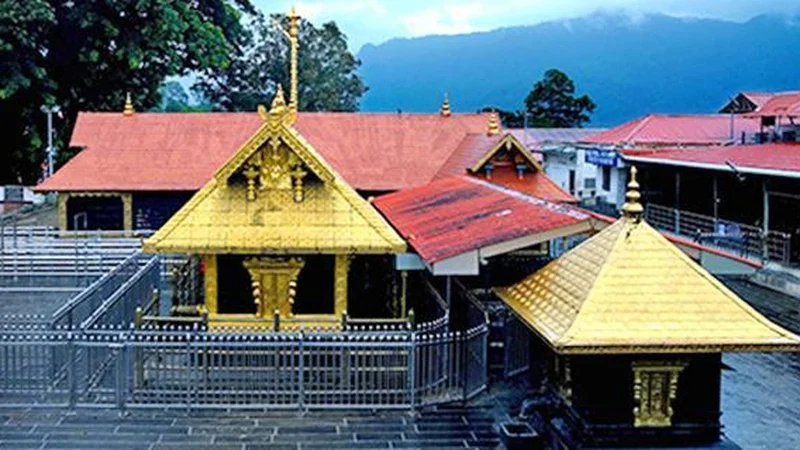
The story so far: The Kerala High Court-appointed Special Investigation Team (SIT) on Thursday (July 23, 2026) detained the former Travancore Devaswom Board (TDB) president P.S. Prasanth for questioning in connection with what has come to be known as the Sabarimala gold ‘theft’ case. Mr. Prasanth’s arrest signals a consequential turn in the sensational case, which continues to rivet public attention and remains an animating factor in Kerala politics.
He is the third TDB president nominated by the previous Left Democratic Front (LDF) government and indicted by the SIT in the case. Earlier, the SIT had arrested A. Padmakumar, a senior Communist Party of India (Marxist) [CPI(M)] leader who has since been suspended from the party, and later, N. Vasu, an LDF fellow traveller designated as TDB president, raising questions about the administration of State-owned temples under the previous ruling dispensation.
The other accused in the controversy include Unnikrishnan Potti, a former part-time aide to a former Sabarimala temple priest, who gained traction in the TDB owing to his good offices with the temple’s priestly orthodoxy. In some measure, Mr. Potti is the progenitor of the Sabarimala gold theft scandal. His off-the-cuff remark to television reporters that a gold-plated copper artefact he had donated to the temple had gone missing since 2019 triggered the High Court-ordered high-profile and largely undercover investigation.
The TDB’s internal vigilance recovered the object from the house of Mr. Potti’s relative, sparking off the expansive Sabarimala gold 'theft’ investigation that spanned Kerala, Karnataka, and Tamil Nadu, and brought celebrity devotees, jewellers, and gold-plating units under its relatively vast scope.
The investigation led to the arrest and incarceration of Kandararu Rajeevaru, the then Sabarimala temple Tantri (head priest). As per the Sabarimala customs, the Tantri’s is the final word concerning religious matters, including those relating to the presiding deity. Several TDB officials were arrested and several more face legal jeopardy as the SIT probe nears the finishing line.
How did the controversy begin?
In 2019, the TDB entrusted Mr. Potti with the original gold cladding that covered the Dwarapalaka stone sculptures flanking the sanctum sanctorum and the gilded panels encasing the wooden door for refurbishment and repair at a private electroplating unit, Smart Creations, in Chennai.
The temple artefacts were fashioned from more than 30 kg of high-grade gold bullion donated to the temple by liquor baron Vijay Mallya, now a fugitive, back in 1998. Mr. Potti returned the artefacts to the temple later the same year, after keeping them in his custody for private worship at the houses and business premises of wealthy Ayyappa devotees in Karnataka and Tamil Nadu, including film stars and famous playback singers.
Mr. Potti’s rather quirky claim that the panels he donated had gone missing from the temple prompted the High Court to order an audit by the TDB vigilance, which flagged that the panels returned to the temple after “repair and replating” at Smart Creations weighed considerably less. The unit told the High Court that the handlers of the artefacts had gleaned an estimated 4.5 kg of gold from the alloy using some in-house chemical process at the electroplating factory.
The TDB Vigilance report opened a Pandora’s box of allegations, including official conspiracy to steal the Sabarimala temple property, which put the LDF government on the defensive and provided sensational grist to the Congress-led United Democratic Front (UDF) government and the Bharatiya Janata Party (BJP) to assail the administration at the hustings in the run-up to the 2026 Kerala Assembly elections.
What do the court filings reveal?
Later in a slew of court filings, the SIT accused many TDB officials, jewellers, Smart Creations owner and others of conspiracy, confidence trickery, theft, illegal pecuniary gain, causing loss to the Ayyappa temple, and violating the shrine’s ritualistic tradition by leasing out the coverings to wealthy devotees for private worship for significant backhanders.
The SIT told the court that Mr. Potti, in hindsight, suspiciously emailed the TDB that he would restore the frayed overlays at the entrance of the sanctum sanctorum to their original golden sheen. Subsequently, the TDB handed him the coverings after “mystifyingly” itemising them as pure copper claddings in temple records. The artefacts took a 39-day detour to the smelting unit in Chennai. En route, the SIT stated, the accused chartered out the religious artefacts to wealthy devotees in Bengaluru, Hyderabad and Chennai for private pujas at their homes in exchange for sizeable compensation.
Why is the 2025 electroplating decision under scrutiny?
The TDB under Mr. Prasanth courted controversy again in 2025 by resending the gold-plated copper panels to Smart Creations for electroplating.
Notably, Mr. Prasanth’s arrest comes nearly three weeks after the SIT questioned Unnikrishnan Potti, the prime accused in the case, as part of its enquiry into the “questionable circumstances” that led the TDB to resend the temple’s gold-plated copper panels ensconcing stone sculptures to Smart Creations, a metal works factory in Chennai, for electroplating in 2025.
According to officials, the SIT suspects that the TDB administration, headed by Mr. Prasanth, cited “non-existent defects” as a pretext to dispatch the gold-plated copper panels flanking the entrance to the sanctum sanctorum to Smart Creations to allegedly cover up an “earlier pilferage” of the gold element in the alloy.
The SIT was reportedly sceptical of the decision’s moral correctness, given that the TDB had sent the same panels to Smart Creations for repair and refurbishment in 2019. The firm then issued a warranty, guaranteeing that the panels would retain their golden sheen for at least 40 years. The firm also promised to repair or replace the panels free of charge if the warranty failed.
Why is the warranty agreement under investigation?
The SIT was also reportedly investigating whether there was any prior criminal intention to defraud the temple trust by issuing the warranty in Mr. Potti’s name, and entirely omitting TDB, the temple’s statutory custodian, from the agreement.
For one, according to officials, Smart Creations had issued a 40-year warranty in Mr. Potti’s name, and the allegedly ambiguous wording of the agreement tacitly insulated the firm from legal liability for any physical damage during the repair and electroplating processes.
How could forensic tests help the probe?
Earlier, the SIT enlisted the help of the National Metallurgical Library under the Centre for Scientific and Industrial Research to compare the original gold covering installed in 1989 with those returned by Smart Creations after electroplating, purportedly to establish a baseline for forensic comparison and possibly to evaluate any “pilferage” of gold.
What happens next?
The SIT probe is meandering towards its conclusion with investigators reportedly poised to give a closure report to the Kerala High Court.
Published - July 23, 2026 03:26 pm IST