Part the First: Another Promising Breakthrough in HIV Therapy. For those of us who were following the HIV/AIDS epidemic more than forty years ago, advances in antiviral therapy have been more effective than many of us could have imagined when the only drug available was AZT, which did not work. Too many healthy friends and acquaintances died a long, horrible death from AIDS until David Ho and his coworkers developed triple therapy in the mid-1990s. Even then, the therapy required many pills that were taken on schedule and true to the free market, HAART (Highly Active Anti-Retroviral Therapy) was not available everywhere it was needed. While the therapy worked and reversed the seemingly upward trend in deaths due severed immune system depression, it was onerous. From As a weekly anti-HIV pill nears the market, vaccine research faces new hurdles:
Rio de Janeiro – Powerful anti-HIV drugs took another step forward at the 26th International AIDS Conference, held here last week. Among the most exciting findings were studies showing one pill a week could be enough to keep HIV under control in people living with the virus—a significant improvement over the current once-a-day regimen. But vaccine development, which has struggled even as treatments advance, faced new questions as a study highlighted the limits of unusually powerful antibodies that the leading vaccine candidates aim to trigger.
The meeting itself was a shadow of its former self. Some 7300 delegates attended, about one-third the number who came to the conference in its heyday between 2002 and ’12. World leaders and celebrities were absent. That partly reflected success: By reducing new infections and deaths, science has made HIV a less urgent topic than it used to be.
But the sparser attendance was also due to the steep cuts in funding by the United States. Its foreign assistance for HIV/AIDS dropped from $8.3 billion in 2024 to $6.2 billion in 2025, a 25% cut, according to a report released at the conference by KFF and the Joint United Nations Programme on HIV/AIDS (UNAIDS). “People are not able to travel or pay for registrations because they don’t have grants,” says Beatriz Grinsztejn, an infectious disease specialist at the Oswaldo Cruz Foundation who chaired the meeting. A study by the nonprofit amfAR showed that in the wake of the cuts, 46 countries closed some 1700 sites that deliver HIV services, with prevention efforts taking the biggest hit. “The scientists have delivered,” said Winnie Byanyima, head of UNAIDS. “
The politicians need to step up.” (Don’t they, though.)…
Now, Gilead has joined forces with Merck, producer of islatravir, to test a pill combining the two drugs. Two trials presented at the meeting—one of which was published in the 29 July issue of
The New England Journal of Medicine(NEJM)—showed the combination can hamper viral replication for 1 week. Gilead and Merck plan to submit the data to regulatory agencies for approval.
We can expect this therapy to work, and further push HIV into the background and then AIDS into extinction, to the extent our resources are allowed to reach. As for HIV vaccines, there has been little real progress for the same forty years, and my (very fallible) intuition tells me that a vaccine for HIV is unlikely absent discoveries that are hiding. But since vaccines do not fit in with the priorities of the Current Administration, perhaps that will not make as much difference for HIV. For other diseases, that is another matter altogether.
Part the Second: A Vaccine that Works Exactly As Expected. A report from Cancer Research UK (Imperial Cancer Research Fund when I almost got a postdoctoral position in Hertfordshire) tells the story: New data shows the HPV vaccine is saving lives from cervical cancer:
The
human papillomavirus (HPV) vaccine has been estimated to reduce the risk of cervical cancer death before age 30 to effectively zero, according to the first study looking at lives saved by the vaccine (no paywall).In the most recent five-year period (2020-2024), and for the first time on record, no women in their early 20s died from cervical cancer in England. Around 9 in 10 women in this age group received the HPV vaccine, most when they were 12 or 13, which is when the vaccine offers the strongest protection.
Cancer Research UK played a vital role in uncovering the link between HPV and cervical cancer and then developing the HPV vaccine.
“This is an incredible milestone and major progress in our mission to beat cancer,” says Michelle Mitchell, our chief executive. “We know the HPV vaccine is extremely effective at stopping cervical cancer before it starts and for the first time, these findings show it is saving lives.”
Let me repeat this: The HPV vaccine will reduce the risk of death from cervical cancer to zero! So far this is an estimate, but studies in other countries that have shown similar results:
This is the strongest evidence yet that the HPV vaccination programme is not only preventing cervical cancer but saving lives. Around 200 cervical cancer deaths have been prevented so far in England but lead researcher Professor Peter Sasieni says this is just the tip of the iceberg.
“As vaccinated generations grow older, we’ll see many more lives saved from cervical cancer,” he explains.
“It is incredible to think that a single jab can almost eliminate a particular type of cancer, and this new research shows just how vital it is to keep HPV vaccination levels high so more people are protected.”
In the early 2000’s, when the HPV vaccine was being rolled out in the United States, I got into an argument (civil but serious) with the father of three young boys. He said that there is no reason for his boys to get the vaccine because they do not have a cervix. No, they don’t. But when I asked him if he wanted them to be HPV spreaders he said they wouldn’t do that. Typical parent of my generation, who thinks his kids won’t do what he did when he was a certain age.
HPV also causes oropharyngeal squamous cell carcinoma (OPSCC) in the tongue and tonsils. Boys and girls have both, and just as with cervical cancer Gardasil® will prevent tonsil tumors, also. Which brings us to a remembrance of the physician scientist who proved that HPV causes these tumors, too.
Maura L. Gillison was a scientist’s scientist and physician’s physician:
Maura Gillison once told an interviewer that she had wanted to be a doctor and a scientist since childhood. She trained in ballet, but as she grew, reaching a height of 6-foot-2, dance became an unlikely career path because she felt that it would draw too much attention to her height.
Instead, she forged a trailblazing career as a medical oncologist and molecular epidemiologist, studying head and neck cancers. In the early 2000s, she was credited as the first researcher to show definitively that the human papillomavirus, or HPV — the most common sexually transmitted infection — caused the so-called oropharyngeal cancers of the throat, tonsils and base of the tongue.
“No head and neck medical oncologist has had a bigger impact on patients than Maura Gillison,” Dr. John V. Heymach, the chair of thoracic/head and neck oncology at MD Anderson Cancer Center in Houston, where Dr. Gillison conducted research beginning in 2017, said in an interview.
Dr. Gillison died on June 21 at her childhood family home in Willoughby, Ohio, northeast of Cleveland. She was 61. The cause was a rare cancer of the small intestine, her husband Dr. David E. Symer, an oncologist, said.
While smoking and heavy drinking cause most cases of OPSCC and other cancers of the head and neck, Dr. Gillison was open to new evidence. She noticed that a significant number of patients with OPSCC did not have any of the usual risk factors. Despite much skepticism (I attended some of the early discussions of this outrageous hypothesis) she persevered. She was correct:
In 2007, she led a team that demonstrated more conclusively that HPV caused cancer of the throat, tonsils and base of the tongue in a paper published in The New England Journal of Medicine. This subset of cancers was distinct from cancers of the mouth primarily caused by smoking and drinking.
She told NPR in 2011 that she suspected that the sexual revolution of the 1960s had resulted in more sexual relationships with more partners, more oral sex and thus an increased chance of developing HPV-related infections and cancer.
These HPV tumors are much more treatable (without surgery!) with focused, high-intensity radiation and conventional chemotherapy (cisplatin) that those caused by smoking and excessive drinking (surgery, radiation, chemotherapy, more invasive surgery, more radiation, more chemotherapy). And because of Dr. Gillison’s work many will not have to go through this grueling regimen in the future! Those of us who have benefited from your research salute you! In a reasonable world we can expect OPSCC caused by HPV to follow cervical cancer into oblivion. As for the immediate future, expect HPV vaccines to come under attack from the usual suspects, those who use the (very persuasive) Merchants of Doubt and those who think sex is icky and that their children won’t do what they did naturally.
Part the Third: On-the-Ground Politics of AI Data Centers. The seeming inevitability of AI and its handmaidens in the form of large, noisy, energy-hogging data centers is in the news every day and should stay there. An interesting dispute has arisen in Effingham County, Georgia, just inland from Savannah. The Current has the story in Anatomy of a secret Coastal Georgia data center. Similar cases of obfuscation and self-dealing are worming themselves into communities everywhere on planet Earth:
Last fall, representatives of Georgia’s largest utility company assumed the role of matchmaker. They contacted Effingham County officials with a proposal: One of the largest tech companies in the world was looking for a location to build a data center.
The ensuing courtship, brokered by Georgia Power and conducted in secret, culminated some nine months later, when OpenAI and Effingham County’s development authority signed a $20 billion deal to construct a data center on a 1,400-acre tract of land near Rincon. Separately, the power company also forged a new contract with OpenAI.
OpenAI’s mammoth investment, county leaders say, will allow Effingham to eliminate residential property taxes, improve services and put the county at the vanguard of the nation’s 21st-century digital economy.
Many of Effingham’s 75,000 citizens aren’t so sure. Like other Georgia communities where data centers have already sprouted, the artificial intelligence revolution has roused skepticism and profound unease across the political spectrum — whether about rising utility prices, environmental pollution, AI disruptions to the economy or the impact of tech companies on American democracy (a rara avis of the first magnitude).
More than two weeks after the deal was approved, basic questions remain unanswered about the impact it will have. What’s more, questions continue to swirl about the vague and contradictory statements county officials gave in public about their intent to woo a data center, even as they held private discussions with OpenAI.
The head of the Effingham County Industrial Development Authority said that the approximately $870 million in tax revenue that OpenAI will pay over 15 years proves why the project is good for the county. Still, the days leading up to the agency’s formal approval illustrate the lack of transparency and mistrust over whether the county is calling the shots, or the California-based tech firm is.
Perhaps my favorite parts are the “$870 million in tax revenue that OpenAI will pay over 15 years.” What is the likelihood that Sam Altman’s maleficent creation will be here in 15 years? And then there is this priceless tidbit:
Development authority CEO Brandt Herndon, who was subject to a non-disclosure agreement with OpenAI until a week before the vote, said that all his board’s meetings are open in keeping with state law. He added that few people attend any of his agency’s meetings, which — as
The Currenthas previously reported — are rarely posted or published online. “We have made sure that this transformational project is in the best interests of the county,” Herndon said.
The stupid, it burns. The question is whether it will burn Brandt Herndon and his minions or the people of Coastal Georgia. Polymarket would predict the latter. If this thing gets built, expect the Floridan aquifer to get drained into oblivion. When a paper plant closed in Savannah recently, the water table rose. Expect the opposite if this water hog, and the similar Hyundai MetaPlant up the road, have their way. Farmers? Meh, they can just depend on the increasingly unreliable rainfall. I also suppose Georgians could just build desalination plants. The 100-mile coastline from the Savannah River to the St. Marys has plenty of salt water as raw material.
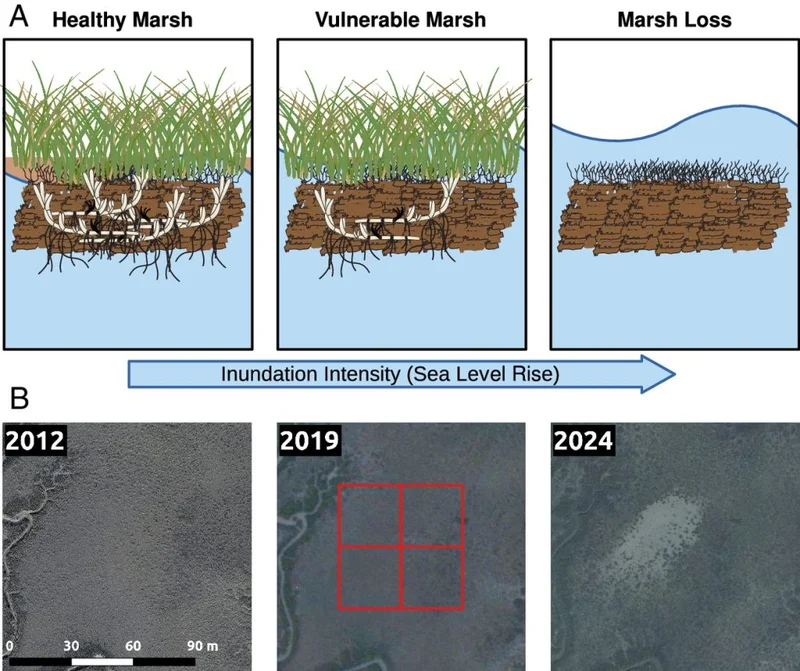
Part the Fourth: Marsh Grass in decline. Staying in Coastal Georgia for this part, a scientist at the University of Georgia Marine Institute on Sapelo Island (founded by Eugene Odum, who is widely recognized as the father of modern ecosystem ecology) finds that The grass looks healthy. But most of Georgia’s marshes are losing their roots to sea level rise (The Current again, which is the only legitimate news source in Coastal Georgia these days). The scientific paper was published in Proceedings of the National Academy of Sciences, with the postdoctoral fellow, Kyle Runion, as the first and corresponding author (Yay, Kyle!). This is definitely the kind of research that is not a priority of the Current Administration and is unlikely to be funded going forward. The conclusion of the paper is illustrated here:
As sea level rises, very slowly, the roots of Spartina alterniflora lose biomass and eventually the grass dies. This is not a difficult concept, but unless one is looking for the unexpected, the result will not be obvious until it is too late (well, it probably already is too late, but at least the collapse of the Spartina salt marsh won’t be a surprise when it happens). We discussed this here previously using the argument that exponential sea level rise looks linear, and slow, for a long time. Until it doesn’t. The modern human mind is not very good at imagining nonlinear growth, except perhaps when it imagines its money and compound interest. This is just another observation confirming that the natural ecosystem with the highest primary productivity in the world will be inundated, and killed, a thousand years before its time. Nature, left to take its previous course, as in the twentieth century, would have just moved the marsh inland by degree, leaving people time to move. Oh, well.
Part the Fifth: A Wendell Berry on What Ails Us. We have not visited Front Porch Republic for a while, where Daniel Vollaro has published The Wendell Berry Moment. I read Berry’s “Why I Am Not Going to Buy a Computer” when it was published in Harper’s and later in a collection of essays. The subsequent letters to the editor were priceless. WB made eminent good sense, even if he ignored the good that computers can do. I remember when molecular biologists aligned DNA or protein sequences by hand. Modern bioinformatics and DNA sequence analysis along with annotated genome sequences have made most of modern biology possible. But the good does not excuse the other:
Berry seems to have understood decades ago that computers would be arrayed against us by governments and big corporations, even as they were being sold to us as tools of efficiency and productivity. He has a keen eye for hucksters. “I have seen their advertisements, attempting to seduce struggling or failing farmers into the belief that they can solve their problems by buying yet another piece of expensive equipment,” he complains. “I am familiar with their propaganda campaigns that have put computers into public schools in need of books.” Prove to me that
yourtechnology will improvemylife—our lives—he demands. Prove to me that computers will do more good than harm.
And this line from WB’s essay is also priceless, “When somebody has used a computer to write work that is demonstrably better than Dante’s, and when this better is demonstrably attributable to the use of a computer, then I will speak of computers with a more respectful tone of voice, though I still will not buy one.” La Commedia – thank you, Professor Joe Berrigan, for everything – has undoubtedly been used to train various and sundry large language models, so they will be able to regurgitate it in part, but I’m guessing not in Tuscan and not with anything approaching Dante’s felicity…Anyway, good food for thought. Or, is it food for good thought?
Thank you for reading! See you next week. In the meantime reserve some screen-free time. Here, for example, if you can imagine you are reading It All Turns on Affection in the paperback version. WB is also good for what ails us, before the Current Administration DOGE’s the National Endowment for the Humanities, which is undoubtedly a nest for un-Americans.