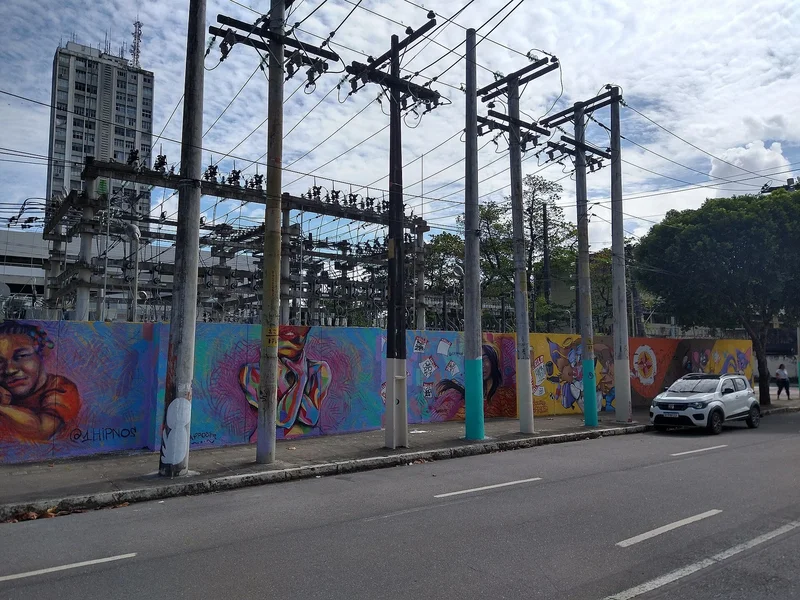
Viva Perifa Brings a Giant Street Mural to a Salvador Public School
Brazil · Culture
A first-of-its-kind community art project is turning a Sussuarana schoolyard into grassroots Bahian street art. With a 178-square-metre mural rising on a public wall.
Viva Perifa has arrived in Salvador for the first time. And it is doing something quietly wonderful: turning the walls of a neighborhood public school into grassroots Bahian street art.
For expats who love the color and grit of Brazil’s mural scene. This is a fresh reason to look beyond the tourist postcard of Pelourinho.
Viva Perifa Comes to Salvador for the First Time
This is the debut Salvador edition of Viva Perifa nas Comunidades, a project that brings graffiti. Murals, and art workshops into public schools in peripheral neighborhoods.
Because it is the first time the initiative has landed in the Bahian capital. There is a real sense of occasion around it.
The action is unfolding at Escola Municipal Novo Horizonte, in the Sussuarana neighborhood, between August and November 2026. In short.
A working schoolyard on the edge of the city is being reimagined as a canvas for local artists and the children who study there.
What the Project Is Really About
At heart, this is community art rather than a museum show. The project revitalizes school spaces through urban art and hands-on cultural workshops.
Using graffiti as a tool for education, pride, and neighborhood identity. It has previously worked in schools elsewhere in Brazil, including flood-affected communities in Rio Grande do Sul, before reaching Salvador.
So if you come expecting ticket booths and gallery lighting, adjust your expectations. The value here is watching a peripheral neighborhood turn its own walls into an open-air gallery.
Made by and for the people who live around them.
The School and the Sussuarana Neighborhood
Everything centers on Escola Municipal Novo Horizonte, a municipal school in Sussuarana, a large working-class district inland from Salvador’s coastal tourist strip. Sussuarana is not on the standard visitor circuit, which is exactly the point: the art is meant to serve the community first.
For newcomers to Bahia, it helps to think of the project as part of the everyday fabric of a residential neighborhood. The murals are not staged for outsiders, yet the biggest one will be plainly visible to anyone passing on the street.
A 178-Square-Metre Mural on a Public Wall
The centerpiece is a 178-square-metre mural on the school’s outer wall, created by graffiti artist Marcos Costa, better known as Cabuloso. Because it faces the street, this is the piece most people will actually encounter, no appointment required.
That scale is significant for a neighborhood school. A mural of that size becomes a landmark.
A splash of color and storytelling that reshapes how a stretch of Sussuarana looks and feels for years to come.
Workshops and a Mural Made by the Students
Inside the school, the project runs graffiti and visual-arts workshops for about 60 students aged 10 to 12, split into two groups. They learn the history of graffiti, meet Salvador’s own urban artists, and pick up drawing and painting techniques.
The workshops are led by visual artist, muralist, and graffiti artist Niiny Santos. At the end, Niiny works with the students to produce an indoor mural.
So the children are not just spectators but co-authors of the art on their own school walls.
The Themes: Diversity, Sustainability, Inclusion
The subject of the big external mural is chosen together with the school community, guided by three themes: diversity, sustainability, and inclusion. As a result, the finished wall reflects local voices rather than an outside artist’s fixed idea.
For a resident trying to understand Bahian culture, that participatory process is half the story. The mural becomes a snapshot of what this particular community wants to say about itself in 2026.
Who Is Behind Viva Perifa in Salvador
The Salvador edition is produced by Yabá Consultoria and co-produced by Aflora Cultural. Funding comes through Brazil’s Lei Federal de Incentivo à Cultura, the country’s federal cultural-incentive law, with corporate sponsorship from Leroy Merlin.
That backing matters because it is what keeps the workshops free for the children and puts a professional-scale mural on a public-school wall. In other words.
A mix of public policy and private sponsorship is paying for grassroots art in a neighborhood that rarely gets it.
How to See the Art Respectfully
Let’s be honest about access. The organizers have not published visitor hours, a street address for drop-ins, or a formal exhibition format.
Because this is a working school and a community program, not a gallery. The workshops and indoor mural are for the enrolled students, not the general public.
What you can freely enjoy is the large outdoor mural. Which lives on a street-facing wall in Sussuarana as it takes shape between August and November.
If you go, treat it as you would any residential neighborhood: be low-key. Do not disrupt the school day, and let the work speak for itself.
Why It Matters for Salvador’s Street-Art Scene
Salvador’s creative energy is famous, but most visitors only ever see it in the historic center. Projects like this one push that energy outward, into the neighborhoods where most Bahians actually live.
And that is where a lot of the freshest work is happening. For expats and long-stay residents who want to understand the city beyond the postcard.
Keeping an eye on grassroots initiatives is the move. This mural is one small, colorful marker of a much bigger community art movement taking root across the periphery.
Frequently Asked Questions
When is Viva Perifa happening in Salvador?
The activities run between August and November 2026 at Escola Municipal Novo Horizonte in Sussuarana. The large outdoor mural takes shape across that period.
Where exactly is it, and can I visit?
It is at Escola Municipal Novo Horizonte in the Sussuarana neighborhood of Salvador, Bahia. The 178-square-metre mural is on the school’s outer, street-facing wall, so you can see it from the street.
How much does it cost?
There is no admission and no ticket. It is a publicly funded community project, so the outdoor mural is simply free to walk past and enjoy from the street.
Who is making the murals?
Graffiti artist Marcos ‘Cabuloso’ Costa is painting the 178-square-metre external mural. While artist Niiny Santos leads the student workshops and the indoor mural made with the children.
This article was produced by The Rio Times’ automated newsroom system. How we use AI · Report an error