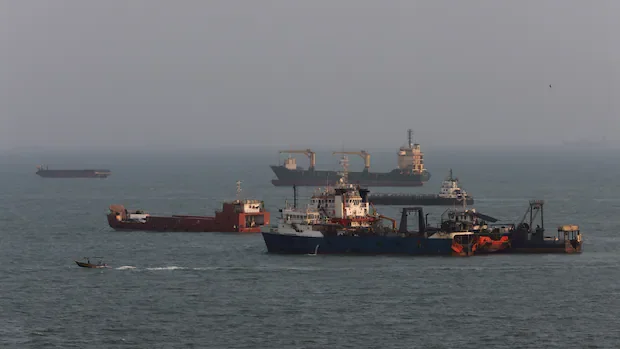
Canada announces new sanctions on Iranian officials over Strait of Hormuz
5 sanctioned individuals include members of Islamic Revolutionary Guard Corps
Five senior Iranian officials will face sanctions for their involvement in activities in the Strait of Hormuz that "undermine international peace," according to Canada's foreign affairs minister.
“Freedom of navigation through the Strait of Hormuz is essential to global trade and energy security. Today’s sanctions target individuals whose actions undermine these principles and threaten global economic and energy security," read Friday's statement from Foreign Affairs Minister Anita Anand.
"Canada calls on Iran to de-escalate and respect international navigation rights."
The sanctions target senior officials of the Islamic Republic of Iran, including members of the Islamic Revolutionary Guard Corps (IRGC), for "activities that have threatened a critical international waterway," according to a press release from Global Affairs Canada.
The press release named the five officials sanctioned:
- Ali Abdollahi, the commander of Khatam al-Anbiya Central Headquarters and a senior IRGC official.
- Lt.-Col. Ebrahim Zolfaghari, a spokesperson for Khatam al-Anbiya Central Headquarters.
- Ebrahim Azizi, a parliamentarian and head of the Iranian parliament’s national security and foreign policy committee.
- Shahram Irani, the commander of Artesh, the Islamic Republic of Iran’s navy.
- Hamid Hosseini, the chair of the board of directors and spokesperson for the Iranian Oil, Gas and Petrochemical Products Exporters Union.
Following today's actions, Canada has now sanctioned 232 individuals and 260 entities across Iran’s security, intelligence and economic apparatus, according to Global Affairs Canada.
Sanctions come as pressure to end conflict grows
The sanctions come as the latest attempt to follow through on a tentative peace deal between the U.S., Israel and Iran, one initially agreed upon in June, remains out of reach.
Since the war began in February following a joint U.S.-Israeli attack on Iran, U.S. President Donald Trump has repeatedly oscillated between threats of escalation and claims that a peace deal is imminent.
Iran, meanwhile, has sought to exert leverage on Washington by controlling the strait. It has attacked some vessels trying to transit the strategic waterway, through which a fifth of the world's oil and liquefied natural gas travelled before the war.
Trump has repeatedly called on allies to help secure the vital global oil shipping route.
In March, Canada signed on to a joint statement by the leaders of seven countries calling on Iran to immediately cease all attempts to block the Strait of Hormuz to commercial shipping and expressed a readiness to contribute to efforts to reopen it.
Trump's requests have come with growing frustration, as the country's relationship with some allies grow strained over the conflict. The U.S. president publicly criticized Britain's stance earlier in the war, saying the once-close relationship was "not like it used to be."
Trump has also repeatedly said throughout the conflict that U.S. and Israeli strikes have largely defeated Iran's military capabilities — even as the disruption to shipping continues.
Secretary of War Pete Hegseth told reporters earlier this week that the U.S. military could keep a naval presence in the region to enforce its blockade of Iran.
"Indefinitely, the United States Navy can maintain a blockade like that because we'll rotate ships in and out, as we have, and we'll continue to," Hegseth told reporters on a trip to Panama.
Trump is under growing pressure to end the war, as high fuel prices drag down his approval ratings ahead of the U.S. midterm elections in November.
The global economy also continues to suffer. The International Energy Agency said earlier this week in a forecast that global oil supply would fall this year by 4.3 million barrels per day, or around four per cent.