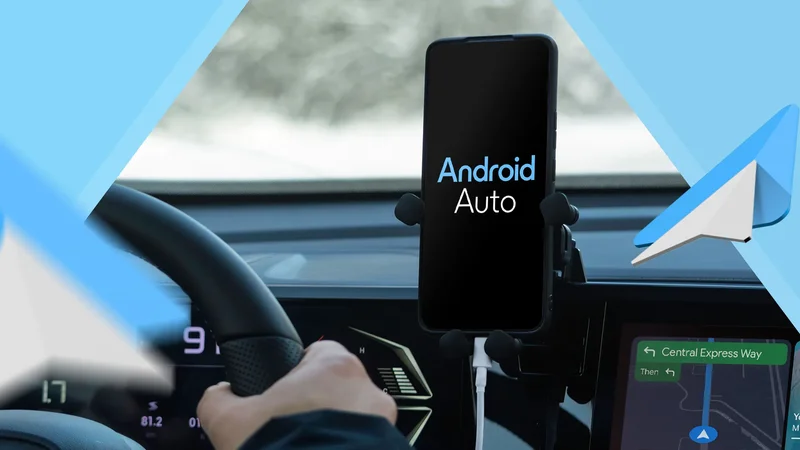
I don't drive every day. Instead, I love taking a long drive every weekend to enjoy relaxed highway driving.
Since I drive for a specific reason, which is more to do with enjoyment than necessity, I don't compromise on what makes it fun.
That's one major reason why I never use my car display as a basic navigation screen. It can mean different things to different people, but for me, it is about striking a balance between entertainment and utility.
I don't shy away from admitting that I spent days researching and finding the right tools for my Android Auto, but what I regret the most is ignoring the most important part of the setup: one that establishes the connection.
However, I couldn't ignore the problem any longer. That's why I took a major decision last week. I permanently abandoned wireless Android Auto in favor of a simple USB cable.
Android Auto trivia
The ultimate challenge
From launch day to the latest features — how well do you really know Google's in-car platform?
In what year was Android Auto first announced by Google?
Which car manufacturer was the first to ship a production vehicle with built-in Android Auto support?
What is the name of the feature that allows Android Auto to work without a physical cable connection to the car?
Which of the following navigation apps was NOT officially supported on Android Auto at launch in 2015?
What is the minimum Android version required to run Android Auto on a phone as of its standalone app era?
Which messaging app was among the first third-party apps to be supported on Android Auto at launch?
What major redesign did Android Auto receive in 2022 that changed its visual layout significantly?
Google discontinued the phone-screen version of Android Auto in 2023, replacing it with what product for direct phone use?
Your Score
Thanks for playing!
A USB cable connection fixed my biggest complaints with wireless Android Auto
It's best for those who want a reliable connection
Not many car owners know this, but you need both Bluetooth and Wi-Fi for the wireless Android Auto to work.
I won't explain why it needs both, but regardless of the reason, I have never in my car-driving experience witnessed wireless Android Auto working seamlessly throughout the journey.
In the last few months, it has become worse. It disconnects every few minutes, and that's a huge distraction when you are driving. It's not safe.
I tried fixing this by resetting the system, but it didn't work. I also tried several fixes from Reddit, but no luck, either.
In addition, the wireless connection is inconsistent. Ideally, the system should start working right after I start my car, but sometimes, it takes forever to connect.
However, this isn't as bad as disconnecting every few minutes, because it doesn't happen as frequently and can be fixed with a restart.
This could be because I paired three phones with my car's system. Because my earbuds are paired with three phones, I face the same challenge connecting them to my phone.
As a consumer, I don't care what causes it to fail. I want a solution, and a USB cable is all I need to fix connection issues.
I care about battery life now more than ever
A wireless connection uses more power than a wired one
For wireless Android Auto to work, you need continuous Wi-Fi and Bluetooth to run a GPS connection and stream high-quality audio simultaneously.
You may not feel their impact on a short trip, but you'll notice a significant drop in battery life on a long drive. This battery drain issue hurts even more when you use a four-year-old handset as your main phone, like me.
My handset doesn't support wireless charging, so I must connect to a power source using a cable to charge it.
Since a USB cable can transmit both power and data simultaneously, a wired Android Auto can charge your phone aside from establishing an Android Auto connection.
However, even if I buy a new Samsung Galaxy phone that supports wireless charging to replace my current handset, my charging concern remains valid.
Sure, I will be able to charge my phone wirelessly in that case, but it's not good for long-term battery health.
A USB cable, on the other hand, doesn't come with any of the above-mentioned concerns. That's why I describe a connection over USB as a plug-and-forget type of connection.
There is one caveat with a USB Android Auto
But there is an easy fix
I didn't have any experience with wired Android Auto before I switched.
So, my biggest concern when I decided to move on from wireless setup was whether it'd damage my phone's USB port because of the repeated plugging and unplugging.
Still, it didn't change my decision. To cause less wear on the phone's USB port, I bought a magnetic USB adapter. What's also great about it is that it still allows my phone to charge.
I finally found the ideal Android Auto setup
An ideal Android Auto setup is about distraction-free driving, and a repeated drop in connection doesn't help.
Don't underestimate the battery drain issue, because a phone that dies while you are at the wheel can cause distractions.
So, other than reliability, a USB connection is equally important for my safety while I'm on the road.
My ideal Android Auto setup now includes a USB cable that supports data transfer and syncing, along with the best entertainment apps and utilities.
I'm not going back to a wireless setup any time soon, at least not until those issues disappear. As a user, I couldn't care less because I've finally found what works best for me.