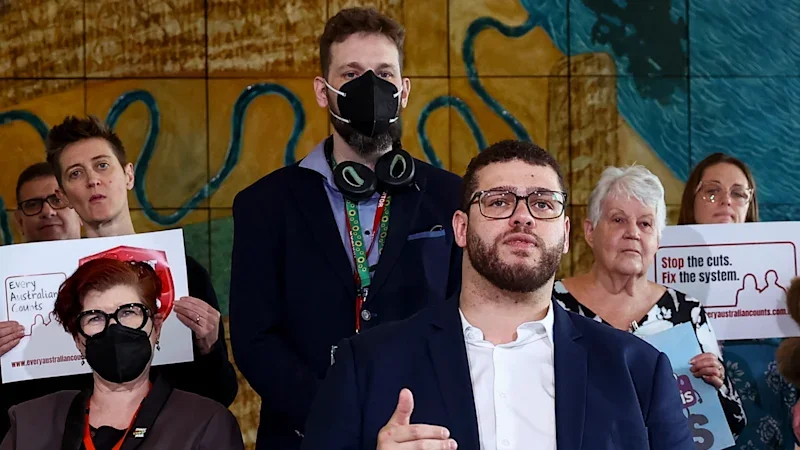
A Labor-led committee has raised human rights concerns over the government’s sweeping National Disability Insurance Scheme overhaul, even as their colleagues in a separate inquiry steamrolled the pleas of the disability community to recommend the reforms pass.
The Senate inquiry into Labor’s NDIS reforms released its final report green-lighting the laws on Friday despite weeks of testimony from disabled Australians, rights groups and legal services who raged against changes that will remove 240,000 people from the scheme within five years.
But the Labor-led joint committee on human rights quietly released its own report on Thursday, in which it warned that vulnerable Australians risked falling through the gaps because alternate supports did not yet exist.
Still, Labor will seek the Coalition’s support to plough ahead with the changes next week, given the Albanese government’s budget hinges on bringing the bloated scheme under control to save $150 billion in a decade.
Health Minister Mark Butler’s changes aim to return the scheme to its original purpose by restricting eligibility to people who must from 2028 prove permanent impairments. He will also cut costs quickly with new powers to slash people’s social and community participation budgets.
The government has promised to set up more “foundational” disability supports for people outside the scheme, but the only program it has announced is Thriving Kids for children eight and under, which should start rolling out from October this year.
Parliament’s human rights committee – a statutory taskforce that examines whether new Australian laws are compatible with human rights – noted that Thriving Kids would be an alternative for children in that age group.
But the report said it was “unclear what other specific supports exist for children outside this age range, or for people with other types of disabilities, and the extent to which such supports are accessible and affordable depending on where people live and their other personal circumstances”.
The report also suggested that, under international law, the government’s aim of ensuring the scheme’s financial sustainability was not justification for the swinging cuts.
The committee, led by Labor MP Zaneta Mascarenhas, said there was “a risk that these measures would be retrogressive in practice, and it had not been demonstrated that the proposed limitations on rights would be proportionate in all cases”.
The report warned that restricting access to the scheme, cutting funding amounts or curbing the types of supports available could infringe a person’s right to an adequate standard of living.
The separate Labor-led NDIS inquiry, however, came up with just one recommendation: that the bill be passed.
The Coalition did not object to that finding, but its senators argued the changes did not go far enough to tackle fraud in the scheme and would fail to improve its social licence.
The Greens slammed the legislation in a dissenting report, and called for a 25 per cent gas tax to fund the scheme to avoid cuts.
“The Greens acknowledge that the NDIS would benefit from reform, including stronger anti-fraud measures and reduced administrative load for participants,” the senators said.
“The NDIS budget does not need to be so significantly cut to be sustainable, instead it can be properly funded to ensure disabled people can live with dignity.”
The minor party celebrated the changes it had already extracted from the government, including limiting ministerial powers to impose sweeping cuts to budgets and ensuring greater transparency around automated decision-making, but maintained the proposal should be scrapped.
Senator David Pocock said he could not support the reforms, and was particularly concerned over the power to impose “blunt, indiscriminate reductions” to social participation funding, as well as the breadth of automated decision-making.
He said the government’s move towards assessing people’s functional capacity for entry to the scheme had the potential to deliver better consistency – if it was designed and implemented with the disability community.
“But any changes must be implemented carefully and must not leave people without access to the treatment, therapy or disability supports they need,” Pocock said.
Earlier this month, the Australian Human Rights Commission urged the government to delay the bill until “significant human rights concerns around process, accountability and the impact of the reforms are addressed”.
“Everyone acknowledges the scheme needs reform to address fraud and market failures. But the government is dismissing genuine concerns that their proposed changes will seriously erode the life-changing impact the scheme has delivered for hundreds of thousands of people with disability across Australia,” Disability Discrimination Commissioner Rosemary Kayess said.
With Natassia Chrysanthos