Forget silicon chip servers, Singapore’s newest data centre needs to be fed
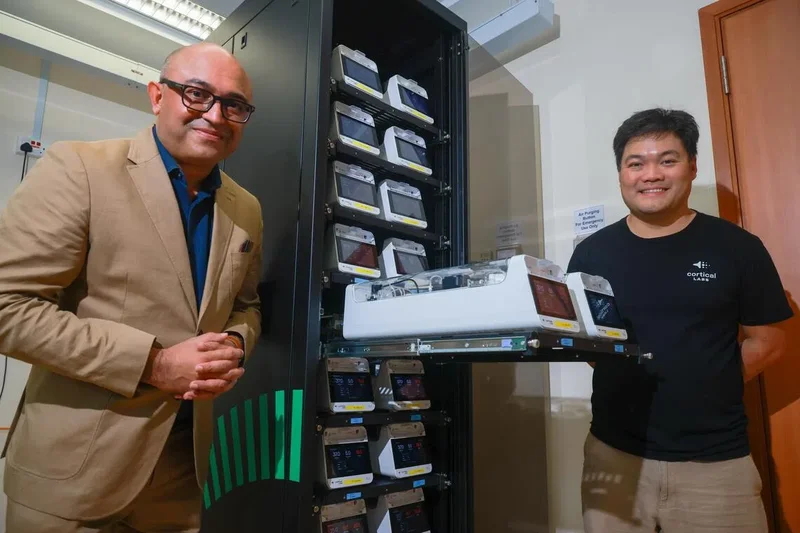
SINGAPORE - Tucked inside the National University of Singapore’s Centre for Life Sciences is a data centre with a pulse.
Unlike traditional server farms running on silicon chips, this facility processes data using living human brain cells.
Every three days, lab technicians feed the brain cells a cocktail of sugar, micronutrients and pH buffers. A gas mixer pumps in carbon dioxide, oxygen and nitrogen, providing a dedicated life support system.
The brainchild of Australian biotech startup Cortical Labs, the setup went live on July 16.
Cortical Labs has joined forces with NUS and data centre operator DayOne to bring the concept to Singapore for their internal research and development. Their tie-up was first announced in March.
It has commercialised a similar biological data centre in Melbourne, its first in the world.
Chong Hon Weng, Cortical Labs founder and chief executive, said that biological data centres are better suited for applications where datasets may be limited and where conditions are highly-unpredictable.
He cited the use of humanoid robots in public spaces, homes, offices or industries where conditions are ever changing.
“There is not enough data in the real world to train humanoid robots to do everything that we need the robots to do using traditional servers,” said Chong during a facility tour on Aug 7.
For instance, teaching a robot to navigate from one point to another may require vast amounts of training data that mirrors the real-world environment.
Biological data centres are also better suited for cybersecurity applications in spotting abnormalies without huge training datasets, he claimed.
“So the solution is to ensure limited data can be used efficiently,” he added. This is similar to how a human can learn from just a handful of examples and applying the learnings even when the circumstances change.
Singapore’s first biological data centre comprises 20 units of biological computers (CL1s).
Each CL1 unit houses at least 200,000 lab-grown brain neurons sitting on an electrode-fitted silicon chip. These living neurons, derived from blood cells reprogrammed into stem cells, exchange electrical signals with a computer, where their neural activities are translated into raw computing power.
There are plans to house up to 1,000 CL1s here, following regulatory approval as well as energy efficiency and safety tests.
Its Melbourne facility currently operates 120 CL1s, with around 20 paying customers including the research arms of companies and universities experimenting with robotics and gaming.
Customers pay US$2,200 (S$2,800) a month to access the computing resources of a CL1. This is about half of the US$4,300 (S$5,500) monthly fee charged by major cloud platforms for renting a high-end AI chip for training and running AI models.
But Chong recognises that traditional silicon chips are far more superior for fast, precise and repeatable calculations that underpins large language models such as ChatGPT.
One huge plus for biological data centres is their low energy footprint as they are not heat-generating servers that require cooling, said Chong.
In Singapore, the energy and water demands of traditional data centres were so intense that the country imposed a temporary pause on new facilities in 2019 to plan for greener digital growth.
In 2019, data centres accounted for about 5.3 per cent of the country’s electricity consumption, a figure that rose to 7 per cent in 2020 as the Covid-19 pandemic accelerated digitalisation.
Brain cells, by contrast, use very little energy and do not need cooling. At 30 watts per unit, each CL1 uses less power than a handheld calculator. This even with its life-support systems factored in, said Chong.
Comparatively, an AI silicon chip such as Nvidia’s H100 SXM can consume up to 700 watts when running demanding computing tasks. A typical data centre server containing eight H100 chips can consume up to about 10,200 watts, including demands from the supporting hardware.
“Singapore is a major fibre connectivity hub in the Asia-Pacific region, so it is naturally a very important place for data centres because they need fast connections to move vast amounts of data. But Singapore has constrains in terms of electricity and water, and our technology can help to overcome that,” said Chong.
The facility at NUS will help Cortical Labs work out the manpower requirements and skillsets needed for commercial uses here.
“By identifying precisely which neurons and support cells work best together, we can build a scientific case for manufacturing these cell types at scale, purpose-built for data centre operations,” said NUS Yong Loo Lin School of Medicine neuroscience professor Rickie Patani, who oversees the biological data centre.