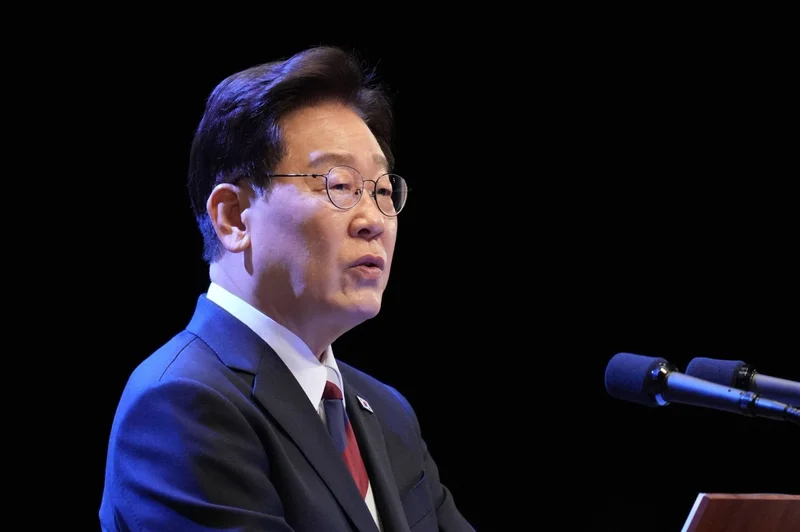
Marking the 81st anniversary of Korea’s liberation from Japanese colonial rule, South Korean President Lee Jae-myung on Saturday called for a forward-looking relationship with Japan, saying bilateral cooperation is more important than ever.
“Over the past year, South Korea and Japan have pursued active shuttle diplomacy and laid the foundation for trust,” Lee said in his Liberation Day address.
The two East Asian neighbors have experienced recurring tensions since normalizing diplomatic ties in 1965, largely over unresolved issues stemming from Japan’s colonial rule of the Korean Peninsula from 1910 to 1945.
Relations sank to one of their lowest points in decades following the 2018 landmark South Korean Supreme Court rulings ordering Japanese companies to compensate victims of wartime labor.
Ties took years to recover but have continued to improve under the Lee administration. Although Lee comes from South Korea’s progressive political camp and was previously viewed by some in Tokyo as a potential hard-liner, he has emphasized pragmatic diplomacy.
Lee on Saturday said the two countries had expanded cooperation in supply chains, energy and advanced industries and pledged to “broaden the scope of cooperation for mutual benefit and work together to address shared challenges.”
Still, the South Korean leader said those gains would not endure without firm trust between the two countries.
“For the achievements made so far to continue without disruption, there must, above all, be steadfast trust between the peoples of our two countries,” he said, acknowledging that there are victims and bereaved families who still live with the wounds of the past.
While Lee has kept bilateral cooperation on track, his government has also taken domestic legal steps to strengthen accountability for colonial-era collaboration.
In June, the government promulgated legislation authorizing the state recovery of assets acquired through pro-Japanese collaboration in the past. The law, which takes effect in December, will reestablish a state investigative commission whose previous mandate ended over a decade ago.
It permits the state to recover both qualifying property and proceeds from property that has already been sold. Recovered assets are expected to be used primarily for programs supporting independence activists and their families.
South Korea’s top court on Wednesday also upheld a ruling ordering Nippon Steel Corp. to pay a total of 80 million won to the family of the late Korean wartime labor victim. The decision added to a series of South Korean court rulings holding Japanese companies liable for damages arising from similar lawsuits.
Tokyo maintains that the compensation issue was settled under the 1965 agreement and has rejected the South Korean claims.