For years, August 15 in Bangladesh commemorated one event above all others: the assassination of the country’s founding president, Sheikh Mujibur Rahman, and most of his family in 1975. It was observed as a day of state mourning.
It rarely evoked the day British rule over the subcontinent ended in 1947 and Bengal was bifurcated. That older date was treated as an event belonging only to India and Pakistan (which attained independence one day earlier).
Bangladesh, after all, was a nation born only in 1971, the “east wing” of Pakistan that achieved its independence after a bloody Liberation War.
But now, two years after the July uprising that brought down Sheikh Hasina’s government and turned her father Sheikh Mujib into a taboo subject, that quiet estrangement from 1947 shows signs of ending.
However, the reasons for this deserve as much scrutiny as the shift itself.
An awkward question
Bangladesh’s reluctance to dwell on Partition was never simply a matter of forgetting. It reflected a deeper discomfort about where 1947 belonged in a national story built overwhelmingly around 1971.
To examine the creation of Pakistan honestly is to ask whether the Two-Nation Theory – the idea that the subcontinent’s Hindus and Muslims constituted separate nations – was sound in the first place.
That question sits awkwardly in a country whose independence was ultimately fought in the name of Bengali nationalism rather than religious nationalism.
Under successive governments led by the Awami League, which had been founded by Mujib, that discomfort hardened into a state-enforced version of a “correct history”: a sanctioned narrative anchored to 1971 that left little institutional room for 1947 or for the people displaced by it.
The July uprising loosened that narrative discipline. But what has rushed into the space it left behind is not primarily a reckoning with the human cost of Partition. Instead, 1947 is increasingly being revived as a way of reasserting Bengali Muslim political identity and creating distance from India.
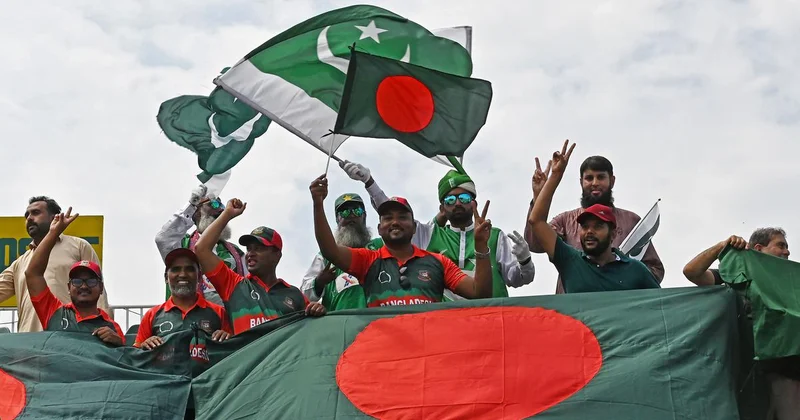
Since Hasina’s fall, Dhaka has presided over a rapid thaw in the relationship with Islamabad, a trajectory that Tarique Rahman’s Bangladesh Nationalist Party government has continued ever since it won power in the February election.
During the period under an interim government led by Muhammad Yunus, direct flights between Dhaka and Karachi resumed after a 14-year gap. Foreign Office talks restarted for the first time since 2010 and Pakistan’s foreign minister made his country’s first high-level visit to Dhaka in more than a decade.
Commentary in sections of the Pakistani press has gone further, framing Hasina’s fall as a belated vindication of those who, in 1971, stood by the old Two-Nation logic.
Whatever one makes of such claims, they help explain why 1947 has become politically usable again in Bangladesh: not as a tragedy to be confronted, but as a precedent – evidence that distance from India carries its own legitimacy.
However, what this revival consistently leaves out is what actually happened to people in 1947 and in the decades that followed.
Punjab violence
Partition in Bengal was never the single, compressed catastrophe that Punjab experienced, with trains carrying corpses crossing the new border within months.
Historian Joya Chatterji described Bengal’s experience as a “long partition”: a process of displacement that began with the Great Calcutta Killing of August 1946, when three days of rioting left, by some estimates, between 4,000 and 10,000 people dead; continued through the violence in Noakhali that year; and then returned in fresh waves in 1950, 1964 and 1971.
Over this drawn-out period, an estimated four million to six million people crossed from East Bengal into India, while roughly 1.5 million moved in the opposite direction.
Because Bengal’s Partition in 1947 was not a single dramatic rupture, it never acquired the same cultural canon as Punjab’s did through writers such as Saadat Hasan Manto, Khushwant Singh and Bhisham Sahni.
This is not to say that Bengal did not produce its own literature of loss: Ritwik Ghatak’s films about displaced Bengalis and Jyotirmoyee Devi’s fiction on the particular suffering of refugee women are among the most powerful examples.
Bangladesh also produced an important body of writing on the upheavals surrounding Partition, including Hasan Azizul Huq’s Agunpakhi, Akhtaruzzaman Elias’s Khwabnama, Abu Zafar Shamsuddin’s Padma Meghna Jamuna and Selina Hossain’s Gayatri Sandhya.
Yet much of this work remained confined to Bengali readers on both sides of the border rather than becoming part of the subcontinent’s shared vocabulary of Partition.
That imbalance remains visible even in popular culture this year.
The Bollywood film Main Vaapas Aaunga has helped bring Partition back into India’s popular conversation in June, while Batwara 1947, released this week, has returned to the subject again.
But both films centre on the Partition of Punjab rather than Bengal. Even as 1947 re-enters the cultural mainstream around the subcontinent and becomes part of popular conversation in Bangladesh too, the Bengali experience of Partition remains largely a peripheral story.
Even in West Bengal, refugees who rebuilt their lives in camps and squatter colonies became, for generations, more valuable to political parties as a loyal constituency than as citizens whose particular losses deserved to be named and mourned on their own terms.
Political raw material
Bangladesh’s renewed interest in 1947 risks repeating that pattern in reverse.
Partition could once again become political raw material – this time for arguments about foreign policy, religious identity and the country’s relationship with India – rather than a history of human beings whose descendants are still living with its consequences.
There is an uncomfortable present-day echo worth considering.
Since August 2024, rights groups in Bangladesh have documented hundreds of incidents of violence against Hindus and other minorities, including dozens of deaths and widespread damage to temples. Much of this has been explained by officials as having political, personal and other reasons rather than being communal violence.
None of this is equivalent to 1947, and collapsing the two moments into one would do a disservice to both. But it is a reminder that no country can claim to be reconsidering Partition in good faith while remaining indifferent to the safety of the very community that Partition displaced in the first place.
If 1947 is finally to enter Bangladesh’s historical imagination, it should enter in the way it has always deserved to: as a history of ordinary people, ordinary homes and ordinary losses – not merely as a convenient argument about which South Asian country to trust.
Jannatul Naym Pieal is a Dhaka-based writer, researcher and journalist. His email address is jn.pieal@gmail.com.
We welcome your comments at letters@scroll.in.