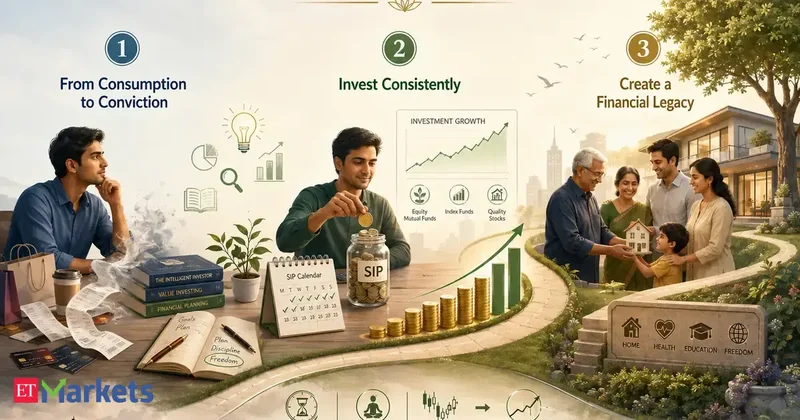
After 25 years in equity research, I have seen that financial freedom rarely comes from one big investment decision. It is built gradually, through small but important shifts in how we think about money. Over the years, I have observed three milestones that often mark this journey.
Milestone One: From Consumption to Conviction
In my early years of research, I noticed that many retail investors viewed the stock market almost like a casino, where luck and timing determined the outcome. The biggest shift came when investors moved from simply consuming financial information to understanding what they were actually investing in.It is a simple but important transition — from asking “What can I buy?” to asking “What should I own, and why?”
I have seen this change happen repeatedly. An investor who initially follows a stock because a friend recommended it or because it is making headlines eventually begins asking more fundamental questions: What does this company do? How does it make money? What gives it an advantage? Can its business sustain growth?
A practical place to start:Pick 10–15 quality companies across sectors that interest you and spend time understanding them. Don’t rush to invest; rush to understand. I have found that this foundation becomes particularly valuable during market volatility. When you understand the business behind a stock, a fall in its price does not automatically become a reason to panic.
Milestone Two: The Discipline of Systematic Investing
The second milestone is moving from sporadic investing to systematic wealth creation.Over the years, I have tracked investors through multiple market cycles. What has struck me is that those who built meaningful wealth were not necessarily the ones who could predict every market high or low. More often, they were the ones who stayed invested and allowed time to do the heavy lifting.
I have seen investors spend considerable time trying to predict what the market will do over the next few weeks, while overlooking a more important question: Am I investing consistently enough for the next 10 or 20 years?
That is where systematic investing makes a difference.
Whether through SIPs, regular investments or periodic portfolio reviews, investing systematically takes some emotion out of the process and reduces the temptation to wait for the “right” time.
I have seen this play out across age groups. The common factor among investors who build substantial portfolios is often not how much they started with, but how consistently they invested and stayed aligned with their goals.
This also means paying attention to asset allocation. The right mix of equities, debt and other investments should reflect your goals, time horizon and risk capacity — and evolve as your life changes.
A practical place to start:Automate your investments wherever possible. It could be ₹5,000 a month or ₹50,000. The amount matters, but consistency matters more. Review your portfolio periodically to ensure it remains aligned with your goals.
Milestone Three: From Financial Goals to Financial Legacy
The third milestone is moving from building wealth for yourself to thinking about the legacy that wealth can create.Over the last decade, I have noticed a gradual shift in conversations with investors. The question increasingly moves from “How much wealth can I accumulate?” to “What do I want this wealth to achieve?”
That is an important transition.
Financial freedom is not just about funding your own aspirations. It can also mean creating security for your family, enabling the next generation to pursue opportunities, supporting causes you care about or giving your family greater freedom to make choices.
In my interactions with investors, I have found that some of the most fulfilling stories are not necessarily about the largest portfolios. They are about what that wealth eventually enabled — a child’s education, greater family security, a business or the ability to give back.
Building a financial legacy can involve ensuring proper documentation and succession planning, maintaining a diversified portfolio, and helping the next generation develop financial awareness and good money habits.
A practical place to start:Talk to your family about money and financial values, not just numbers. Explain how you think about saving and investing, and help younger family members understand the basics of financial markets.
A financial legacy is not created at the end of the journey. It is built through the choices we make along the way.
The Connecting Thread: Patience
If there is one quality that connects all three milestones, it is patience.After 25 years of watching markets, this is perhaps one of the simplest lessons I have come to appreciate.
We live in a world of instant information, real-time prices and constant notifications. But wealth creation does not work at the same speed.
I have seen investors become uncomfortable when their investments do not deliver immediate returns, while others stay invested through difficult periods because they understand that financial goals are measured in years, not weeks.
Market corrections and volatility are inevitable. The challenge is not to avoid every difficult phase, but to ensure that short-term noise does not derail long-term plans.
In my experience, some of the most valuable investment decisions are often the ones investors make by doing nothing — staying invested, continuing their contributions and giving compounding the time it needs.
An Independence Worth Building
This Independence Day, as we celebrate our nation’s freedom, let us also reflect on the financial freedom we want to create for ourselves and our families.It does not require extraordinary intelligence or perfect market timing. It requires three things: understanding before investing, discipline in execution and patience over time.
The journey to financial freedom is not a sprint or about finding one perfect investment. It is about moving, step by step, from consumption to conviction, from sporadic investing to discipline, and ultimately from personal wealth to financial legacy.
Start wherever you are. Stay curious. Stay disciplined. And give your investments the time they deserve.
(The author Rajesh Palviya is Head of Research, Axis Securities. Views are own)
(Disclaimer: Recommendations, suggestions, views and opinions given by the experts are their own. These do not represent the views of The Economic Times)
(What's moving Sensex and Nifty Track latest market news, stock tips, Budget 2025, Share Market on Budget 2025 and expert advice, on ETMarkets. Also, ETMarkets.com is now on Telegram. For fastest news alerts on financial markets, investment strategies and stocks alerts, subscribe to our Telegram feeds .)
Subscribe to ET Prime and read the Economic Times ePaper Online.and Sensex Today.
Top Trending Stocks: SBI Share Price, Axis Bank Share Price, HDFC Bank Share Price, Infosys Share Price, Wipro Share Price, NTPC Share Price
(What's moving Sensex and Nifty Track latest market news, stock tips, Budget 2025, Share Market on Budget 2025 and expert advice, on ETMarkets. Also, ETMarkets.com is now on Telegram. For fastest news alerts on financial markets, investment strategies and stocks alerts, subscribe to our Telegram feeds .)
Subscribe to ET Prime and read the Economic Times ePaper Online.and Sensex Today.
Top Trending Stocks: SBI Share Price, Axis Bank Share Price, HDFC Bank Share Price, Infosys Share Price, Wipro Share Price, NTPC Share Price