179 new S’poreans take the pledge; diversity a strength amid shared conviction: Edwin Tong
AI generated
SINGAPORE - New citizens can bring special qualities to the table, with a diversity in experiences and perspectives, said Law Minister Edwin Tong.
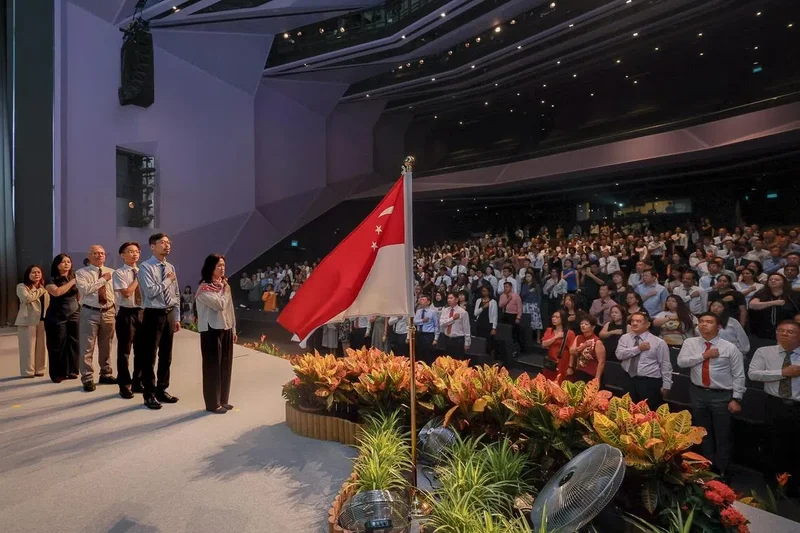
But all citizens should still be bound together by the Singapore identity to become “collectively stronger” and better than the sum of its parts, he said, addressing 179 new Singapore citizens from the East Coast GRC at the National Citizenship Ceremony on Aug 15.
Tong, who is also Second Minister for Home Affairs, said diversity and multiculturalism are among Singapore’s strengths.
“And we welcome that diversity because each of you will have differences that will be different from myself, different from the person perhaps sitting next to you, where you grew up, your values, your experiences, but now coming together, forging that common identity as Singaporeans,” said Tong.
Not many other countries, if any, can bring together such diversity and differences, he said at the event held at the Singapore University of Technology and Design in Changi.
What matters less is where people were born or raised, he added. What matters is a shared conviction to forge a common identity as Singaporeans and work together to take the country forward.
Organised by the People’s Association and supported by the National Integration Council, which works to promote social cohesion and integration, the National Citizenship Ceremony was first held in 2007 to showcase the significance of citizenship.
New citizens are required to receive their citizenship certificates either at the annual ceremony, which constituencies take turns to organise, or at other ceremonies held at the group representation constituency level.
One way Singapore has managed diversity and multiculturalism has been through a strong adherence to the rule of law, said Tong.
“That means everyone in Singapore is treated the same. It doesn’t matter where you come from. It doesn’t matter your background. One rule for all,” he said.
He added that since the inception of the UK’s Second Charter of Justice 200 years ago, which gave Singapore its legal framework, the Republic has amended and contextualised laws to make it applicable for the nation.
This includes recognising race and religion as a special feature of Singapore’s community, and protecting spaces for the practice of religion and for growing different ethnicities, he said.
He also highlighted the significance of Singapore’s pledge, which he led the new citizens in reciting.
The first word, ‘we’, is particularly important, he said.
“If you look around the world, you will see a fractured society that is driven by identity, driven by differences in skin color, in race, in language, in religion, sometimes even in gender, or even the way you speak,” said Tong.
Singapore cannot afford the same divisions, he said.
The number of immigrants expected to call Singapore home in the coming years is expected to rise, amid the nation’s falling birth rate and ageing population.
In February, Deputy Prime Minister Gan Kim Yong said Singapore’s preliminary total fertility rate fell to a record low of 0.87 in 2025, and warned that the population could shrink by early 2040s without intervention.
Over the next five years, Singapore will grant up to 30,000 new citizenships annually - up from the 21,300 citizenships granted annually between 2020 and 2024.
The number of permanent residents (PRs) will also increase from an average of 33,000 a year between 2020 and 2024, to around 40,000 a year in the next five years.
Those looking to apply for Singapore citizenship must be PRs for at least two years.
For new citizens such as Nathaniel Naplah, 51, the process of putting down roots in Singapore has taken decades.
** O**riginally from Liberia, Naplah came to Singapore in 1995 and played professional football in the then S. League alongside household names Fandi Ahmad, V. Sundramoorthy and Malek Awab.
Now working as a teacher’s aide, Naplah said: “It is an honour to become a citizen of the nation I have called home for almost three decades. Being here, watching my three boys grow up, and building a life with my wife, has given me deep roots and a foundation for our family. I’m truly grateful and proud to call Singapore home.”
Another new citizen, commodities trader Michael Phelps, originally from Britain, came to Singapore in 1999 for a two-year work assignment. Phelps, who had already worked in London, Tokyo and Hong Kong by that point, said he came without any expectations.
“Two years became three years, then five years, then 10 years. I loved my work and Singapore lifestyle,” said the 51-year-old, adding that he had met his Singaporean wife Lynn during that time, which led to him deciding to become a citizen here.
“I hope to grow my career further and contribute to the country’s future. I have so many dreams and ambitions and if they can happen anywhere, it’s in my new home,” said the father of four children.