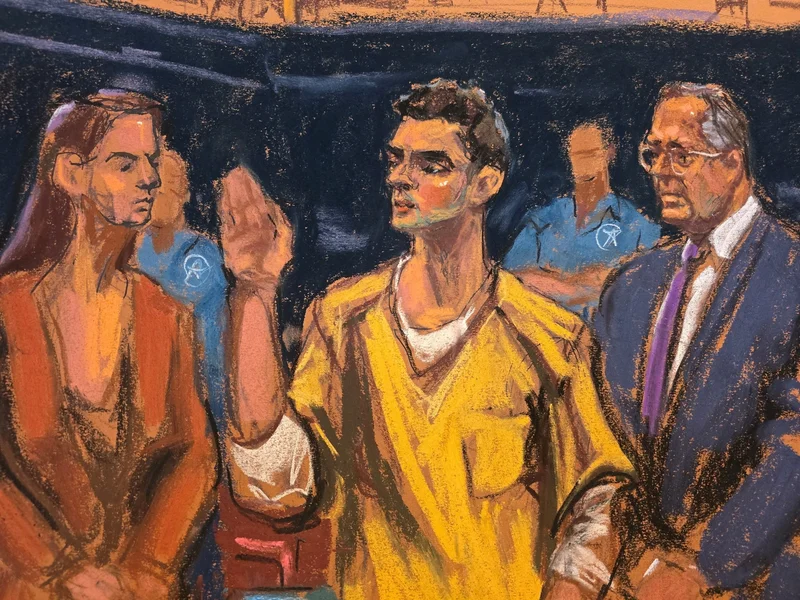
Luigi Mangione pleaded guilty Friday to federal stalking charges in the killing of UnitedHealthcare CEO Brian Thompson, acknowledging in court that he followed the executive to an investor conference before fatally shooting him on a New York City street in 2024.
Mangione, 28, told a Manhattan federal court that he used a 3D printer to make a gun, traveled to New York and posed as an investor at a multibillion-dollar company to obtain information about the conference.
“On the morning of Dec. 4, 2024, I shot Mr. Thompson in Manhattan, and he died,” Mangione said.
He appeared in court wearing a beige jail uniform, shackled at the ankles but without handcuffs.
Thompson’s wife, Paulette, sat in the courtroom and took several deep breaths as Mangione spoke, repeatedly wiping tears from her eyes.
Federal prosecutors are expected to seek a life sentence when Mangione is sentenced Dec. 18. Asked by U.S. District Judge Margaret M. Garnett whether he understood that he could spend the rest of his life in prison, Mangione responded evenly: “Yes.”
In a statement, Thompson’s family called the plea “an important step toward justice” and noted that Mangione still faces other cases, including a New York state murder prosecution. It carries the potential for a separate lengthy prison sentence.
Federal prosecutors didn’t give Mangione any deal or incentive to plead guilty, they and his lawyers said. Nor did Mangione plead guilty to avoid a potential death sentence. That possibility was taken off the table when a federal murder charge was dismissed this winter.
Mangione’s lawyers didn’t explain why he chose to plead guilty now, but after he entered the plea at Friday’s hastily scheduled hearing, they quickly sought to have the New York case dismissed on double jeopardy grounds. The state’s double jeopardy protections can apply if a prior prosecution ends in a guilty plea.
“Mr. Mangione has accepted full responsibility for the death of Brian Thompson,” defense lawyer Karen Friedman Agnifilo said outside court, arguing that her client shouldn’t face two prosecutions over a “single tragic event.”
The Manhattan district attorney’s office, which is handling the state prosecution, said it remains committed to its case and would contest the defense’s efforts to shut it down.
Surveillance video of the ambush showed a masked gunman shooting Thompson, 50, from behind. Police say “delay,” “deny” and “depose” were written on the ammunition, mimicking a phrase used to describe how insurers avoid paying claims.
That detail, along with revelations that Mangione’s private writings lambasted health insurers as greedy, according to authorities, made the case a focal point for debate about the industry and turned Mangione into a cause célèbre for some of its critics.
A University of Pennsylvania graduate from a wealthy Maryland family, Mangione told the court Friday that he pursued Thompson “after years of enduring severe pain from a broken back, navigating the obstacles of the health insurance system and witnessing similar experiences of countless others.”
Friedman Agnifilo later said her client “believed that the system had failed him and destroyed his life.”
Mangione was never a UnitedHealthcare customer, according to police and the company.
“To those who idolize Luigi Mangione, I say this: Violence is not a cause. Murder is not a message. And a killer is certainly not a hero,” New York Police Commissioner Jessica Tisch said outside court Friday.
U.S. Attorney Jamie McDonald, whose office handled the federal case, added: “There can be no celebrity in assassination.”
Thompson led one of the largest health insurers in the United States, but he wasn’t well known outside the industry. Trained as an accountant, he worked at parent company UnitedHealth Group Inc. for 20 years and became CEO of its insurance arm, UnitedHealthcare, in 2021. He and his wife had two sons, who were in high school when their father was killed.
Thompson’s violent death “devastated everyone who knew and loved him,” the company said in a statement Friday, thanking law enforcement for bringing Mangione to justice.
Mangione was arrested five days after the shooting, when he was spotted at a McDonald’s in Altoona, Pennsylvania, about 230 miles (370 kilometers) west of Manhattan. Police had released various images of the suspected shooter, including one showing his face as he checked into a hostel.
Although his lawyers got the federal murder charge dismissed, Garnett also delivered some setbacks to the defense, ruling in January that prosecutors could use items collected from Mangione’s backpack during his arrest as evidence against him. They included a 3D-printed pistol that investigators said matched the one used to kill Thompson and a notebook in which authorities say Mangione described his intent to kill an insurance executive.
Similarly, the judge in the state case threw out terrorism charges against Mangione but agreed to let the gun and notebook be used as evidence. The case has been heading toward a September trial, but his lawyers’ new bid to dismiss it could complicate the timeline.