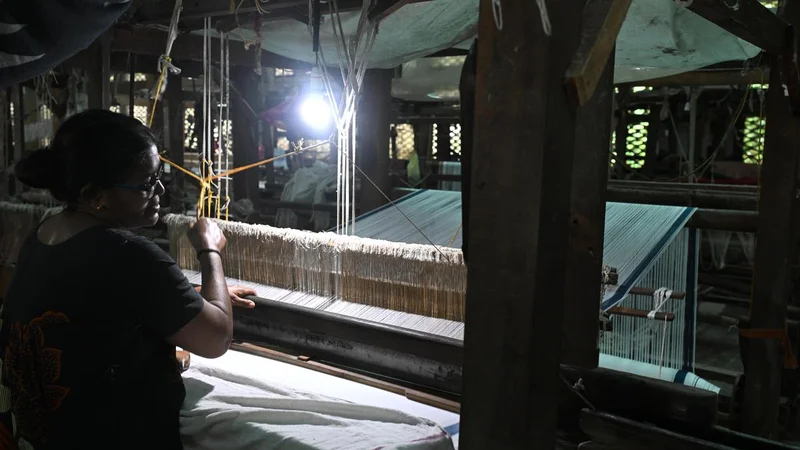
Another Onam is around the corner, and Chendamangalam is weaving the same old story about a sunset industry struggling to survive in the frail hands of an ageing workforce. The twist in the tale, though a bit late, is that the looms of the region have started reverberating a call for change.
The traditional weavers of the famed handloom industry, in and around Chendamangalam village in North Paravur taluk of Ernakulam district, say the demand during the Onam season has been encouraging, though the cooperative-based sector finds it difficult to supply enough. The disequilibrium has prompted stakeholders to call for adequate modernisation in production and marketing.
“The demand in both direct and online markets has been encouraging, but we have been lagging behind in production, primarily due to the shortage of skilled workers. There are only around 400 handloom weavers in the Paravur region now, while the number used to be above 4,000 a few decades ago. The sector needs to adapt to necessary technologies to improve production even as attracting the young workforce,” Rajeev P.P., president of a handloom society, said. He added that all of the 30-odd weavers under the society are above 50. The society clocks a turnover of around ₹25 lakh a year, with over half of it from Onam and Vishu markets.
Sagari. C.P., a weaver with 43 years’ experience, said customers have been coming from across the world in search of Chendamangalam Kaithari products, including sarees, dhotis, and shirt pieces. “However, our younger generation does not find the job attractive. The industry may not survive once our generation retires,” she rued.
Low wages
Low wages despite intense manual labour is cited as a major factor driving the youth away from the sector. “A skilled worker is only paid around ₹350 a day now. It should rise up to ₹1,000-1,200 if the sector has to woo youngsters,” T.S. Baby, State executive member, Kerala Kaithari Council, said. Mr. Baby, a veteran weaver of the Chendamangalam tradition, said it was high time the sector was modernised even as sustaining its traditional uniqueness. “Machines can be used in labour intense phases while limiting manual labour into the core work of hand weaving,” he said. He also called for cashing in on the marketing opportunities from e-commerce.
A section of cooperative societies has started using social media for marketing, though in a very small scale. “We post photos of our new products on our social media pages and sometimes find orders from other e-commerce sellers,” said a staffer of the Paravur Kaithari Neyth Cooperative Society (No: 3428).
Mr. Baby said the weaving community has already initiated works for the necessary shift to e-commerce. He exuded confidence that linking the Chendamangalam Handloom Village project to the region’s tourism potential as well as facilitating advanced training in production and marketing will improve the fortunes of the sector.
Published - August 15, 2026 08:06 pm IST