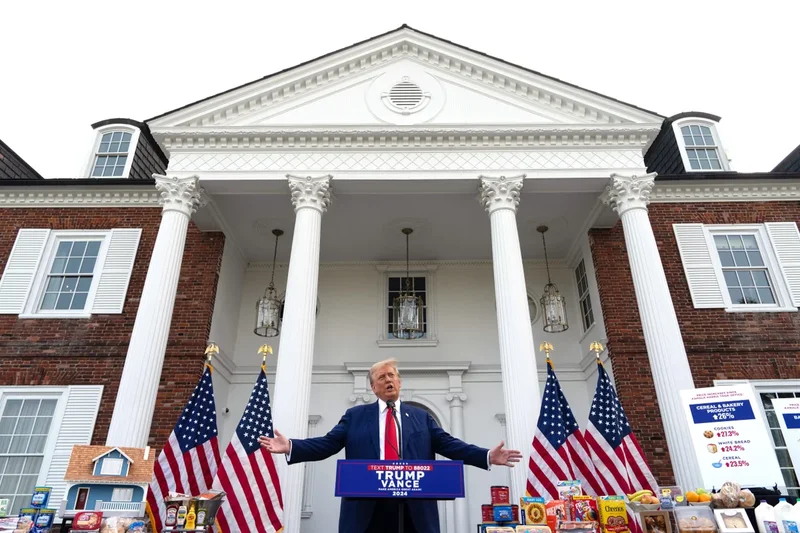
Two years after Donald Trump staged a press conference in New Jersey where he stood alongside basic household groceries to attack Democratic inflation, food costs continue to climb.
At his Bedminster golf club on August 15, 2024, he stood amidst displays stacked with meat, fruit, cereal, milk and standard pantry items while laying the blame for steep grocery price hikes on the Biden administration. The event, featuring charts illustrating rising costs, targeted Democratic nominee Kamala Harris while emphasizing Trump’s primary claim: that he was uniquely equipped to curb inflation and ease the cost of living.
Fast forward two years, and elevated prices at the pump and the supermarket continue to strain family finances, making living costs the dominant concern for the electorate.
The disparity between his promises to lower costs and the daily reality for shoppers has emerged as a critical weakness for the Republican Party leading into November's midterm elections.
According to Reuters/Ipsos polling, voters currently favor Democrats over Republicans by a slim margin on economic stewardship, marking the first time in almost ten years that Democrats have held this advantage.
Sheila Carney, a 68-year-old Trump voter, voiced her frustration with a curse word while loading $70 worth of groceries into her trunk near Trump's Bedminster facility. The haul was minimal, consisting of a bit of meat, laundry detergent and a 12-pack of iced tea.
For Carney, that checkout total demonstrated that the cost-of-living struggles Trump has on occasion brushed off as a Democratic "hoax" are very real for working families.
"This is real. He can say it's not, but it is," said Carney, a hospital administration assistant who has postponed her retirement to help clear her son's student loan debt. "He hasn't brought anything down."
An examination by Reuters covering 26 food categories monitored by the Bureau of Labor Statistics—and displayed during Trump’s Bedminster presentation—shows that prices have increased by 3.4% during the initial 19 months of his second term.
While that rate is under one-fourth of the increase registered over the equivalent stretch of former President Joe Biden’s term, it misses Trump’s goal of bringing prices down, as sharp price surges for beef, coffee and apples have outweighed price reductions in goods like butter and eggs.
A White House official cited figures released Wednesday showing minimal growth in U.S. consumer prices from June to July as proof that inflationary pressure is stabilizing.
"The July CPI report is further proof that President Trump’s long-term agenda is delivering: prescription drug and auto insurance costs continue to fall, real wages are rising, and beef prices have cooled while other household essentials like eggs, poultry, and dairy remain low," the official said.
LACK OF ENTHUSIASM
Carney, a registered Republican, noted that elevated supermarket and fuel costs stemming from the conflict with Iran have driven her toward enough disillusionment that she may skip the upcoming midterms, mirroring broader polling trends that show weaker voter enthusiasm among Republicans compared to Democrats.
Carney was among 17 independent and Republican voters surveyed by Reuters in New Jersey's 7th Congressional District, a competitive area encompassing Bedminster where turnout among undecided voters could decide the outcome. The contest features Republican incumbent Tom Kean against Democratic challenger Rebecca Bennett, who has made economic frustration a centerpiece of her campaign.
Over half of those surveyed indicated they were undecided or leaning toward Bennett. Although food inflation was a major concern, grievances regarding Kean frequently focused on his multi-month absence from public appearances earlier in the year, an absence he subsequently linked to depression.
These economic perspectives align with comments from other Trump supporters interviewed in recent months who, despite backing the president, report that ongoing financial strain has weakened their motivation to turn out in November. Such hesitation creates an added headwind for Republicans and puts greater pressure on their voter mobilization efforts.
Francesco Trebbi, a professor of public policy at the University of California, Berkeley, recently co-authored a study demonstrating that Trump received higher support during the 2024 election in counties where inflation overtook wage gains, undercutting consumer buying power.
Because real wage growth remains sluggish and behind overall economic expansion, Trebbi suggested that dynamic could invert this November.
"I expect the same anti-incumbent shift to happen in 2026, this time possibly weakening Republicans," he said, noting that weekly grocery trips serve as a "psychologically salient" reminder of household budget constraints. "Each time one does it, it is the equivalent of a campaign ad against the incumbent."
TRUMP SUPPORT
Presidents have limited influence over inflation, which stems from complex economic variables and is primarily managed by the Federal Reserve. A significant portion of Republicans remain inclined to grant Trump leeway, even as tariff policies and the military conflict in Iran add upward pressure to prices.
Bonnie Chandler, 64, intends to back Kean, and said she believes some companies are intentionally maintaining high prices to damage Trump politically. She said the rise of progressive figures within the Democratic Party rules out supporting Democratic nominees.
"I'm going to vote Republican. I'm not a woke person. I'm not a communist. I'm not a socialist," she said.
Lauren DeGirolamo, a 34-year-old Trump voter, noted that priorities like border security and education carry greater weight for her than food costs, which she considers to have leveled off under Trump following sharp rises under the Biden administration.
"I feel grocery prices are pretty much at level with where they were during Biden. I know some of the key things that I look for - eggs - have gone down," she said, confirming her plan to vote Republican in November.
Data from the Bureau of Labor Statistics indicates egg prices have dropped almost 40% under Trump, marking a market stabilization after avian flu outbreaks drove a sharp price hike that originated during the Biden presidency. Eggs are one of six categories out of 26 to experience price drops since 2025, alongside bacon, butter, and cooking fats and oils.
However, the majority of the products featured during Trump’s Bedminster showcase have grown more expensive, several by substantial margins. Raw beef has surged 19.2%, fresh fish and seafood 8.6%, apples 14%, and coffee roughly 23%.
HITTING CLOSE TO HOME
A Reuters/Ipsos survey completed earlier this month revealed that Trump's net approval rating on managing the cost of living stood at -47%, down sharply from -6% when his term began. This marks his lowest score by a broad margin, far behind his standing on the general economy (-35%) and immigration (-16%).
Bennett told Reuters that, if victorious, her priorities would include reversing Trump's tariffs, seeking an end to the Iran conflict, and restoring food stamp funding to assist households struggling with grocery bills.
The challenge is personal, according to Bennett, a military veteran and married mother of two daughters.
"This is not an abstract concept to me," she said. "For example, beef is very expensive, so we don't buy beef anymore."
Whether Kean—whose campaign team did not reply to inquiries for comment—can retain his district could depend on voters like Margaret Derkach, a traditional Republican leaning voter who is contemplating changing her ballot if financial burdens do not ease.
"The cost of living, as far as homes, apartments and food - the necessities - they have gone up. It's shocking, shocking," said Derkach, 84, speaking after a trip to discount supermarket Aldi.
While acknowledging that Trump "inherited a mess" from Biden, Derkach added, "I am undecided right now. I have to see."