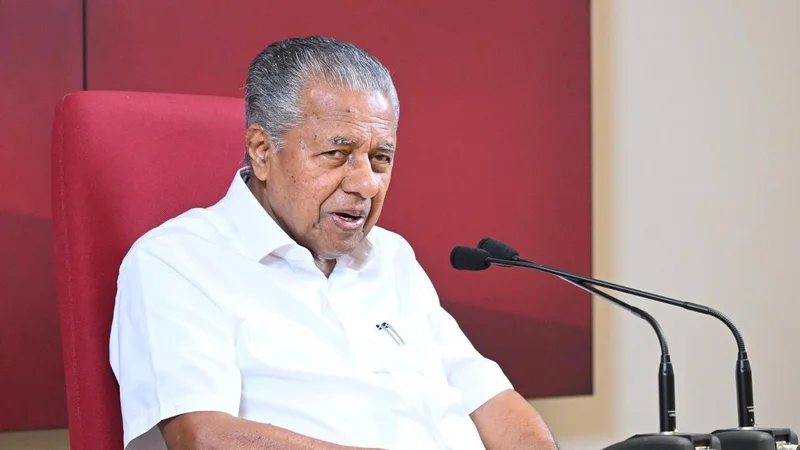
Kerala Leader of the Opposition Pinarayi Vijayan on Saturday (August 15, 2026) described the full rendition of Vande Mataram at the AICC headquarters in Delhi and in Congress-ruled States such as Karnataka, Himachal Pradesh and Telangana as the “capitulation of the party to the Sangh Parivar at a time when defending India’s secular and democratic character demands greater unity”.
Taking strong exception to the development, which he said smacked of the Congress’s soft-Hindutva approach, Mr. Vijayan said it was “quite serious” that Vande Mataram was sung in full at the Independence Day celebrations at the State Forest headquarters. The Congress, he alleged, had proved that it was committed to the Hindutva agenda of the RSS and not to India’s secular nationalism.
Recalling the Congress Working Committee decision in 1937 to restrict the rendition of Vande Mataram to the first two stanzas, as the rest of it was “riddled with religious symbols unsuitable for a plural society,” Mr. Vijayan said the Congress had now jettisoned its own secular legacy by singing the national song in full.
The Supreme Court has made it clear that the singing of Vande Mataram is not at all mandatory at State events. Even under the new legislation passed by the Centre, choosing not to sing Vande Mataram is not a punishable offence. Despite not being legally bound, singing it in full as per the diktats of the RSS is tantamount to betraying the secular society, he said.
Ideological vacuum
A.A. Rahim, MP, too, attributed the full rendition of the song to the Congress’s ideological vacuum. “The Sangh Parivar has taken a seat in the ideological vacuum of the Congress,” Mr. Rahim, who is also the national president of the Democratic Youth Federation of India (DYFI), said.
He alleged that Sangh Parivar politics had already found space within the Congress.
Published - August 15, 2026 09:02 pm IST