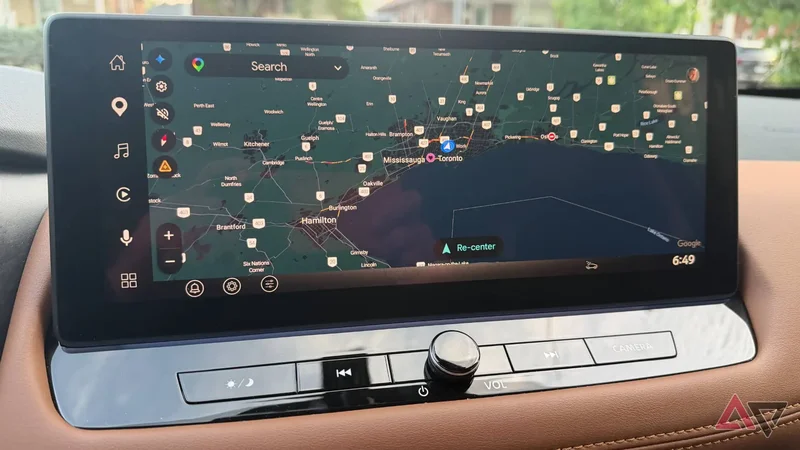
Last month, I traded in my trusty 2021 Nissan Rogue for the latest 2026 model and was delighted to discover how far in-car infotainment systems have come in five short years.
Instead of a navigation system that looked like it had been drawn by a toddler on a sugar rush, my new chariot came with Google Built-In (aka Android Automotive).
To say that was a breath of fresh air would be an understatement.
It's something I had been looking forward to from the moment that I ordered the new car. Sadly, the reality didn't quite match the promise.
Don't get me wrong — Android Automotive is great in a lot of ways. It's nice to catch up on YouTube videos while I'm waiting for my daughter (I can finally ditch the Carlinkit AI Box), and using Gemini to adjust the temperature is indisputably cool.
The Google Account silo
Workspace users need not apply
I've been a Google Workspace user for nearly 20 years. I signed up when it was still called "Google Apps for Your Domain," and have been all-in ever since.
In that time, I've often been frustrated by places where free Gmail accounts get more features than those of us who pay Google real money.
That means I'm no stranger to feeling like a second-class citizen in the Google ecosystem, but I've also been happy to see most of these limitations fall by the wayside in recent years.
Unfortunately, Android Automotive is the one remaining brick in that wall.
To use the Google features in my shiny new car, I have to sign in with the personal Gmail account that I use for almost nothing but collecting spam.
Although I'm content to do that to unlock basic voice assistant features like Gemini, and (re)download apps from the Play Store, it's an extra pain point for Google Maps.
I live my entire life in my Google Workspace account, which means that all my contacts, favorite addresses, and place searches happen there.
None of that data lands in my personal Gmail account. I never use that, and I'm not about to juggle two Google accounts on my desktop to keep my car happy.
This isn't a problem everyone will have, but it's a deliberate wall that makes Android Automotive a non-starter for Google Workspace users right now.
Still, I'd be willing to live with the account juggling if the native navigation experience was flawless. As an app, Google Maps in Android Automotive is great, but it falls woefully short in one critical area.
You can't get there from here
Google Maps no longer leads in real time
I'll start by saying this is one of the biggest areas where your mileage may vary, but I was floored by the inaccuracy of Google Maps when it came to things like road closures.
I've flipped back and forth between Apple Maps and Google Maps over the years, but had mostly settled on Apple Maps when navigating with my iPhone.
I'd still fall back to Google Maps when using my Pixel (via an AAWireless adapter, as my 2021 Rogue didn't do wireless Android Auto), but those trips were the exception.
They both used to be roughly on par for accuracy, with Google Maps having a noticeable edge when it came to business information.
However, in anticipation of the new car, I went all-in on Google Maps in May, figuring I'd be able to seamlessly transition into Android Automotive when the time came.
The experience via CarPlay was a bit clunky, as life often is when using Google apps on an iPhone, but that wasn't the worst part.
As I navigated around Toronto, I discovered that Google Maps appeared to have no clue whatsoever about local road closures.
It frequently tried to take me down roads that were completely closed. The first time, I gave it a pass as it had been a recent closure, but I was left scratching my head when it still wasn't aware of that two weeks later.
The final straw came when Google Maps insisted that the street I lived on was closed for two blocks on either side of my house. It told me I had to park somewhere else and walk home.
I ignored it, and drove home anyway. Unsurprisingly, there weren't any signs of a road closure.
Moving at the speed of government
Is Google actually losing to Apple here?
That was a month ago, and my street hasn't been closed, so this isn't a matter of Google jumping the gun. It's faulty data, plain and simple.
I reported these problems, and Google fixed them within 24 hours, only to see them revert a couple of days later.
As far as I can tell, Google is scraping this info from city databases. It seems that a human corrects errors based on reports, only to have an algorithm overwrite that manual change on the next update.
However, that doesn't explain how Apple Maps gets this completely right. So does Waze, which is even more ironic, considering it's owned by Google.
Apple Maps is eerily accurate. A legitimate road closure in my neighborhood was correctly listed on both Apple Maps and Google Maps. Apple cleared it the day it re-opened. Google took two weeks to update.
A premium dashboard with a bad sense of direction
Features are great, but accuracy matters more
These are more than cosmetic errors, as they impact where Google Maps takes me. It hasn't been a serious problem in my neighborhood, but facing a "Road Closed" sign in an unfamiliar area would quickly get frustrating.
It's surprising, as Google Maps used to be a paragon of accuracy. Yet, despite all the negativity often thrown in Apple Maps' direction, it's proven to be superior, at least in Toronto.
But it's also disappointing, as there are things that Google Maps still does better, such as suggesting alternative routes on the fly, including ETAs and eco-friendly routes, and showing gas prices.
The Android Automotive experience is also faster and more responsive than using CarPlay or Android Auto, and it integrates better with the dashboard and heads-up display when navigating.
However, none of that matters if I can't trust it to get me to where I need to go without leading me into a rabbit hole. Or, worse yet, telling me I can't even get there.
The sad part is that Google Built-In was one of the things I was most looking forward to in my new car, and it's still a fantastic upgrade.
But until Google remembers that paying Workspace users drive too, and that real-world maps require real-time accuracy, Apple Maps and CarPlay will continue to live on my infotainment screen.