Your support helps us to tell the story
From reproductive rights to climate change to Big Tech, The Independent is on the ground when the story is developing. Whether it's investigating the financials of Elon Musk's pro-Trump PAC or producing our latest documentary, 'The A Word', which shines a light on the American women fighting for reproductive rights, we know how important it is to parse out the facts from the messaging.
At such a critical moment in US history, we need reporters on the ground. Your donation allows us to keep sending journalists to speak to both sides of the story.
The Independent is trusted by Americans across the entire political spectrum. And unlike many other quality news outlets, we choose not to lock Americans out of our reporting and analysis with paywalls. We believe quality journalism should be available to everyone, paid for by those who can afford it.
Your support makes all the difference.
Read more
While gardeners are accustomed to the occasional peculiar fruit or flower, some botanical discoveries defy expectation, revealing forms that are surprisingly human-like. Tomatoes, for instance, are known for their mischievous shapes, sometimes resembling horned animals, Russian dolls, or even large-nosed figures, often influenced by extreme temperatures or vivid imaginations.
However, it is the orchid family that often holds the most astonishing surprises. Far from their typically elegant reputation, many species display an uncanny resemblance to various creatures, from animals and insects to distinct human figures. These remarkable orchids stand out for their striking mimicry, captivating observers with their unique and often amusing forms.
These remarkable orchids stand out for their striking mimicry, captivating observers with their unique and often amusing forms (Huntington Library Art Museum an)
Let's get back to that naked man orchid
The Orchis italica, known as the 'naked man orchid,' offers a whimsical sight. Its blooms 'smile broadly' while hanging, with 'legs splayed and arms extended as if requesting a hug.' Its 'decision to forgo pants is obvious.' Also called the 'Italian orchid,' this species hails from the sunny Mediterranean. Its Mediterranean origin may explain its apparent 'decision to wear what resembles a hat.' It thrives in partial shade and infertile soil, growing up to 20 inches tall before midspring flowers appear.
The Orchis italica , known as the 'naked man orchid,' offers a whimsical sight (Getty Images)
Other orchid varieties resemble babies, doves, bees and monkeys
Nature’s artistry often surprises, but few botanical wonders are as captivating as orchids that mimic other life forms, from swaddled infants to playful primates.
Among these extraordinary blooms is the Swaddled Baby orchid (Anguloa uniflora), a two-foot tulip orchid found exclusively in the high-humidity Andes region of South America. Its delicate pale-pink-to-white petals form a striking resemblance to a newborn lovingly wrapped in a blanket.
The Swaddled Baby orchid is a two-foot tulip orchid found exclusively in the high-humidity Andes region of South America (Getty Images)
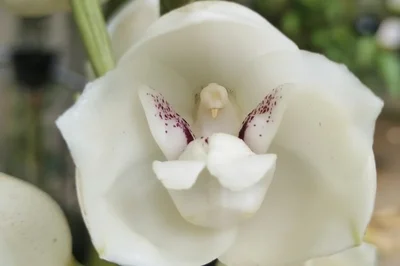
Equally remarkable is the Dove orchid (Peristeria elata), Panama's national flower, known locally as flor del Espíritu Santo. Its blossoms uncannily mirror a dove's head, beak, body, tail, and purple-speckled wings. These upright stems can reach three feet, producing up to 20 blooms from late summer through early fall, thriving in warm conditions with ample air circulation and consistently moist roots.
The Dove orchid is Panama's national flower, known locally as flor del Espíritu Santo (Getty Images)
Perhaps the most cunning is the Bumble Bee orchid (Ophrys bombyliflora). This Mediterranean beauty employs an ingenious strategy, its scent and flower mimicking a female solitary bee. Mate-seeking male bees are tricked into landing, their hopes dashed, but not before inadvertently pollinating the flower and nearby orchids, ensuring the species' propagation.
This Mediterranean beauty employs an ingenious strategy, its scent and flower mimicking a female solitary bee (Getty Images)
High in the humid Andes forests, the Monkey orchid (Dracula chimaera) thrives in cool, moist, and partially shady conditions. Growing just six to twelve inches, its two-inch-wide flowers bear an undeniable resemblance to an adorable monkey's face.
The Monkey orchid (Dracula chimaera) thrives in cool, moist, and partially shady conditions (Getty Images/iStockphoto)
Unlike misshapen produce, these orchids' unique appearances are entirely nature's design. While some may be available from specialty nurseries, cultivating them at home demands replicating their specific native climates, often requiring greenhouses or humidifiers. For many, the simpler delight lies in appreciating these botanical marvels from afar.