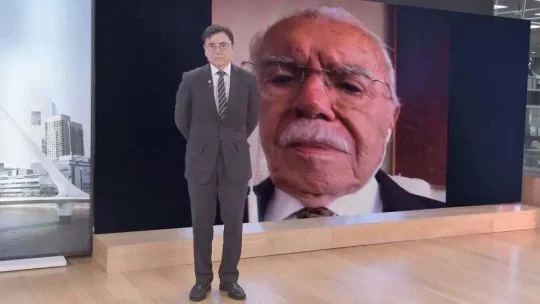
At the age of 96, former Brazilian José Sarnay continues to be one of the most authorised voices to speak of the relationship between his country and Argentina.
Brazil’s first civilian president after 21 years of dictatorship, Sarney governed between 1985 and 1990 and, together with Raúl Alfonsín, pushed a historic transformation ending decades of mistrust between both countries. The Declaration of Foz de Iguazú, the birth of the Mercosur bloc and the nuclear cooperation turning South America into the world’s only region free of any arms race between its main powers were some of the milestones of that process.
In this interview, the ex-president analyses the diplomatic crisis between Javier Milei and Luiz Inácio Lula da Silva, vindicating the need to preserve the bilateral relationship as a state policy, reflecting on the resurgence of nuclear tensions and the new international order and maintaining that the experience of integration between Argentina and Brazil constitutes a lesson from which the world still has a lot to learn.
Firstly, thanks for your recent column published in the Brasília-based newspaper Correio Brazilience entitled “¡Arriba Argentina!” What motivated you to write it?
I write weekly in Brasília’s main newspaper syndicated to around 90 newspapers throughout Brazil. In that week, the issue was the conflict between Brazil and Argentina following the controversial visit by Argentine President Javier Milei, to Brazil.
That countries have commercial, economic, political problems, etc. is part of life. And we are not at a good time nowadays because we have an Argentine president hostile to Brazil and a United States president who always mentions Brazil in a restrictive way, slapping heavy tariffs on at least three occasions.
How did the statements of Argentine president Javier Milei in São Paulo on July 25 strike you, when he called the current President of Brazil a thief and convict?
Totally inappropriate to any presidential dignity. The presidency is a transitory post which may not be guided by personal feelings because it represents a country and its inhabitants. It is a disrespect towards Brazil and a president in office. Brazil has had presidents of every type: lawyers, sociologists and also, a worker, and all deserve equal respect.
Milei crossed another Rubicon, because he was not only insulting the head of the Executive Branch but also the Supreme Court whose members are for life, representing not only a government but also the permanent power of the state.
Yes, of course, we are witnessing, after a progressive distancing between our two countries a series of inappropriate remarks by the Argentine president against President Lula of Brazil and against the Federal Supreme Court Justice Alexandre de Moraes, beyond all civilised limits, as Supreme Court Chief Justice Edson Fachin said, using appropriate words and respecting the neutral vocabulary which should be the domain of official language.
(Ed.: Alexandre de Moraes did not prohibit Milei any visit but (ex-president Jair) Bolsonaro is forbidden to receive any visit, even from his family, for having violated the protocol of house arrest; De Moraes will be the next Supreme Court chief justice).
Milei did something similar in Spain, insulting the Spanish premier and participating in an opposition campaign rally but he did that alone, whereas in the case of Brazil he was joined by Foreign Minister Pablo Quirno. Does the latter’s presence alongside Milei aggravate the consequences because it is not just about one person but the official representation of the Argentine government?
The foreign minister should know the diplomatic norms and the limits of the possible and if not, that a campaign rally is electoral interference.
(Ed.: Javier Milei participated in a CPAC Conservative Political Action Conference celebrated in Brazil at the Expocentro of the Camboriú beach resort in mid-2024 together with Jair Bolsonaro but it was not then part of an electoral campaign, like this time, but to launch the midterm candidacy of Flávio Bolsonaro, and nor did he insult the President of Brazil).
And how did Lula’s reply strike you, calling Milei a “thing” while at the same time maintaining that he loves the Argentines dearly?
It seemed to me a moderate reply. Lula is a conciliatory person heading a great government.
The personal hostilities against foreign presidents began with Jair Bolsonaro, who called the wife of French President Emmanuel Macron an “old woman” and criticised the son of Argentine ex-president Alberto Fernández for his sexual inclinations. I cannot imagine Alfonsín or yourself with those manners. Have Bolsonaro first and Milei afterwards shattered the culture of institutional respect?
Yes, of course. Alfonsín was a statesman. The happiness of the peoples clearly came first for him.
Both in the case of Macron’s wife and the son of Alberto Fernández, Bolsonaro compared his own wife and children favourably with them. Flávio Bolsonaro’s candidacy represents a nepotistic culture. Would it have been better to have São Paulo Governor Tarcísio [Gomes de Freitas] as the candidate for that political wing?
Look, I have as a norm in life never to criticise the presidents succeeding me or preceding me. That makes me a very serene person in my judgments.
I do not wish to make any judgment about the attitudes of our country’s candidates, knowing that elections are being disputed at this time and that my opinions could be interpreted as party positions. I would thus ask you to excuse me from pronouncing on this issue.
Excuse me. Donald Trump also resorts to personal insults. What do you think of the US president’s way of communicating?
Another president off the rails. He has no notion of what it means to be President, especially of the United States, a country from which some of the fundamental ideas of modern democracy have emerged. The US statesmen, the Founding Fathers, always cared about broadcasting democratic principles and human rights as values to be promoted and expanded worldwide. This man does not know what that means nor comprehends the US tradition and role played by the United States in the history of the world. He thus cannot serve as a reference. In a certain way, he has unleashed that type of behaviour adopted today by other presidents, resorting to personal insults and unacceptable judgments while, at the same time, pushing the world into various conflicts and fuelling them when he says that he has come to bring peace but in reality he is making war.
In your article you also quote the phrase of [Roque] Sáenz Peña: “Everything unites us, nothing separates us.” You explained that everything can change except geography, which is a source of union between the territories of Argentina and Brazil. We also share the Americas with the United States. What do you think of the Monroe Doctrine and its vindication as the “Donroe Doctrine” by Trump and the idea of areas of influence?
Look, the Monroe Doctrine was conceived to prevent the invasion of American territory by foreign powers and never so that one power could act against other countries of the same continent. The US President thus does not know his own country’s history.
I can tell you of an episode related to the Monroe Doctrine. I was in the United States accompanying President João Figueiredo when the Malvinas War broke out. I had an audience with a senator for Alaska and went to meet him in Congress. As it took little time and I am very punctual, I was thinking of withdrawing when he finally showed up, apologised very effusively and explained to me that he had been at a meeting with then US President Ronald Reagan. I then asked him what had taken so long. He replied to me that President Reagan had wanted to consult the senators and members of Congress about the policy the United States should adopt towards Argentina in the Malvinas War. He told me that the members of Congress had reminded him that the Monroe Doctrine was still valid and that the United States could not accept a foreign power using American territory to attack another country of the continent. He told me that they had thus taken the decision that Britain could never be permitted to bomb Argentina – i.e., they would never accept American territory being violated by an extra-continental power by virtue of the Monroe Doctrine. After that conversation, I took the liberty of communicating with the Brazilian foreign minister as to what I thought would be the position adopted by the United States. Nevertheless, they finally adopted a position favourable to Britain in the Malvinas conflict. I also wish to recall that when I had the opportunity to address the Argentine Congress, I concluded my speech with a very clear phrase: “The Malvinas are Argentine.” I thus expressed the position of Brazil and its president to the Argentine Congress in a display of absolute solidarity, a solidarity we maintain to this day.
You have told how you cheered on the Argentine football team during this World Cup but on social media, some influencers criticised idiosyncratic aspects of Argentina. Has the affection of some Brazilians for Argentina diminished in recent years?
No. This kind of thing, like the aggression of the Argentine president against Brazil, can somehow influence certain sectors with no deep knowledge of the relationship between Brazil and Argentina, nor what that relationship represents nor what Mercosur means. But I do not believe that to be the reality of our peoples. I cheered on Argentina, and not just me, also my children, my wife, my children and grandchildren, all cheering on Argentina because they understood that they had achieved something extraordinary: making South America the only continent in the world free of nuclear weapons while, at the same time, constructing Mercosur, Latin American integration and the unity of the Southern Cone. That’s why I believe we have to stay united. We cannot separate Pelé from [Lionel] Messi, nor Messi from [Diego] Maradona.
Do you think that the fact that Milei is close to Trump and that Trump has an attitude hostile to Latin America could also be related to some Brazilians losing their affection for Argentina?
Yes. We all share the same spirit of liberty. We cannot pretend that in a country of 200 million inhabitants, there does not exist one percent or even 0.5 percent of people who think otherwise but that does not represent Brazil nor the Brazilian people because we Brazilians love Argentina dearly. I was the Brazilian president who loved Argentina most, visiting the country on many occasions. I was friends with Raúl Alfonsín during his Presidency and continued to be afterwards. We met up many times – he came on numerous occasions to Brazil to meet me and we always conversed about the relations between our two countries.
I wish that my feelings towards Argentina, which I believe to be shared by very many Brazilians, the immense majority, almost the totality of Brazilians, stay alive.
Does the Brazilian people have a national pride which has been hurt by Trump’s economic measures against Brazil?
Look, I find it unacceptable that Mr Trump has no notion of what Brazil is. Brazil was a country during two world wars, the First and Second, which sent Brazilian contingents to Europe alongside the US troops to defend the democratic ideals which we continue to maintain to this day. Raúl Alfonsín and I could only push Mercosur and achieve the nuclear weapons ban because we had, in reality, transformed our countries into democracies. Raúl Alfonsín was the first Argentine president after the military dictatorship and I was the first president of Brazil after the end of the military régime.
President Sarney, what was the relationship with the United States like when you were president between 1985 and 1990 as Brazil’s first democratic president?
As from then, they were absolutely calm and mature relations based on mutual respect although we had some problems, such as with steel and some sanctions because they form part of a US foreign policy inviting you to negotiations although they arrive with a gun in the hand and when the conversation begins, you realise that it is already loaded. Minor differences always crop up but they are questions proper to diplomatic relations and rapidly resolved. And that is what happened.
You were the first democratic president after years of dictatorship in Brazil with the Brazilian and Argentine military viewing each other as enemies and their hypothesis of conflict always being a war against the other country. What did the Brazilian military tell you when you expressed yourself in favour of Argentina?
Along the same lines the Brazilian and Argentine military academies had a possible war between Brazil and Argentina as their hypothesis of conflict and naturally we ended up putting a stop to the hostilities between our two countries – so much so that today the hypotheses of war studied in our military academies are completely different. That is why we have withdrawn our troops from the frontier with Argentina. Today they are oriented towards Amazonia because the danger no longer comes from the south – peace and friendship come from the south. In the north there might come tensions with the United States, due to the attitudes of the US president and also the guerrillas who still persist, fundamentally in some countries on the northern frontiers of Brazil. I became president in 1985, after the Malvinas War, which had occurred three years previously. After a war with Chile was averted thanks to the intervention of Pope John Paul II, the Argentine military were on the point of declaring war against Brazil over Itaipú. Indeed in the Brazilian Foreign Ministry, Itamaraty, the generation of diplomats were categorised as “pre-Itaipú” and “post-Itaipú.”