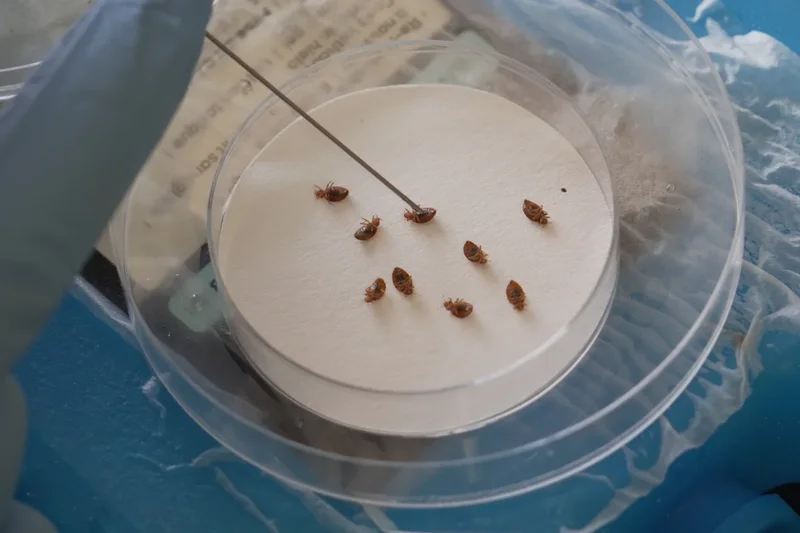
Sometimes called the vampires of the insect world, bedbugs spend daylight hours hidden in crevices before emerging at night to feed on human blood.
While generations of children have grown up with a nursery rhyme warning them to sleep tight and avoid their bite, recent trends offer little reassurance: infestations are rising, reaching their seasonal peak during the warmer months.
Adding to concerns, some scientists think the pests could potentially transmit the antibiotic-resistant superbug MRSA.
For centuries, the parasites have tormented households and prompted public alarm. In 2018, New York City authorities removed at least six municipal buses from service following reports of bedbugs crawling on seats. A similar disruption occurred in Paris in 2023, where sightings in cinemas, trains, and buses generated widespread concern ahead of the 2024 Olympic Games.
"They certainly are out there," said Christopher Hayes, a North Carolina State University assistant professor who has been bitten by bedbugs more than 50 times in the course of research.
"And if you're unaware, if you're not on top of your game, it's easy to bring them into your home."
Bedbugs really do come out at night
Roughly the size of an apple seed, the reddish-brown insects are estimated by some researchers to date back to the era of the dinosaurs. However, they are best known for their persistent ability to cohabit with and feed upon human hosts.
Capable of squeezing into narrow gaps in furniture, they also hide in clothing, linens and mattresses. Though difficult to spot directly, their presence is frequently betrayed by small, dark excrement stains.
While bedbugs remain a year-round threat, they historically flourish during the summer. They typically emerge under the cover of darkness, crawling onto exposed skin and utilizing a beaklike body part to pierce human tissue and siphon blood over several minutes.
Because the bite itself is painless, physical reactions vary significantly. Some individuals develop itchy, red welts within a day or two, while others show no physical response at all.
This absence of symptoms presents a distinct hazard, as individuals unaware of ongoing bites can quickly find themselves dealing with a severe infestation.
Bedbugs’ threat to humans
The health impacts of unmanaged infestations were highlighted in a 2020 French medical journal case report.
The paper documented a 70-year-old man living alone in a Paris suburb who collapsed on the street. Upon admission to a hospital emergency department, doctors diagnosed him with dementia alongside severe anemia resulting from prolonged blood loss.
Medical staff discovered bedbugs actively feeding on his neck, head, and shoulders. A subsequent inspection of his apartment revealed thousands of the insects inhabiting his mattress, walls, flooring, and curtains.
Historically, experts considered bedbugs incapable of transmitting infectious diseases between humans. Their internal anatomy and digestive processes were believed to prevent pathogens from passing on effectively, according to Chow-Yang Lee, an entomologist at the University of California at Riverside.
However, a 2023 study conducted by researchers at the University of South Dakota challenged this assumption. Utilizing artificial skin and blood capsules, the experiment demonstrated that bedbugs could contract MRSA during one feeding session and subsequently spread it during a later meal.
Further research is required to confirm whether bedbugs actually transmit MRSA to humans in real-world settings, noted study co-author Jose Pietri, now based at Purdue University. Nevertheless, "it changes the perspective of what bedbugs do, in terms of public health," Pietri said.
Bedbugs’ resistance to pesticides
Bedbug populations across developed nations experienced a sharp decline following World War II due to the widespread application of the chemical pesticide DDT. In 1972, the U.S. Environmental Protection Agency banned DDT for most applications, citing evidence of environmental harm and potential human health risks.
By that time, bedbugs had already begun developing immunity to the chemical. According to Lee, growing insecticide resistance has driven a sustained resurgence of the pests in recent decades.
Determining the exact scale of the resurgence remains difficult. Pest control firms publish annual rankings of U.S. cities with the highest infestation rates—with Orkin currently placing Chicago at No. 1, while Terminix identifies Philadelphia as having the biggest problem. However, these lists rely on corporate customer call volumes rather than rigorous scientific surveys.
Many infestations occur within public or low-income housing developments, where property managers may not engage the commercial firms compiling those statistics, Lee noted in an email.
How to protect yourself from the pests and treat them
Pest management specialists emphasize that prevention is the most effective defense, urging individuals to avoid bringing the insects into their living spaces in the first place.
Travelers frequently transport bedbugs home from lodging establishments. Prior to unpacking in a hotel room, guests should inspect the premises by pulling back bedsheets and mattress covers to check for live insects or fecal spots.
Luggage should never be placed directly on beds or carpeted floors near sleeping areas; instead, bags can be stored in light-colored trash bags or placed inside the bathtub. Upon returning home, suitcases should be unpacked outdoors, and all laundry transferred directly to the washing machine and dryer.
Secondhand furniture and household items also serve as common vectors. Hayes advised visually inspecting all pre-owned goods and treating them prior to bringing them indoors. Experts recommend vacuuming, steaming, or applying heat to furniture, or isolating items in a garage or storage unit for several days.
For clothing, items should be laundered and run through a high-heat dryer cycle for an hour. Non-washable items like shoes can be placed in a freezer for a week "to make sure that everything in there that could be alive is taken care of," Hayes said.
For those dealing with an active infestation, the U.S. Environmental Protection Agency provides self-treatment instructions, though the process is labor-intensive and requires systematically sealing harborage spaces and treating affected goods.
The guidance also warns against common missteps.
"You can't just blast random chemicals and expect it's going to work because there's a fairly high likelihood that they'll be resistant to some of the first-line insecticides," Pietri said.
Consequently, experts strongly recommend hiring licensed professional exterminators experienced in bedbug eradication, though services can cost hundreds or thousands of dollars.
Alternative control methods beyond chemical treatments exist. For instance, silica dust formulations work by absorbing the moisture from a bedbug's body, causing fatal dehydration.
Thermal treatments using sustained dry heat are also highly effective, destroying both eggs and adult insects. However, the process requires maintaining temperatures of at least 122 degrees Fahrenheit (50 degrees Celsius) and carries a risk of damaging personal property, meaning it must be carried out by professionals.
"I think the biggest piece of advice is just people shouldn't panic," Hayes said. "They just need to take action. If you think you have bedbugs, don't wait to deal with it."