- The Last Emperor of China is available now from the Mail Bookshop
In the early 20th century, the world was a steaming mess. Rapid industrialisation, political upheaval and unfettered colonial expansion led to the senseless slaughter of the First World War and to monarchies toppling. Nations were contorting themselves to fit into the new age and China was no exception.
Except deep in the heart of Peking (modern-day Beijing) lay a place seemingly forgotten by time. Behind the scarlet walls of the Forbidden City (twice the size of the Vatican) Emperor Puyi, his wife, English tutors and castrated servants played out the final act of the Qing dynasty.
The strange and melancholy life of China’s last emperor saw him fall from being the most powerful child in the world to being employed as a gardener near the palace he used to occupy. Unsurprisingly, artists have been inspired by this story for generations. Millions flocked to see Bernardo Bertolucci’s Oscar-winning masterpiece The Last Emperor, based on Puyi’s relationship with his tutor Reginald Johnston.
Now, sinologist and author Paul French has written this biography of the emperor from his accession to the throne in 1908, when he was only two, to his eventual expulsion from the Forbidden City in 1924.
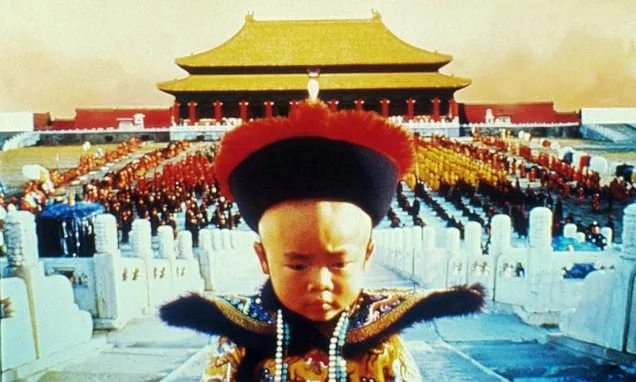
SPLENDOUR: Puyi portrayed in the 1987 film The Last Emperor
Puyi was born to a Manchurian noble family in 1906 at the tail end of Dowager Empress Cixi’s infamous reign. Cixi was a sociopathic despot who seemed to delight in poisoning anyone who stood in her way, even her own nephew. Her final act of cruelty before slipping off to Hell was to name her two-year-old great-nephew, Puyi, her successor.
Barely even a toddler, Puyi was told that he was the conduit between the kingdom of Heaven and the people on Earth. He was whisked off to the Forbidden City ‘by cavalry mounted on Mongolian horses flanked by palace eunuchs in their brilliant scarlet uniforms’. He wrote latterly that he screamed and cried through his coronation.
China’s political system was in tatters and when the revolution of 1911 finally established China as a republic, no one was surprised – not even the Imperial Family. Luckily for them, the statesman who had forged the new China, Dr Sun Yat-sen, ‘believed that a semblance of the past, of China’s continuity, was important’. He also thought that ‘the brutality of executing a six-year-old emperor would win him few friends either at home or abroad’.
As cages go, Puyi’s may have been the most gilded of any in history. French describes the splendour of sequestered life in magnificent detail; acres of gardens blooming with chrysanthemums, sumptuous banquets, and an army of eunuchs who treated Puyi as God. The ‘little Court’ was allowed to function – stripped of all its powers – and given an enormous annual stipend.
Happy Couple?: Wanrong and Puyi seemed more like playmates than lovers
Reginald Johnston’s 1934 memoir of the years he spent teaching Puyi (1918-24) is the reason we know so much about life in the ‘Great Within’. Johnston was a colonial official based in China who picked up the language uncommonly well. When he was hired as tutor, he developed a paternal fondness for the young emperor, and Puyi came to rely on him for everything.
Johnston was one of the many voices encouraging Puyi to marry. In 1922, teenage Puyi picked Wanrong from a selection of photos of Manchurian noblewomen.
The wedding was a bizarre mingling of republicanism and monarchy. The streets of Peking were choked with spectators who had come to watch the bride carried on a red sedan chair on her way to her confinement in the Forbidden City. The republican marching bands played American jazz music ahead of Qing princes on horseback.
If anything, the meaningless theatrics just proved that whatever this was, it couldn’t last.
Rather than a wife, Wanrong became a sort of playmate for the teenage emperor. French paints an endearing portrait of the couple cycling through the ancient citadel, taking cheeky photographs of each other, dressing up themselves and their tutors in ancient costumes.
However, they were imprisoned. Puyi began to dream of simply being a citizen and free of the palace and its eunuchs.
The eunuchs are undoubtedly the strangest feature of life at the palace, and in my opinion, its most pitiable inhabitants. For more than a millennium, royal tradition dictated that the emperor be served by eunuchs. Eunuchs could work in the royal palace ‘without threat of tainting the imperial bloodline’. They also didn’t have the distraction of families, which might shift their focus from the emperor.
Often, they were castrated as children. Poverty-stricken parents would pin their only financial hopes on their son becoming an imperial servant. For all of Puyi’s life ‘they had surrounded him as servants, sweeps, clerks, playmates, grooms, entertainers and, later, target practice for his airgun’. Puyi admitted in his memoir that ‘by the age of 11, flogging eunuchs was part of my daily routine... Whenever I was in a bad temper the eunuchs would be in for trouble.’
Unhappy ends: Puyi was imprisoned for 10 years after he accepted the emperorship of Japan's illegally annexed territory Manchukuo, while Wanrong, who was addicted to opium, died in a prison cell incontinent and in the midst of withdrawal
Since these people had lost their genitals (they kept them in brine jars so they could be buried with them) you’d hope the only perk might be job security. However, the ever-looming threat of permanent expulsion meant they didn’t even have that. Naturally, they took to looting. They would pilfer some of the inexhaustible treasures within the Forbidden City and sell them as curios to delighted tourists.
When Puyi discovered this, he expelled all 600 palace eunuchs in a fit of rage. Many became homeless, many killed themselves. The emperor would be tossed out himself not long after them.
In November 1924 the emperor and empress were finally expelled from the Forbidden City. The forging of the new republic had quite a few teething problems, with warlords trying to assert their dominance up and down the country. Eventually, the president was ousted and the warlord Feng Yuxiang seized Peking. He had ‘no time for monarchy in any form’ and his sympathy with the Bolsheviks rightfully terrified Puyi and Wanrong.
They were made to vacate the palace and fend for themselves. Despite Puyi’s long desire to leave, life outside the scarlet walls only went from bad to worse. Puyi was easily persuaded by Japan (China’s enemy) to accept the emperorship of their illegally annexed territory Manchukuo.
This rendered Puyi and his wife enemies of China and he was arrested after the Second World War and sent to a re-education camp. Wanrong, who had become addicted to opium since leaving Peking, died in a prison cell incontinent and in the midst of withdrawal. She too had been accused of collaboration with the Japanese.
Puyi was released after ten years in prison and ended his life as a gardener in Mao’s Beijing.
This is a surreal and upsetting story, which French writes with a verve that brings the magnificence and miseries of the Forbidden City to life.
The eye-opening biography lays bare the character of a ‘modest and intelligent’ boy, doomed to be, according to one American journalist, ‘the least consequential monarch on Earth’.