Liam Dann, Business Editor at Large for New Zealand’s Herald, works as a writer, columnist, radio commentator and as a presenter and producer of videos and podcasts.
Subscribe to listen
Access to Herald Premium articles require a Premium subscription. Subscribe now to listen.
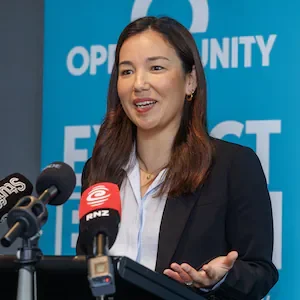
The rise of Qiulae Wong's Opportunity Party is the one clear trend of recent polls, writes Liam Dann. Its policy of compulsory KiwiSaver and higher contribution rates should appeal to National. Photo / Mark Mitchell
How about those politics, huh? It’s sure been a week of it.
Fast-paced, engaging drama, tailor-made for a modern world of short attention spans.
Let’s be honest. It’s all been highly entertaining.
But it’s not good for us. We need to get back to talking about policy now.
I almostdon’t even care which policies – as long as they are offering some sort of serious solution to the economic malaise that has taken hold of the country.
It probably all seems boring compared to the reality TV-style drama of the National Party’s internal leadership battles.
Will the PM be voted off the show? Who will be revealed as the traitor?
It’s addictive. We’re all addicted.
But please, New Zealand, can we direct that addiction to Love Island or House Hunters: Naked and Alone or Awkward Farmers On Blind Dates, or whatever we’re watching these days.
When we turn to serious matters like politics, let’s be serious.
Politicians have become obsessed with being likeable and relatable.
They go on podcasts and radio shows and try to compete with the comedy chops of the presenters.
In Australia, Prime Minister Anthony Albanese is in trouble again for making what appeared to be Benny Hill-style hand gestures about the melons he received as a gift from the Japanese Prime Minister.
Really? Okay, he did it on a comedy podcast where it may have made some sense in context.
It’s easy to manufacture controversy by taking jokes out of context.
But politicians aren’t comedians. It’s a bit tragic that they seem to think they need to be.
They should be well aware that nothing stays in context these days.
He’s copping a bit of flak for that too, although I’m sure his next meeting with our Prime Minister won’t be as awkward as his next with the Japanese PM.
Likeability is overrated.
It’s an almost innate trait that has little to do with competence and, in fact, can go a long way to masking a lack of competence.
Being likeable doesn’t make you a good person either.
Plenty of evil dictators were famously considered quite charming and charismatic in person.
I think our Prime Minister has tried in the past to push back against the obsession with likeability.
He’s emphasised attributes such as his commitment to hard work, management skills and financial nous.
But I think, with the economic recovery struggling and his leadership being undermined from within his coalition and his own party, he’s second-guessed himself.
Based on the current polls, it looks like it will be an extremely tight result on November 7.
As I’ve said before, I don’t think we’ll see enough of an economic recovery by then to shift the dial for National.
Both Labour and National look like they’ll need the Opportunity Party to take power.
If there is one clear trend emerging in the polls, it is the rise of Opportunity.
The Opportunity leader has said she’ll talk first to the party that polls highest on election day.
However left-wing or otherwise you think her tax policy looks, that sounds like a fair, level-headed centrist party approach.
I don’t think either National or Labour can take Opportunity’s radical tax overhaul seriously.
And for that reason, I think the party is still in play as a coalition partner for the left or the right.
I’ve never been convinced that Luxon has technically ruled out doing a deal with Opportunity.
What he said at the post-Cabinet press conference on July 27 was that National wouldn’t work with them on tax because it was fundamentally opposed to its tax policy.
“When I look at the TOP policies, as I see them today, and in a very cursory glance, it looks like they just want to increase taxes – that’s not what we want to do,” Luxon said.
I would suggest that the Prime Minister ought to take a second, less cursory, glance at Opportunity’s policy list.
What he will find is that, when you get past the radical tax reform – which Labour won’t be agreeing to either – the next biggest policy is the implementation of compulsory KiwiSaver and higher contribution rates.
That puts Opportunity on the same page as National (and NZ First) and, unless something changes, at odds with Labour.
This is no small policy issue.
If Opportunity has a conservative side, it is its focus on savings and productive investment – a legacy of its roots as a political invention of fund manager and economist Gareth Morgan.
It’s not hard to see how Opportunity would be prepared to do a deal with National if it could claim to have been a part of materially changing the dial on New Zealand’s savings regime.
If the party is still sitting at 8%, or higher, it’s hard to imagine either Labour or National refusing to talk to them on November 8.
I should note that, after the confusion of the Prime Minister’s post-Cabinet remarks, his office later confirmed that National was ruling out a deal with Opportunity.
But a statement from a faceless press officer is not the same as a promise from the leader.
And as we’ve seen time and again in the MMP era, even that promise needs to be very, very specific.
We seem to have only just reached a media consensus that NZ First and Labour will not work together – despite both parties having ruled each other out numerous times in the past year.
Ultimately, whether Opportunity ends up as power broker or not, we have a very live – and very lively – election campaign to look forward to now.
I don’t think we need to have any fear of it being boring. So let’s try and keep the politicians focused on big policy choices that lift this country out of the doldrums.
Liam Dann is business editor-at-large for the New Zealand Herald. He is a senior writer and columnist, and also presents and produces videos and podcasts. He joined the Herald in 2003.
Catch up on the debates that dominated the week by signing up to our Opinion newsletter – a weekly round-up of our best commentary.