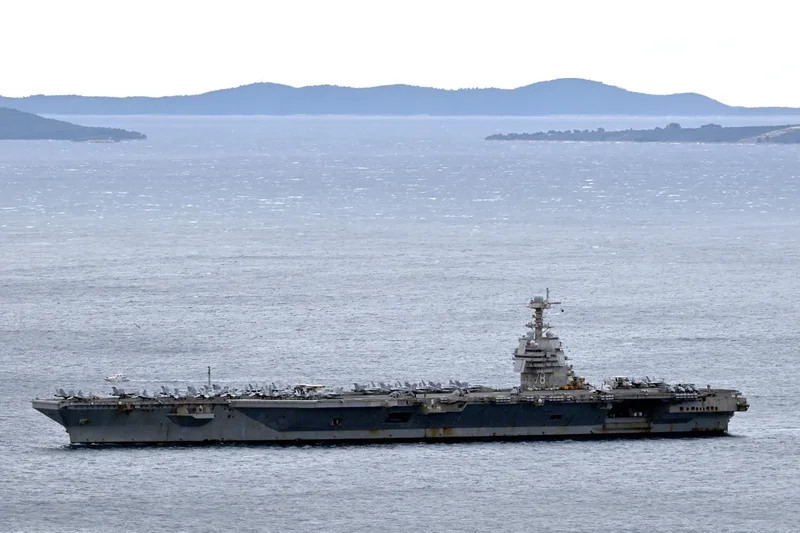
The U.S. Navy is reportedly evaluating a major, costly redesign for its newest class of aircraft carriers to align with President Donald Trump’s aesthetic preferences.
Seven current and former U.S. officials familiar with the matter told The Washington Post that the service was reviewing whether it could relocate the multistory command center — known as the “island” — farther forward toward the middle of the ship. In modern ships, the island is typically at the rear, however, in World War II it was more in the middle.
The review comes in response to concerns raised by Trump regarding the appearance of the Ford-class carriers, where the tower is currently positioned closer to the stern.
Officials cautioned that the assessment remained in its early stages, noting that such a shift would require substantial time and financial resources. A former senior official told The Washington Post that a similar study conducted during Trump’s first term concluded that moving the island would cost billions of dollars and cause major program delays.
“It came back that the cost and time to do so would just be extraordinary,” the former official told the publication.
Bryan Clark, a senior fellow at the Hudson Institute, added that altering the island’s location would disrupt the vessel’s weight and buoyancy.
“You could change it, but it’s very disruptive,” Clark said.
The command center was originally positioned near the back of the Ford-class design to improve flight deck efficiency and flight safety. Three officials told the newspaper that the layout gave aircraft more room to park near the catapults and that it minimized air turbulence for landing planes.
News of the island evaluation follows a national security presidential memorandum issued by the White House Thursday directing changes to carrier launch systems. In the document, titled “Rebuilding the United States Navy and America’s Shipbuilding Industrial Base,” Trump ordered the military to abandon the newer Electromagnetic Aircraft Launch System on future construction.
The memorandum states that defense officials have 60 days to submit a plan outlining how the Navy will strip high-tech electric catapults and bomb elevators from its newest upcoming aircraft carrier, the USS Doris Miller, known as CVN-81, and revert to older steam and hydraulic systems, including the timeline and costs involved.
The directive argues that the Navy “has experienced a series of shipbuilding setbacks stemming from overly complex designs and iterative design change procedures, which have resulted in cost growth, delays, and cancellations.”
It adds that the administration intends to rely on “proven, reliable, and affordable technologies and ship designs.”
An accompanying White House fact sheet confirmed that the directive targeted the construction of CVN-81, the future USS Doris Miller.
The Ford-class program currently consists of four planned vessels: the USS Gerald R. Ford, which is active; the USS John F. Kennedy, currently conducting sea trials; and the USS Enterprise and USS Doris Miller, both under construction. The Navy eventually plans to procure up to 10 of the carriers to replace the aging Nimitz-class fleet, with the Congressional Budget Office projecting future costs at $22 billion per ship, according to The Washington Post.
The administration’s shipbuilding review comes amid broader operational strains across the fleet. Navy carriers have faced extended deployments to the Middle East, including the USS Abraham Lincoln, which has remained at sea for 200 days without a port call.
The Independent has contacted the White House for comment.