The world not thankful to Iran for its sacrifices
Iran and the Resistance Front have been paying the price to keep the “Grater Israel” project incomplete
TEHRAN — Close your eyes and trace the borders Washington and Tel Aviv intended to draw.
In this alternative geography, the 1982 invasion of Lebanon never really ended. The Israeli border sits permanently at the Litani River.
Gaza is a flattened wasteland occupied and settled by an emboldened Israel; its surviving population, along with the inhabitants of the West Bank, has been forcibly liquidated into the Sinai and the Jordanian desert to solidify an unchecked Pax Judaica.
To the east, the vacuum left by a dismantled Resistance breeds a new generation of warlords.
Ahmed “al-Jolani” al-Sharaa, no longer bothering to present a fake “moderate” image, commands a sprawling Takfiri emirate from Damascus. Iraq and the Arabian Peninsula are fractured into sectarian extraction zones, managed from afar by Western intelligence agencies. The “Greater Israel” scheme stretches unchallenged from the Nile to the Euphrates, its borders drawn in blood and enforced by impunity.
That dystopia remains imaginary. The actual map holds because Iran and the Resistance Front have been paying the price to keep it incomplete.
The math of survival
The war that erupted on February 28 was designed to permanently close the Iranian file and the Resistance File. The operational theory inside was violently simple: decapitate a nation of 90 million and watch the state apparatus shatter.
American and Israeli ordnance reached the sitting head of state. Ayatollah Seyyed Ali Khamenei was martyred at the beginning of the campaign. Over 3,500 Iranians have followed him to martyrdom since that day.
Assassinating the Leader was a different category of escalation. It was supposed to trigger an immediate internal collapse.
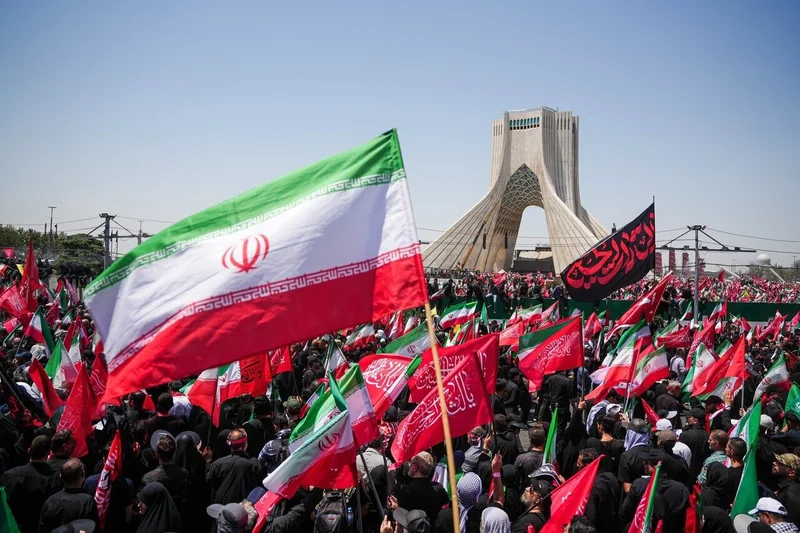
It produced a succession. Ayatollah Seyyed Mojtaba Khamenei now holds the office. The state ordered national mourning, buried its martyrs, and settled into a grinding war of attrition that has outlasted the man it was built to remove.
“We pledge to avenge your pure blood and the blood of all the martyrs of these two [recent] wars by taking revenge against the criminal, disgraceful murderers. This vengeance is what our nation is demanding, and this must definitely be done,” Ayatollah Mojtaba Khamenei wrote in a message on July 9.
Furthermore, the Strait of Hormuz, the artery that once pumped a fifth of the world’s energy exports, remains under Iranian management, while Washington finds itself mired in a fiasco with no easy way out.
A debt written in 1953
The resilience of this system may puzzle Western analysts, but viewed through Iran’s history, it is hardly surprising.
Tehran’s profound distrust of American assurances was forged in 1953 when the CIA and British intelligence agencies removed an elected prime minister for daring to nationalize Iranian oil.
Some in the international community looked away, while the West, the Soviet Union, and several Arab states helped sustain Saddam’s genocidal war machine, leading to the death of over 200,000 Iranians.
Iran walked out of those trenches having absorbed a permanent truth. No outside power is coming to the rescue. A diplomatic signature in Washington expires the moment a new administration takes office.
The Resistance Front follows directly from that historical trauma. Fighting a conventional, symmetric war against the United States is mathematically impossible.
Iranian strategists built an asymmetric forward defense instead. Lebanon, Iraq, Yemen, and Gaza became the architecture of a front that refuses to lease its security to foreign belligerents, marauders, and colonial oppressors.
The sovereignty tax
Standing on the moral side of history and defending true sovereignty carries a heavy price, and Iran is paying it in full.
The nation could have taken the path of its neighbors. It possesses the hydrocarbon reserves to exist as a pliant, immensely wealthy rentier state. Normalized banking and Western investment sat on the table during multiple eras.
Tehran has declined the terms of surrender. By refusing to dismantle its forward defense or abandon Palestine and Lebanon, Iran chose the economic guillotine.
The Iranian economy has shrunk. Inflation is high. The Iranian rial has sunk. The people bear the heavy brunt of this defiance. The nation is navigating a survival economy.
The Middle East is a theater designed for unipolar subjugation. Almost every capital operates on a ruthless transactional logic. China buys infrastructure. Russia secures its immediate borders. Arab monarchies in the Persian Gulf purchase dynastic insurance. Iran and the Resistance Front stand as the singular anomaly, anchoring its statecraft in indigenous liberation.
The world does not thank Tehran for this sacrifice. Most of the international community prefers the quiet, frictionless compliance of client states.
Future historians, however, will record the exact cost of this endurance. They will study a nation that took the empire’s heaviest blows, honorably buried its martyrs, accepted economic cost, and stubbornly refused to be erased from the map.