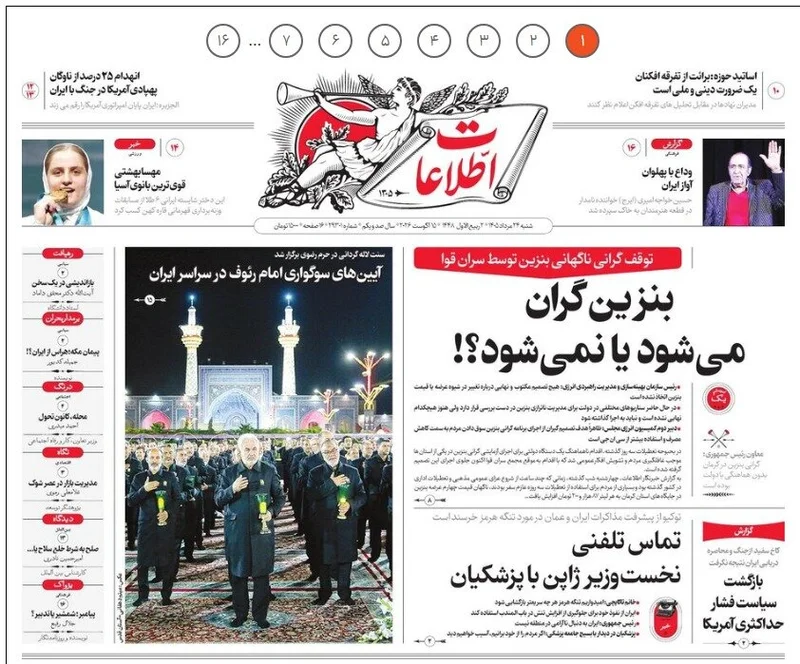
No fixed strategic objective
Ettelaat examines the reasons behind Donald Trump’s contradictory behavior. The paper notes that Trump has repeatedly claimed victory in unjustified aggression, even asserting that the Strait of Hormuz is open, while Iran continues to exercise strategic control over this vital waterway.
Iran and Oman have not yet reached an agreement to reopen it. According to the paper, confusion has become one of the most serious weaknesses of the Trump administration’s Iran policy. The absence of a “fixed strategic objective” is cited as a core element of this confusion. Trump’s contradictory actions suggest he is primarily focused on constructing a narrative of victory in a conflict he initiated without justification — a policy that has deepened Tehran’s distrust and reinforced Washington’s repeated failure to honor commitments in signed agreements. Washington’s attempts to portray Iran as weakened — economically or militarily — and then to create hope to push Tehran toward accepting an unequal agreement reflect a miscalculation that Iranian officials have repeatedly rejected.
**Donya‑e-Eqtesad: Iran controls Strait of Hormuz **
Donya‑e-Eqtesad analyzes why oil prices have fallen below $100 and writes that an old saying in financial markets holds that prices reflect all available information. So, what does the current oil price tell us? Oil below $90 does not indicate a shortage. But how is this possible amid regional tensions? The release of strategic reserves and the use of alternative pipelines to bypass the Strait of Hormuz have contributed to stability. Meanwhile, China’s reduced oil imports have left more barrels available for other buyers, and commercial inventories are acting as a buffer. Still, this is not the whole story. Evidence suggests that Iran’s efforts to assert defensive authority over the waterway and regulate passage are underway in a serious manner, producing a picture quite different from what US officials claim.
Kayhan: Hiding in a food truck
Kayhan publishes a sharply critical piece about Trump’s fear of assassination and his hiding in a food‑delivery truck. The paper writes that Trump’s promise of a quick victory over Iran has collapsed into such a miserable situation that he cannot escape it. His “disgraceful flight” from Ankara in a food truck and the severe psychological distress reportedly affecting sailors aboard the USS Abraham Lincoln are presented as examples of this deterioration. Kayhan argues that Trump’s problems in the war with Iran go far beyond the closure of the Strait of Hormuz, rising fuel prices in the US, plummeting approval ratings, or even the depletion of America’s strategic missiles. Reports of him hiding in a food truck during his recent trip to Turkey — out of fear of Iranian missile strikes — have triggered widespread commentary and mockery on social media. US media reports claim that despite Trump’s assertion that he had destroyed Iran’s missile capability, he hid in a food truck on his return from Turkey out of fear of those very missiles.
Ham‑Mihan: An emerging security architecture
Ham‑Mihan highlights the importance of the Mecca Security Pact for Iran. The paper argues that the pact could potentially expand to include other Muslim countries. Early speculation mentions Qatar, Egypt, Azerbaijan, and Central Asian states. If such expansion occurs, the central question for Washington, Tehran, and Tel Aviv will no longer be whether the pact is “anti‑Iranian or anti‑Israeli.” The Mecca Pact should not be framed solely as an anti‑Iran agreement. Iran will inevitably view it with suspicion, and strategically, the pact adds a layer of deterrence around Iran. The key issue is whether Iran can position itself within the emerging regional security architecture — or whether that architecture will gradually be built around Iran rather than with Iran. This, Ham‑Mihan argues, is the true significance of Mecca.