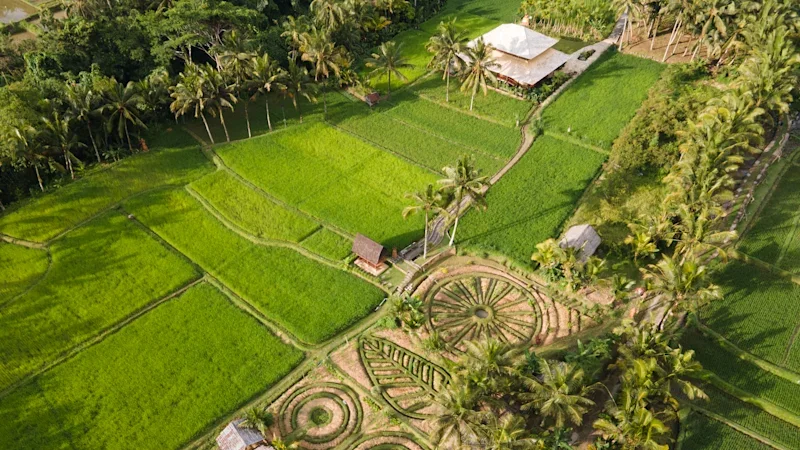
A farm-to-table restaurant, serving organic food in a pavilion in the middle of a serene rice field, is a rather rare bird indeed nowadays in nature-challenged Bali.
Rarer still is the bird they serve up, and I mean up, at Begawan Biji in Payangan, near Ubud, Bali’s so-called cultural heart.
That bird isn’t the superbly prepared organic chicken thigh sambal with a Sumatran green chilli emulsion, cooked over fire, among the restaurant’s skilled array of Indonesian and Asian dishes.
No, the species in question is the Bali starling, the rarest bird on the Island of the Gods. Critically endangered and endemic to Bali, and also known as the Bali mynah or jalak Bali, it’s noted for its brilliant white plumage, bright blue skin around its eyes and long, drooping crest.
Of course, they unequivocally don’t cook these precious birds, rare or otherwise, at Begawan Biji – heaven forbid, no – but patiently and lovingly conserve them.
Get exclusive travel deals delivered straight to your inbox. Sign up now.
There are as few as 600 individuals remaining on the island, most within West Bali National Park, and on the island of Nusa Penida. That’s far fewer than the 1000 to 2000 birds that survive in global captive breeding programs and sanctuaries.
More than 25 years ago, now retired expatriate couple Bradley and Debora Gardner, set up the overarching Begawan Foundation. It didn’t take long for the not-for-profit organisation to gain renown throughout the island for its community-driven regenerative farming and conservation efforts and the restaurant, designed by an architect on traditional lines, is the latest iteration of their work.
The starling conservation and breeding program began in 1999 when the foundation imported two breeding pairs to Bali. To date, it has bred and released more than 135 birds into the wild, the only private breeder in Bali to achieve such success.
To supply the restaurant, which opened two years ago, there are regenerative rice fields and vegetable gardens, where organic ingredients are grown in a striking mandala-shaped kitchen garden.
On a pre-prandial ramble – around its snow pea-green paddies and along the shaded forested pathways lined by lofty coconut trees – you’ll almost certainly spot one or more of the successfully released birds.
Happily, the captive-bred birds tend not to escape to other parts of the island, such as the national park. Perhaps sensibly, they stick around the idyllic farm itself, content to occupy the sizable, and rather fetching, wooden birdhouses attached to those same coconut trees.
I’ve travelled the hour-and-a-quarter by car to Ubud in Bali’s more vegetated, slightly less developed interior, from the beachy Seminyak, home to The Legian, a luxurious beachside resort with 67 suites and 15 pool villas.
There are other deluxe resorts much closer to Begawan Biji, but the Legian (via parent company Legian Hotel Management) secured the management rights to the stellar restaurant.
The Legian prides itself on providing guests with high-value cultural experiences, such as Gaya, a high-end Italian-Balinese ceramic maker not far from Begawan Biji, formed through partnerships with like-minded and artful Balinese businesses.
I’m delighted to dine at the restaurant, which has been attracting plaudits in Bali and beyond, but I’m a little disappointed to have missed one of Begawan Biji’s own bird tours. These allow visitors to not only spend more quality time on the farm but to also get close, though not too close, to the starlings in their protected enclosure, where they can even help prepare their food.
A portion of the proceeds from tours helps to fund starling breeding and conservation. At the nearby release site for the birds, tour participants learn about their behaviours and post-release care, while observing the liberated birds flying freely in their natural habitat.
In turn, and on a doubtless larger scale, revenue from the restaurant supports the foundation in its nature conservation efforts in Bali. It all helps, since few such precious places on the planet are so challenged by overtourism, overdevelopment and climate change.
Among the most concerning is the strain that the millions of tourists (me included) place on the island’s limited water supply. At Begawan, the farm’s natural filter provides a source of pure water for irrigation and at every turn, the restaurant included, water management is a prime concern.
Lunch finally beckons at the beautiful open-sided restaurant. Its design, by Conchita Blanco of the Bali-based architects Blancostudio, was inspired by a traditional Balinese wantilan pavilion, commonly used for community gatherings, meetings, and cultural events.
The two-storey pavilion, with its large and airy open kitchen, was built on environmentally sustainable design principles. The reclaimed ironwood, sandstone and bamboo all came from Indonesian sources.
Art and antiques from the owners’ private collection decorate the airy dining room, where delightful shared dishes are accompanied by chemical-free single origin, highly nutritious mansur heritage rice cultivated mere metres from my table.
Halfway through lunch and from the vantage point of my table, I glimpse a pair of Bali starlings in flight, dipping and soaring above the rice fields, the black tips of their wings and tails on full display.
To add to this decidedly bucolic but slickly delivered dining affair, one of the farm’s female workers arrives in the restaurant, the large basket on her head bearing greens freshly plucked from the adjacent permaculture garden and soon to become ingredients in Begawan’s dishes.
My visit concludes on a gastronomic and photogenic high – Begawan Biji’s signature Balinese orange mousse is teamed with chocolate crumble with makrut lime ice-cream.
For a thousand reasons, Bali could do with a thousand more Begawans, and a thousand or more Balinese starlings, for that matter. For now, we remain grateful for this model of farming and conservation taking wing.
THE DETAILS
DINEBegawan Biji, at Payangan, near Ubud, is open for lunch and dinner Tuesdays to Sundays between 11.30am and 10pm. A farm-to-table dining experience, including a tour of the estate, a set three-course lunch and a non-alcoholic beverage costs about $60 per person. A la carte dining with dishes to share is also available.
See
begawan.org
Related Article
TOURGuests of The Legian Seminyak and The Club by The Legian Seminyak can choose between lunch or dinner experiences at Begawan Biji with chauffeured transport to Ubud and return. The bookable Bali starling bird tours include a set lunch with one non-alcoholic beverage.
STAYRooms at The Legian Seminyak and The Club by The Legian Seminyak from $617 per night, excluding taxes and fees. See
lhm-hotels.com
*The writer travelled as a guest of The Legian Seminyak, Bali *