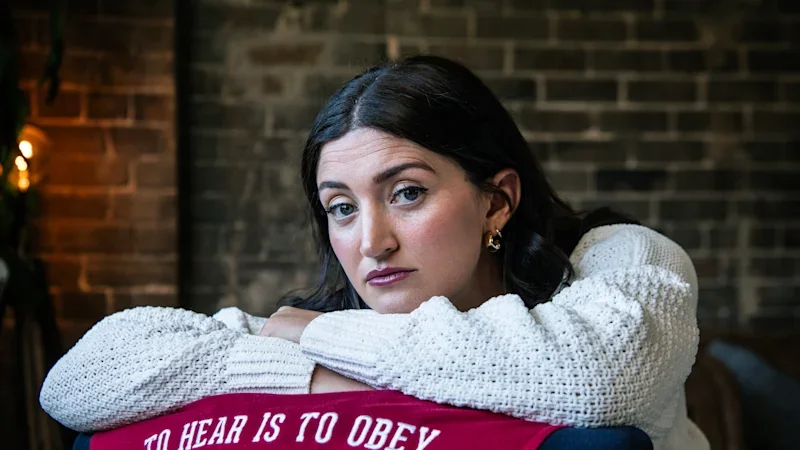
**Alexandra Garth appeared this week before the NSW parliamentary inquiry into the Redeemer Baptist School at North Parramatta, detailing her experiences in – and how she escaped from – the church community. The inquiry was prompted by a six-month investigation by The Sydney Morning Herald’s Emily Kowal, together with 60 Minutes. **
Fitz: Alexandra, I was fascinated – and appalled – by some of your account this week. Can you tell us something of your background in that church community?
AG: I was born into it. My grandfather Pastor Noel Cannon was a founding elder who established Redeemer Baptist Church and was the first principal of the school. My uncle Jonathan Cannon is the current principal. The Cannon family drove a more expensive car, lived in a larger house compared to the majority of the community who lived more modestly.
Fitz: And you were raised in fundamentalism?
AG: One hundred per cent. From birth, we were taught that the world’s evil outside, that the Redeemer Baptist Church is the one true way, and that those who leave are evil.
Fitz: And yet, somehow, you managed to challenge it?
AG: When I was about nine years old, I remember just feeling so hopeless in that I could see my whole life in front of me, and it wasn’t my life. It was what they wanted me to do. I didn’t have any agency, and I knew that if I were to have the chance to leave one day and be free, it would be at the cost of never seeing my family again. So I became quite depressed from a really young age. I would often ask, “Why do we have to do this, why are things this way?
Fitz: What “things”?
AG: Why is it only men who make all the decisions, and why aren’t women treated equally to men? Why are all the elders, men? Why are women not allowed to preach? We were told that to protect our young men from sinning, it’s our job as women to not cause them to lust with our clothing. What? And when I questioned things, I would be told, “Oh, Alexandra, you don’t always have to over-intellectualise everything. Just have faith. Remember our motto: ‘To hear is to obey’. Trust us.” I was told: “Submit to the leadership.” When I still questioned things, I was labelled as “a troublemaker” or referred to as “a tyranny”.
Fitz: A tyranny? Geez, Louise. That sounds grim. Now, don’t tell me anything if it will trigger post-traumatic stress in you, but what were the absolute low points for you?
AG: It’s ok. [She refers to allegations she made under parliamentary privilege, on Monday.]”My dad was going to spank me on my parents’ bed and I didn’t want it. I said, ‘No, I hate my life.’ And I just snapped after years of bottling it up. Then (my uncle, the principal) Jon Cannon came into my parents’ bedroom . . . and listened to me and said, ‘Well, you can’t just say that and get away with it.’ He held me down on the bed so my dad could hit me. I was struggling underneath them. Then they managed to hit me three times on my upper thigh, but I was struggling”.
Fitz: To which I should emphasise, this is what you alleged during the parliamentary inquiry on Monday, as the Redeemer Baptist Church denies this. And what about the other episode, if it won’t trigger you?
AG: No, fine. I alleged I was indecently assaulted four times by a church member who was [several years] older than me when I was 12 and 13.
Fitz: Get to the part where your father or your mother grabs this bloke by the ear and says, “If you ever touch my daughter again, I will give you holy hell, alright!” just before they call the police. Is that what happened?
AG: No. The fourth time, when I told someone, I alleged I was walked to the principal’s office with my parents, and I had to demonstrate on my mum what had happened. I was told by the principal, “look at what you’re wearing”. That didn’t help. I was wearing what all the other girl waiters – serving the year 12 students and teachers – were wearing that night. And I’d worn that outfit for years, and it’d never been a problem.
Fitz: And was he punished?
AG: Yeah, he was stopped from playing [his instrument] at the school and church music ministry for a certain time period. And I had to continue serving him, seeing him and eventually working with him.
Fitz: And this proceeded through the criminal justice system, and he was ultimately acquitted of any crimes. Did this push you further down the path of thinking “this is outrageous”?
AG: Yes. One of the fundamental reasons for leaving is I knew I really wanted to be a mum and the thought of raising a child in that environment – where I couldn’t question the leadership’s decision, and I would have to defer to them – didn’t sit right with me. I knew I couldn’t give my children the childhood I’d had. And it was around that time, I remember reading an article in high-school about the 10 signs you were in an authoritarian group, and ticking off literally every single box.
**Fitz: ** Your account is that reading that stuff about these indicators helped awaken you. What were the key things you allegedly ticked off?
AG: Having an unquestioned leadership, where every life decision had to be run past them. Tick. The restriction of communications with people on the outside. Tick. The shunning of normal things that other people do. Tick. The control of every facet and domain of life with regards to education, schooling, marriage, family relationships, clothing, personal grooming, holidays. Tick. Tick. Tick. Tick.
Fitz: You said that listening to the radio in the bathroom also helped liberate you?
AG: Yes, I had an MP3 player, which had a radio. We were meant to listen to Hope 103.2, which is a Christian radio show, but in the bathroom I would listen to FM 104.1 and 106.5, like Kyle and Jackie O, Fifi Box and Rove McManus. But you always lived in fear of getting found out, and then it was found out, and it was confiscated.
Fitz: Once a tyranny, always a tyranny! But listening to the actual outside world helped liberate you?
AG: Definitely. And I think one of the things that is fundamental for someone to leave a high control group is meeting someone independent on the outside who’s willing to help. For me, it was my university friend. I told her about my life, and she’d be like, “Oh, that’s a bit odd. Can you elaborate more on that?” And through talking to her it made me realise, “Oh yeah, that is a bit weird”. And then one day, she said, “If you ever want to leave, Mum said that you can come and live with us.” That was a light bulb moment. Suddenly, I had a way out.
Fitz: The great American writer, Garrison Keillor, once said, “I grew up in Iowa. I was 19 before I realised we were free to leave”. Was it like that for you?
AG: Yes, except I was not free to leave. When it came to it, I threw some of my belongings in a washing basket, and I knew my friend was parked outside. But when I tried to leave, I was stopped by four members who’d found out what I intended to do.
Fitz: Allegedly! Go on.
AG: I allege. Nothing was easy preparing for that moment. The week before I left, I was moved to another house in the community but before that, I was still sharing a bedroom with my primary school teacher, while in the bedroom opposite was the school librarian and school receptionist. And down the corridor was the principal’s assistant who lived with us. But on this night, they put the January roster up for volunteer work they insisted we do, and I found I was placed on days without prior consultation, despite my peers being asked what days they were available. I was already judged a flight risk. It broke me. I felt, “This can’t be my life any more.” So I ran to the bathroom, messaged my uni friend and said, “I’m done. Pick me up NOW.” My parents were away, but four members intercepted me in the corridor, and for two hours they were at me. My uni friend was trying to message me, but I couldn’t reply. And the members were like, “You know, you’re not mentally well? We can get you some help. You can marry someone in here.”
Fitz: That must have been harrowing.
AG: Yes. They’re sobbing, and you feel so guilty. In the end, it was so difficult – my cousin’s little kids were in the next room, and I didn’t want their last memory of me to be this – so I agreed not to go. When you have 200 people telling you this world view and you’re the only one questioning it, you actually begin to believe that you are the one who’s crazy. So I texted my uni friend words to the effect of: “I’m so sorry. Please go. I’m not going.” But I didn’t realise that she had brought her mother. And my friend texted back along the lines, “That’s okay. We will go, but Mum’s here with me, and she says we want to physically see you and make sure you’re alright. She wants a welfare check. And that if you don’t come out by 11.30 she’s going to call the police.”
Fitz: Hero! Though again, I note, the Redeemer Baptist Church denies they tried to stop any members from leaving.
AG: After she said this, I’m like, “You know what? I’m just gonna run.” So I just sprinted out the door and ran to the car, and we just sped off. They tried to follow, but we got away, running two red lights at James Ruse Drive and Pennant Hills Road, so they couldn’t get us. The next day, I was in Kmart, and I couldn’t believe I could buy any item of clothing I wanted. And I lived with my friend’s family for a year.
Fitz: Tell us the good news. Have you lived happily ever after?
AG: For the most part, yes. When you leave Redeemer, you feel like a refugee in the country that you were born in, so it took a long time to adapt. It’s really hard when you’re working full-time and dealing with the loss of your whole identity, your whole family, trying to deprogram. But yeah, that was five years ago. I now have a full-time job nursing – Redeemer did give me a great work ethic – and I met my partner on a dating app, which I never thought would have happened. We’re greatly in love, we’re looking at buying our first house together, and his family are wonderful to me. His grandparents, his parents, have wrapped me in their arms. His sister is one of my best friends, and I was a bridesmaid at her wedding. They are my family now.
Fitz: And your own parents?
AG: They have refused all contact, unless I return. I’ve dropped off presents and been told they’re not going to be opened. I’m like Harry and Meghan from the royal family – in exile. But I sort of understand. When your parents are actually born into this institution, as many kids are, they’re also victims of it. (They wouldn’t say that, though.) And if they tried to leave, they have no super, no house, no car, no idea how the outside world works – though they’d deny that. I would have to support them. But my brother and sister have followed me out, so I see them all the time, and my partner’s family are wonderful to them, too. We still have one sister in there, but my parents don’t speak to the three of us on the outside.
Fitz: Are you an atheist?
AG: I would say I’m agnostic. I believe in something, but I don’t know what. And I don’t really care. I’m just living my life.
Fitz: It seems to me your experience is right on the fault line between two competing forces. Firstly, families have a right to raise their children in the way they see fit, in a society where there must be freedom of religion. And yet, secondly we, as a society, have a responsibility to make sure that children are not being outrageously oppressed, without even the option of opting out.
AG: Yes, I agree with that. In my case, I was never able to consent to anything because I was born and raised in it.
Fitz: So this parliamentary inquiry seems to be designed to get information to help decide at exactly what point does society’s responsibility to intervene trump a family’s right to raise their children in the faith of their choice? So I ask you: what conclusion do you want them to come to, and what legislation would you like to see?
AG: They need to conclude there is a problem and the legislation has to be framed to protect the community children in situations like that and to give them agency over their own life. And services need to be provided to help people who want to leave high control groups in Australia. When I left, there was no specialised or free services I could access to get counselling support to help me with what I’d suffered. The only way I could get help was because of the indecent assault allegations I had made. But then there are members who need help, and it doesn’t fit under domestic violence services. So there must be free specialised counselling provided, where you’re not treated like an oddity.
Fitz: Last thing. I want to hero the mum who said to you if she can’t see you in the flesh by 11.30 she’s gonna call the cops, so prompting you to make a run for it!
AR: [Laughing.] She’s amazing. She just texted me this morning. She’s such a lovely woman and is a maternal figure in my life that I look up to. She’s one of the most kind, loving people I’ve ever met.
Fitz: I love her from a distance! Women, looking after women. Bravo. Good luck, and thank you.
AR: Thank you.