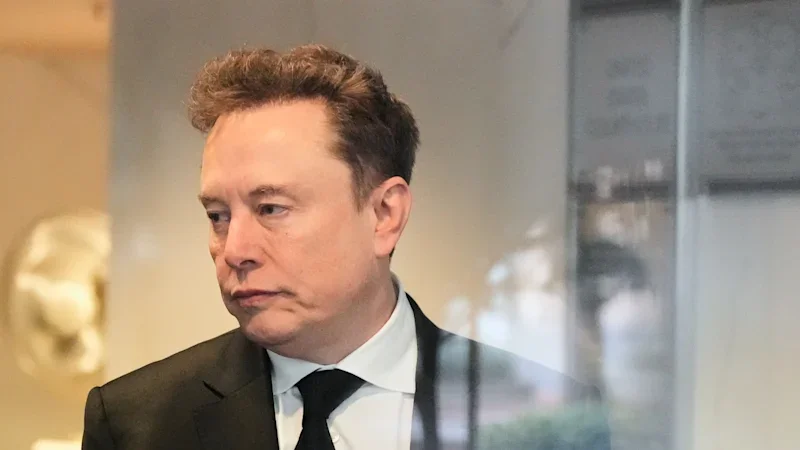
According to the richest person on Earth, pretty soon money will be a thing of the past. He’s not just talking about physical cash, either, although our rates of using coins and notes have been on a downward trajectory for quite some time now.
No, according to Elon Musk, within just 10 years’ time, artificial intelligence and an army of robots will essentially negate our need for money, to the point where it “won’t matter” any more.
Speaking to The Economist recently, Musk said, “You want money for goods and services, right? You want money for obviously food, housing, transport, entertainment. Well, if that is so abundant that the robots and AI are providing more goods and services than any human could possibly consume, what do you need money for?”
As tempting as it might be to roll our eyes and write Elon Musk and his many predictions for the future off, what he says still holds an incredible amount of sway. The incredible financial success of his companies Tesla, Starlink and SpaceX, which is the basis for his exorbitant wealth, means that when he speaks many people listen (not least because he makes users of his social media platform, X, listen).
And this is what, I think, is one of the biggest problems with him, and his willingness to offer up opinions on any number of topics so freely. But to use an old saying that feels especially fitting when applied to Musk, talk is cheap.
Back in 2011, he said that within a decade his company SpaceX would have put a person on Mars. By 2016, he revised this prediction, saying that by 2018 they would be sending rockets to Mars, which would then be followed by biennial missions, and then people being sent would come after that.
Musk’s promised fully autonomous car is still nowhere to be seen.
“If things go according to plan, we should be able to launch people probably in 2024, with arrival in 2025,” he said at the time. But 15 years on from the initial promise, we’re still no closer to seeing human life on Mars.
During the same period as his space predictions, he said his electric vehicle company, Tesla, would have a fully autonomous driving car on the market by 2018, meaning people could essentially have their own private taxi service.
So much so, that he said owning a traditional car where a human is required to operate the vehicle would be the social equivalent of still having to ride a horse into town. Eleven years later, Tesla has models that have some semi-autonomous technology, but the promised fully autonomous car is still nowhere to be seen.
The following year, in 2016, he launched Neuralink, which aims to combine AI technology with human intelligence by implanting a microchip into a human’s brain. At the time, he predicted the first chips would hit the market by 2021. Much like the self-driving cars, we are still waiting to see how that pans out.
Then in 2019, Musk confidently told the world that there would be a million self-driving autonomous robot taxis on the road by 2020 for those who don’t need to own a vehicle permanently, but who also don’t want to use Ubers or public transport.
Seven years on, that prediction is nowhere near close to being a reality, with CNBC estimating fewer than 50 robotaxis are on the roads in the United States.
In the leadup to the 2024 US presidential election, Musk announced that under Donald Trump he would create the Department of Government Efficiency (DOGE – named after a cryptocurrency “meme coin” he’s invested in) and cut $US2 trillion in what he said was federal government misspending.
Now we know that DOGE not only failed to uncover the “waste, fraud and abuse” Musk said was there, but that his employees wreaked havoc, with potentially long-lasting impacts to government-funded programs, and that government spending actually increased on his watch.
Speaking of Dogecoin, Musk has long been a fan and public champion of the highly volatile “meme coin”. Currently, it’s trading at about $US0.073 – a drop of around 90 per cent from its all-time high of $US0.74 in 2021.
When he was working at the White House, the coin pushed up to $US0.48 before dropping again, which is now very much the pattern. But Musk’s disciples are hopeful that a new all-time high is just around the corner, with SpaceX set to launch its DOGE-1 satellite in September, which was fully paid for by Dogecoin.
This pattern of saying one thing and the reality being entirely different is important because it shows that just because Musk says something doesn’t mean there’s any weight to it. So often, his words do not match up to the eventual outcome – or lack of an outcome.
But this pattern also suggests that he is extremely comfortable with volatility, and isn’t spending much time thinking about the power of his influence and how much money the people hanging onto his every word could lose.
And this brings me back to his prediction that money will be a thing of the past that no one will need or even really care about within just 10 years’ time.
Unsurprisingly, people were pretty quick to wonder why Musk is holding on to a personal fortune that’s greater than some countries’ entire GDP if money is really on the way out.
On social media, the Nobel Prize-winning economist Daron Acemoglu asked, “If money won’t matter in 2036, why don’t you pledge to donate your current wealth of approximately $1 trillion to charity no later than 2036.
“This would establish with great credibility your belief in the powers of AI and technology. It would also assuage many people around the world who are worried about the political and social influence of billionaires and trillionaires.”
Surprisingly, Musk actually responded to Acemoglu and claimed he is “going to do something along those lines”.
Once again, unsurprisingly though, details beyond these few words that would provide a clear road map as to how Musk would get there by this deadline were nowhere to be seen.
Until that crucial detail arrives, it’s probably best for everyone to keep calm, carry on, and take what the man who promised us self-driving cars and a space colony says with a giant grain of salt.
Victoria Devine is an award-winning retired financial adviser, a bestselling author and host of Australia’s No.1 finance podcast, She’s on the Money. She is also founder and director of Zella Money.
- Advice given in this article is general in nature and is not intended to influence readers’ decisions about investing or financial products. They should always seek their own professional advice that takes into account their personal circumstances before making any financial decisions.