Private sector players are mulling whether to make a bid to help build the Melbourne Airport rail link as key questions remain over the funding and delivery of the project from Sunshine to Tullamarine.
The Carroll government maintains it is not currently considering any public-private partnerships for the long-awaited project. Since becoming premier, Ben Carroll has said that the rail line to the airport is his top infrastructure priority, while he has also promised to work more closely with business.
This has prompted conversations among investors and builders about putting together an offer to the government to deliver some part of the project with an injection of private capital – six years after the government shut down a market-led proposal that would have resulted in $7 billion injected on top of taxpayer funds.
Upgrades to the rail network from the city to Sunshine are already in the process of being built or tendered, but 18 months of meetings between federal government, state government and airport representatives are still yet to land a model to deliver the rail line past Sunshine to two new stations at Keilor East and Tullamarine.
This masthead has spoken to five construction, engineering and investment industry sources, who confirmed there had been fresh discussions in the private sector about putting forward a proposal for the project.
This has included seeking out old technical details and costs contained in a 2018 market-led proposal, known as AirRail, from a consortium backed by industry super funds to build the project with a six-kilometre tunnel between the city and Sunshine.
The group put up to $7 billion on the table, on top of the $10 billion committed by the federal and state governments at the time, but the offer was ultimately declined in 2020.
IFM Investors, the major financier in that bid and a key shareholder in Melbourne Airport, declined to answer questions from this masthead about whether they were considering a bid as part of their ongoing work exploring investment opportunities.
If they or another bidder does make an offer, they will confront a construction market that has changed significantly since the Andrews government rejected the market-led proposal in 2020.
A revived private sector plan would need new costings, accounting for significant construction price rises this decade, and to assess how public transport patronage has changed since the pandemic.
Multiple sources, who were not authorised to speak publicly, suggested the AirRail proposal to build a new set of tracks between Sunshine and the CBD was off the table because upgrades to this part of the network were already under way.
A station in Keilor East, which was added to the project after advocacy from Carroll as the local MP, would also be non-negotiable.
Carroll’s enthusiasm for the project has sparked a belief in the private sector that his government will seek to announce a major development before the election, but three industry sources warned questions over funding and delivery would challenge this timeline.
One issue that has ignited interest from the private sector is that authorities are yet to agree on the best method to contract and deliver the new passenger rail corridor from Sunshine to Tullamarine.
In March last year, a steering committee was appointed to work with representatives from the Commonwealth, state government and Melbourne Airport to work out how to deliver the rail line and resolve any outstanding issues – including claims from the airport for compensation. These negotiations remain ongoing.
Upgrades at Sunshine are being tendered through an “alliance” delivery model, a co-operative contract in which government, builders, designers and public transport operators work as one team, reducing the likelihood of litigation over differences.
The level crossing removal program is being delivered through four different alliances, and these groups are also delivering four separate parts of the Sunshine upgrade. But authorities have not finalised how to deliver the rest of the project, including whether to continue using the level crossing removal teams or enlist bids from a new consortium of players.
Until these decisions are made, the gap provides time for the private sector to put forward their own proposals.
A spokesperson for federal Transport Minister Catherine King said the steering committee was meeting regularly and would continue to do so as they determined how to deliver the rail line.
“The timeline for future stages of the project will be established as part of the planning work currently being undertaken by the steering committee,” the spokesperson said.
In 2021, before airport rail was put on ice and delayed by up to four years, the state government had proposed to tender out six different packages of work.
This included a contract to build what would have been Melbourne’s second-tallest bridge over the Maribyrnong River, measuring 550 metres long and 50 metres high.
Other packages were outlined for the station at the airport, an elevated rail viaduct over the Western Ring Road and new tracks along the existing freight corridor from Albion to Jacana.
It has not yet been determined whether these packages will be revived, bundled together or completely rewritten, and whether firms who apply for this work will need to make fresh bids.
Adding to the uncertainty is the final cost of the project, which in 2022 was budgeted at $11.5 billion, with an estimated ceiling of up to $13 billion. Victoria has committed $5 billion and the Commonwealth has committed $7 billion, bringing the total taxpayer funds available to $12 billion.
However, the scope of the project has expanded significantly through the $4 billion program of works dubbed the Sunshine super hub, which includes rebuilding Tottenham and Albion stations and widening and simplifying six kilometres of tracks between Albion and West Footscray. This is being funded equally by the state and federal governments at $2 billion each.
Much of this work was not envisioned in the original business case, leaving it unclear if further funding is needed on top of the existing $12 billion airport rail link commitment.
Construction costs have soared since the project was delayed. In 2024, the Victorian government estimated construction costs had increased by about 22 per cent since 2021. Inflation has since rocketed further due to conflict in Europe and the Middle East, and a raft of trade tariffs.
Although it is difficult to untangle the total cost of the project from the Sunshine work, three construction industry sources agreed the total cost would probably be $15 billion.
A Carroll government spokesperson said they were not exploring private sector involvement in airport rail, but that the project was a priority.
“Major works are under way for the first stage of the project – transforming Sunshine station to cater for 1000 trains a day to run through the west and regional Victoria,” the spokesperson said.
A Melbourne Airport spokesperson said final decisions on timing and overall delivery rested with the government, but that it was not pursuing a public-private partnership as an organisation.
“Melbourne Airport’s draft Master Plan 2027 is currently on public exhibition and protects for the government’s planned track alignment and elevated station design,” the spokesperson said.
“Melbourne Airport is working constructively with state and federal governments on planning, including how the project is packaged and delivered.”
The draft master plan, released this week, sets out the airport’s development over the next 20 years and assumes the rail link will be open by 2035.
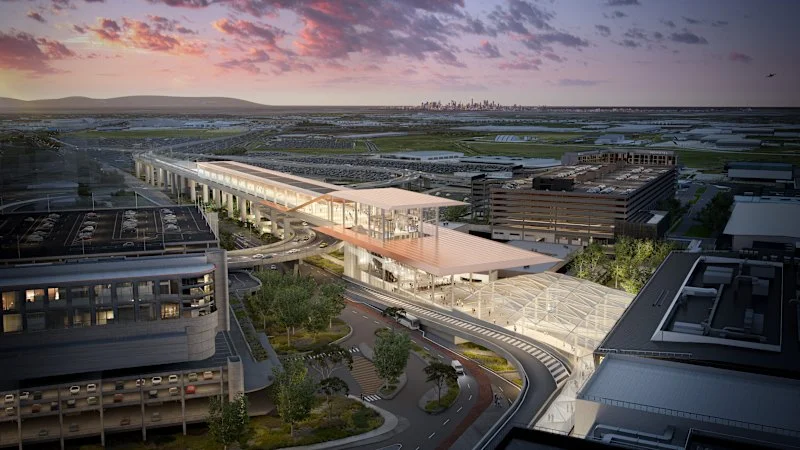
However, the plan also hints at tension between the airport and state and federal governments over the final design of the project. Melbourne Airport had previously pushed for the station to be underground, whereas the state government surprised it in 2022 by releasing designs for an elevated station located between two multi-storey car parks outside Terminal 4.
The plan says: “It is important that the design of the airport rail station is seamlessly integrated into the airport’s transport network, ensuring strong connectivity with existing ground transport facilities and terminals, and no adverse impact on the operation or performance of the ground transport network.”
For the Sunshine upgrade, works are already under way on a contract to relocate underground utilities in the area. Further contracts will be announced this year and in 2027 for work including realigning tracks and building the new Tottenham and Albion stations.
An alliance will be set up to build platforms and other major upgrades at Sunshine station. Two consortiums have been shortlisted for these works.