Sign in. It’s quick, free and it’s up to you.
An account is an optional way to support the work we do. Find out more.
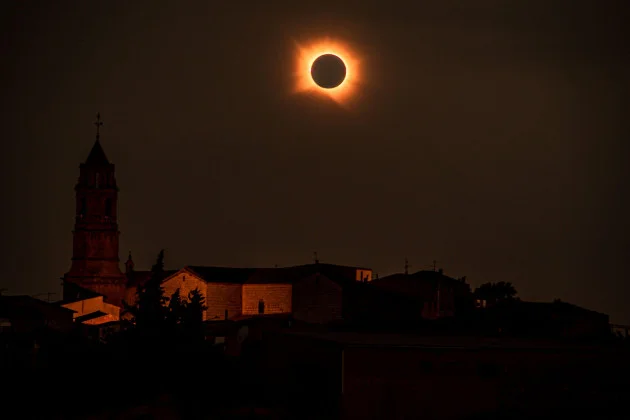
IF THERE WAS part of you this week that was thinking this 94% totality is pretty amazing but I really want the full show like the folks in Reykjavík or Zaragoza, the good news is that eclipses are pretty predictable.
All things considered, seeing an eclipse is among the more achievable ambitions if you feel that way.
Eclipses are so predictable that Nasa has calculated the time and locations of them across the word for about the next thousand years. You can literally see the paths of eclipses up to the year 3,000 if you so wished.
In the nearer term, there are some options that don’t require some kind of immortality.
They will all require getting on a plane or a boat, however, as Ireland won’t anything like Wednesday’s show until 2090 (more on that later).
So what about the eclipses over the next five years, where would I have to go to see them?
The next big event is in about six months’ time on 6 February, when a solar eclipse will track from the Pacific Ocean across southern Chile and Argentina and across the Atlantic until it reaches the west coast of Africa.
The Uruguayan coast and a sliver of Brazil near Porto Alegre will also get some totality, but you’d want to do some precise research before travelling.
The Nigerian city of Lagos and its 15 million inhabitants will be the final spot for this eclipse.
This solar eclipse will be an annular solar eclipse. This means that, as the Moon passes between the Sun and the Earth, the Moon will be at or near its farthest point from us.
This has the effect of the Moon not completely covering the Sun even though it is directly in front of it, with the Moon instead looking like a dark disc with a ring around it.
The next total solar eclipse akin to yesterday’s will be in just under a year’s time, with Spain again getting the best view in Europe, albeit just about.
The southern Spanish cities of Cadiz and Malaga will be in the path of totality, and technically speaking British soil will also enjoy some eclipse as it will pass directly over Gibraltar.
In the news recently, the Spanish enclave of Ceuta on the Moroccan coast will be in the eclipse’s path before it moves over all the countries of North Africa before also touching Saudi Arabia and Yemen.
In Ireland, we will be able to partially view this eclipse but the magnitude of the eclipse will peak at 46% here, less than half of Wednesday’s 94%.
Another annular eclipse will take place in January 2028, with this one catching more of the northern portion of South America and taking in Ecuador, Peru and Brazil before the Moon’s shadow makes its way across the Atlantic to again include Spain.
Some of the best viewing here will be in the Algarve in Portugal as well as some of Spain’s biggest cities including Seville and Valencia. The southern suburbs of Madrid will even be in the path of totality.
Australia and New Zealand will be the only countries to experience totality during the total solar eclipse that will take place in July 2028.
This eclipse will be a big news event because it will pass directly over Sydney after traversing the Australian outback near Alice Springs. The best viewing spot in New Zealand is likely to be in Dunedin.
This eclipse in June 2030, another annular solar eclipse, has the longest track of the eclipses we’ve looked at. There are plenty of options if you want to fly to go and see it but you may be travelling some distance.
The eclipse will again take in Northern Africa before going directly over Athens and Istanbul before sweeping over cities like Volgograd in Russia and onwards east before it’s ultimately over Japan, with the city of Sapporo the last major city under totality.
Ireland will get a partial eclipse here, peaking at about 53%.
As you may have heard over the last week, the next time Ireland has a solar eclipse to the extent of Wednesday’s will be in 2090, 23 September to be exact.
It will be a Saturday, in case you’re making plans, and the eclipse will begin at 5.25pm, peaking at 98% totality, so even closer to the full monty than we got this week.
Just for completeness’ sake, let’s answer the question of when Ireland will get a 100% total solar eclipse.
Well, the bad news is that not only will none of us be here to see it, but anyone who does see it on the day will need a deep dive to find you as an ancestor.
That’s because the date is 11 April 2442 when Dublin, Cork and the entire south-east of the country will be treated to the total eclipse spectacular.
The question therefore becomes not so much when will Ireland see a total eclipse, but what Ireland even means in statehood terms when it happens in over 400 years.
To embed this post, copy the code below on your site