- See more Daily Mail on Google - save us as a Preferred Source
Make no mistake, the death of Professor Jason Arday is an absolute tragedy. It doesn’t matter how much he embellished his CV or exaggerated his achievements – he didn’t deserve to die.
Now, inevitably, the blame game begins. As with the late Caroline Flack, the Love Island presenter who killed herself in 2020 after she learned she would be facing prosecution for allegedly assaulting her boyfriend, this is one of those awful moments that forces every one of us in the media to pause for a moment of sombre reflection.
However justified or widespread the criticism of this young man may have been (and his story was covered in great detail and with gusto by everyone, from The Guardian to the BBC), the fact remains that, like Flack, the furore generated must have inevitably played a part in the mental anguish that led to his death.
As the MP James Cleverly put it so succinctly on X: ‘Even the most casual observer could see he was a vulnerable fantasist.’ I think there is a lot of truth in that.
I also know from personal experience how desperate it can feel when the whole world is hating on you, how the thoughts can become very dark and very invasive. It’s happened to me, it’s happened to people I love. It’s a desperate place to be.
It was the same with Arday. As allegation after allegation came to light, I could see this young man’s whole world collapsing around him as, one by one, his academic chums, once so keen to bask in the reflected glory of his achievements, quietly hung him out to dry.
Where suddenly they had all wanted to be party to his success, now he risked embarrassing them at their high-falutin’ dinner parties, exposing their stupidity and vacuousness. Again, as Cleverly pointed out, ‘A number of people at a number of academic institutions have serious questions to answer. They put him into positions he was clearly not qualified for so they could have a black wunderkind to show off, they pushed him into the spotlight for their own benefit. His exposure was inevitable, a case of when, not if.’
However vulnerable he was, it would not have been right to ignore the allegations against him. In any profession, it is not good or fair that people in trusted senior positions should misrepresent themselves. Cambridge, where Arday was Professor of Sociology of Education, is a world-class academic institution that demands world-class standards.
How would you feel, for example, if the doctor treating you turned out to have faked his or her qualifications, or the person driving your cab had lied about passing their test? These things matter for good reason.
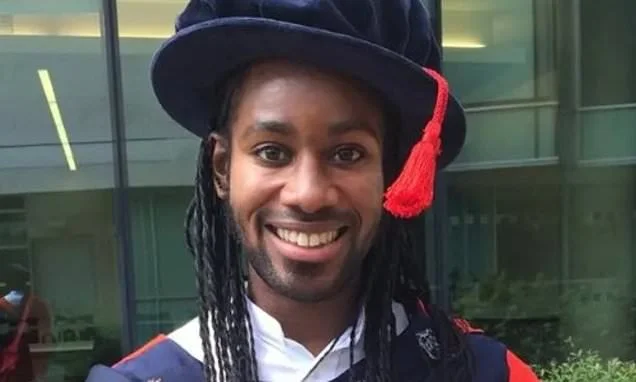
Professor Jason Arday was found dead at his home in Battersea, south-west London, on Friday
And there were, I’m afraid, plenty of holes in Arday’s CV. The non-existent academic positions at Ohio State University and the University of Glasgow (both of which the institutions denied); the Master’s degree from Birkbeck that the university could find no record of; the earlier biography that was never published; the 30 marathons in 35 days; the racist incident with a pig’s head that the police claimed never took place; the claim that he took part in the famous TV series 7 Up, which would have been impossible given his age; the claim that he was non-verbal until the age of 11, which was disputed by several of his school friends, including one who remembered him as a ‘chatty patty’; the £5million he allegedly raised for charity that turned out to be part of a collective fund-raising initiative involving over 100 people.
Of course, none of this would have mattered very much had he been a professor at the University of the Back of Beyond. But he wasn’t. And the fact that Cambridge failed to carry out even the most basic due diligence is on them, not him. After all, can you blame him for taking advantage of the system when the system is so spectacularly stupid? They too should be examining their consciences like the rest of us.
Another elephant in the room that really can’t be dodged is the question of race. Was Arday singled out because he was black? There are those who think so.
‘White supremacy killed Jason Arday. Murdered him,’ wrote the author and commentator Nels Abbey on X, shortly after Arday’s death was announced. The British actor and director Noel Clarke, who last year lost his libel case against The Guardian after it published a series of #MeToo allegations against him, simply posted a picture of Arday on X with the caption, ‘They did it again.’
As a middle-class white woman, I would not presume to deny the experience of two working-class black men. But I genuinely don’t think it’s as simple as that. Any fixation with Arday’s race did not originate from the media or those investigating the false allegations – it began with Cambridge itself, which made such a song and dance about the fact that he was the youngest black person to be appointed to a professorship, as though a black man reaching such academic heights were some kind of minor miracle.
The notion that someone should be immune to legitimate criticism simply based on their skin colour or social background is, when you think about it, a form of racial profiling.
It’s also patronising nonsense. There are plenty of black people in positions of responsibility and authority in the UK. Until recently our deputy prime minister was a black man, David Lammy. Was his demotion racially motivated? Of course not. Cleverly, too, has served as both foreign secretary and home secretary. And let’s not forget that the Leader of the Opposition in Britain is a black woman, Kemi Badenoch. No one accuses those who question her – often in the most lacerating terms – of racism, do they?
Crying racism when someone is in an indefensible position (as I fear Arday was) is a weak defence that only undermines the person concerned. And yet this is exactly how the Good Law Project tried to frame the case against Arday, publishing an open letter, signed by various senior academics and politicians, including Zack Polanski, Clive Lewis, John McDonnell and Apsana Begum, accusing the ‘Right-wing media’ of attempting to ‘smear Professor Arday’s reputation and undermine his career’. The statement added that this ‘should concern everyone who believes in academic freedom, fairness and due process’ and concluded that the whole story was a plot to ‘undermine black people who hold positions of influence’.
That said, once a case like this makes it into the mainstream it inevitably attracts the attention of people who are genuinely racist, and that is unacceptable – an ugly side of Britain no one can deny.
And that perhaps goes to the heart of why Arday’s story got so out of hand: social media. What began as legitimate journalistic inquiry into certain serious allegations grew into an internet pile-on, with all that entails.
For all our faults, newspapers are tightly constrained in what can and cannot be written. But the same is not true of the internet, which continues to resist all attempts at regulation. And once it becomes clear that a story has online traction, there are countless influencers and content creators keen to capitalise for clicks. That’s what happened with Flack, and also with Arday.
In different times, Arday’s case would have probably been a minor academic scandal, swiftly and quietly resolved internally. It would have raised eyebrows in certain circles and gone largely unnoticed in most others. There might have been a stern leading article in the Cambridge Gazette, but not much else. He might have simply been demoted, shuffled off into a minor role.
Instead, the poor man was flayed alive by a million voices who never met him or knew him, and punished in ways that far exceeded any crime he may or may not have committed. Had he had the right support, he might still be with us. But sadly there was none when he truly needed it.
May he rest in peace. And may we all learn to reserve our anger for those who truly deserve it. God knows there’s no shortage.