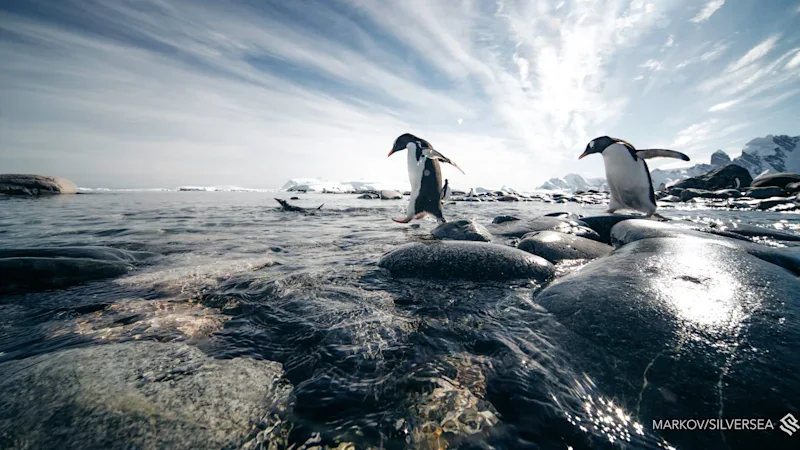
A few decades ago the prospect of icy Antarctica catching fire may have seemed like science fiction, and rather far-fetched science fiction at that.
It’s now a live option, according to Australian scientists who have found evidence of grass spreading across parts of Antarctica in response to human-induced climate change.
Science reporter Angus Dalton details the new research in The Sun-Herald today that shows invasive grasses are competing with native vegetation in the Antarctic region.
The findings “raise the prospect of a dramatically and rapidly changing Antarctic region, and in particular this prospect of fire”, said Professor Melodie McGeoch, an ecologist from Monash University who supervised the research.
Fires are already striking the Antarctic, Dalton reports. In January 2025, a wildfire burned 55 per cent of Amsterdam Island, an island of the French Southern and Antarctic Lands, and in 2024 a fire also burned on Bird Island in the sub-Antarctic.
The complexity of the world’s climate systems means that it’s not a simple story, and the Antarctic isn’t necessarily “greening”. There won’t be sheep farms at the South Pole any time soon.
“Every single island is undergoing its own mini-climate change,” said Monash University PhD student Noemie Sheppard, who led the research.
“Some are drying, some are wetting, some are increasing in temperature, so all the grasses across these islands are undergoing different changes.”
The local effects of global warming are diverse but a common thread is the natural world straining under the stress of rapid change, more wild weather and more heat.
The expanding Antarctic grasses are one part of the puzzle showing the effects of rising temperatures. Another piece is the unprecedented heatwave that swept Europe last month, leaving thousands of people dead. Another, the huge El Nino that is likely to drive temperatures even higher later this year.
It is perhaps understandable that some people might look at the bigger picture of advancing climate change and feel resignation, even despair. But the best response to risk is to take action.
Multinational efforts to slow climate change by cutting emissions and adapting to some of its effects continue, despite setbacks. In recent years, gains in renewable energy deployment have often been wiped out by sudden policy reversals. Progress is too slow.
How is Australia faring in this effort?
It is a mixed picture. As a major exporter of fossil fuels, the nation is helping to fuel the crisis. It has sometimes played a laggard role in international negotiations, holding back stronger action.
On the plus side, Australia has made some strides in cutting its own fossil fuel use. It has proved that emissions can be “decoupled” from economic growth.
Since 2005 – the baseline year for measuring emissions under the Kyoto Protocol – Australia has cut back its total carbon pollution by close to 30 per cent.
There are millions more Australians today than there were in 2005, millions more cars on the road, manufacturing output per person has stayed steady, and average net wealth per person has more than doubled.
This serves as an encouraging reminder that the naysayers were wrong, and their wild claims that cutting emissions would destroy our way of life were just so much hot air.
Yet most of the work remains to be done. Australia is again starting to veer away from the net zero trajectory it has pledged to achieve, and the next few years remain crucial.
Later this year Australia will co-lead the next round of international climate talks, alongside Turkiye.
It is an opportunity to galvanise global efforts to tackle climate change and make sure voices of those most directly affected – including those from Pacific island nations – are heard by policymakers.
Australia has a chance to make a real difference, and the world will be watching.
Jordan Baker sends a newsletter to subscribers each week. Sign up to receive her Note from the Editor.