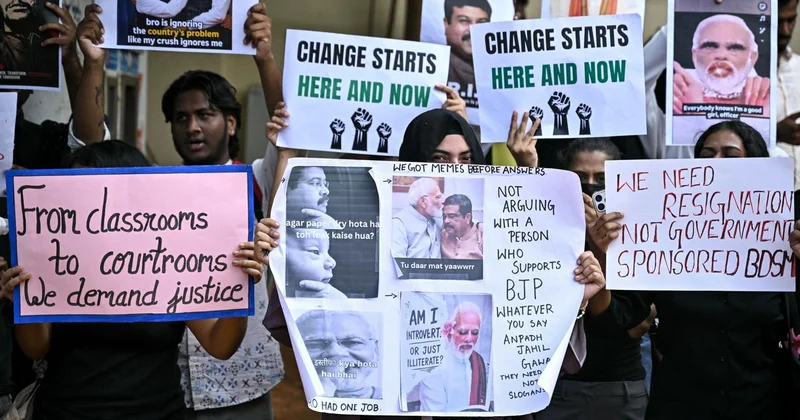
Gen Z has already passed the baton in India. After spotlighting the country’s broken public examinations through an unprecedented popular movement, it is Gen Alpha’s turn to lay bare even deeper layers of dysfunction of India’s education system. There’s a message for the world in all this, and it better listen, because India’s education crisis is a global problem.
School students have picked up where the “cockroach movement” left off last month when nationwide youth protests that began with a satirical campaign triggered by question paper leaks and unemployment forced the Narendra Modi government to let go of its education minister whose resignation the cockroach activists had demanded.
This month, frustrated school-goers in many states have decided it is their turn to push back.
They are not asking for much, just the basics that the Indian state still fails to provide nearly 80 years after Independence.
So, in Uttar Pradesh, they are marching with national flags demanding the construction of a long-overdue road leading to their school. The principal of a government school for hearing and speech-impaired students in Rajasthan was suspended after the students staged a protest against the lack of decent toilets and proper classrooms.
In Madhya Pradesh, schoolgirls are protesting a bus fare hike they say has made their daily commute a burden on their families. In Maharashtra, students have been staging an indefinite sit-in demanding teachers.
Most government schools, on which the country’s poor depend, function with barely any teachers, proper ventilation, functioning toilets, desks, science laboratories, or libraries. This leaves students of these schools poorly equipped to compete with those who come from families that can pay for their education, pushing them into menial and lower-order jobs almost by design.
India’s chronically low state investment in education and the growing dependence on private financing in the field thus replicate the existing class hierarchies rather than widening the base for inclusive development.
The trend has intensified in the last 12 years under Modi as the federal government’s outlay for education in the annual budget has declined from 4.6% in 2013-’14 to 2.5% in 2025-’26. An average of 25 government schools closed every day in India over the past 10 years while private equity is marching into Indian classrooms. The poor are being pushed out of quality education while even the middle classes struggle to meet the rising expenses to acquire it.
By the government’s own count, there are about 100,000 schools that operate with one teacher, who are in any case burdened with administrative duties and sundry government assignments, such as election duties, which leave them with little time to teach.
The result is telling. A parliamentary panel report this week found that nearly 73% of students enrolled in government and government-aided schools dropped out before completing their higher secondary education. The country faces a deepening learning crisis.
According to the World Bank, it has the highest percentage of Grade 2 students in the world who cannot perform a simple two-digit subtraction, and comes second after Malawi in a list of 12 countries with the highest percentage of Grade 2 students who can’t read a single word of a short text.
The examination paper leaks that triggered the cockroach movement comprised only one layer of systemic breakdown, but it does not even scratch the surface of the real scandal of India’s thoroughly broken education system.
And therein lies the source of many of India’s ongoing struggles, not the least its failure to produce highly skilled workers and innovate up the value chain, its depressed productivity, and limited real wage and consumption gains, resulting in its economic engine stalling. India’s economic growth has been collapsing, the currency has been in free fall, dragging it down from its status as the fourth largest economy to the sixth, foreign investors are taking their money out, Indian capitalists are refusing to invest at home, and industrial dependence on China is increasing.
As growth slows, graduates are struggling to find jobs – nearly 70% of India’s unemployed youth are graduates, the percentage doubling in the last two decades. Wages have been stagnating for years, household savings are falling and household debts are rising. Agriculture now employs a greater share of workers than it did five years ago, a reversal that in fact points to deindustrialization. Reverse migration of labour from factories to farms, a sign of distress in the labour market as well as economic reversal, has been steadily increasing in the past decade.
Education is hence no longer a ticket to upward mobility as quality jobs become scarce with the economy not deepening enough to deliver broad-based prosperity. Only one in 20 in the 15-29 age group hold regular salaried jobs with contracts and social security, the rest are either unemployed or toil in the shadow of informality, even outright slavery.
Deepening inequality
Higher the income bracket, greater the ability to buy quality education and escape precarity. Inequality is thus deepening in the world’s largest democracy – the country being more unequal now than it was under the British. Indians are the least likely among peer countries to break out of the education and income bracket into which they are born, according to the World Bank.
These structural constraints limit both India’s economic rise and the extent to which its growth translates into all-round development, preventing it from becoming a global engine of growth. Non-inclusive growth hinders economic development as it concentrates gains in a narrow segment of society, which weakens demand, limits human-capital formation, suppresses wages and purchasing power, gives firms less incentive to expand and invest, and makes growth less durable. All of these pathologies are now evident in India.
Decades of policy choices neglecting human development, especially education, are coming home to roost, with Modi’s unfettered neoliberalism dealing the final blow. For several decades now, the world has looked to India as an emerging economic powerhouse that would benefit the global economy by adding a large new engine of growth, innovation, trade, and demand. This is because India grew at an unprecedented pace for nearly three decades, lifting hundreds of millions out of poverty.
But the country’s skewed growth model may finally be coming apart for neglecting the basics like education. As India turned 79 this Independence Day on August 15, India’s young offer a reality check. By exposing the deep rot in the education system, the cockroaches are telling the world that India is failing, and is unlikely to live up to the expectations once placed on it.
That’s bad news for everybody, not just Indians.
Debasish Roy Chowdhury is a journalist, researcher and author based in Hong Kong, having recently co-authored To Kill A Democracy: India’s Passage to Despotism, OUP/Pan Macmillan.
This article first appeared on the Toda Peace Institute website.
We welcome your comments at letters@scroll.in.