How China's marine farming model can reshape Iran's coasts
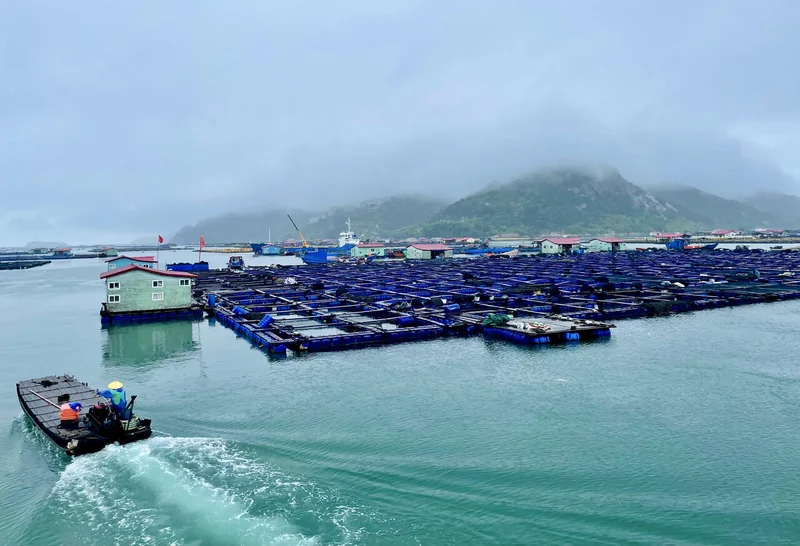
TEHRAN- Two years ago, on a spring morning in May 2024, I stood at the Sandu'ao Port in Ningde, Fujian Province, alongside a group of journalists from across Asia. What I witnessed that day was far from ordinary—a vast, industrial-scale aquaculture operation stretching across the sea, built on foundations of advanced technology.
Today, that experience remains a powerful reference point for understanding the future of fisheries, particularly for a country like Iran, which possesses rich marine resources but has yet to harness their full potential.
China's transformation in marine aquaculture offers critical lessons for Iran's coastal development. This is not about mere translation but about extracting the strategic blueprint behind the success.
From wood to plastic: The infrastructure revolution
Sandu'ao Bay's ideal geography and water quality have long made it a haven for the prized large yellow croaker. However, the leap to becoming the country's largest production base began with a decisive policy shift in 2018. Ningde City initiated a large-scale upgrade, replacing traditional wooden cages and foam floats with environmentally friendly plastic cages and advanced floating structures. In total, approximately 1.427 million aquaculture facilities were reorganized or upgraded, marking a significant standardization of marine infrastructure.
For Iran, with its extensive coastlines along the Persian Gulf and the Sea of Oman, this is the first critical takeaway: transitioning from traditional methods to modern, sustainable infrastructure is a feasible necessity.
Green energy: Powering a cleaner industry
One of the most compelling aspects of Ningde's model is its integration of renewable energy. A pioneering project, developed in partnership with the new energy giant CATL, has established a microgrid system at the aquaculture sites. This system combines vertical and horizontal wind turbines, floating solar panels on the sea surface, and rooftop solar arrays to provide a stable, clean power supply.
The project generates approximately 280,000 kilowatt-hours of clean energy annually, reducing carbon dioxide emissions by an estimated 244 tons. Crucially, battery storage systems resolve power outage issues, ensuring uninterrupted oxygen supply for the fish. For Iran, which faces energy challenges in its southern coastal regions, this model is directly relevant. Adopting floating solar and offshore wind to power shrimp and fish farms in provinces like Hormozgan and Bushehr could reduce costs and environmental impact.
Economic growth: Beyond the sea
The transformation in Ningde has extended far beyond environmental improvements. In 2025, the value of the large yellow croaker industry in Ningde exceeded 20 billion yuan (approximately $2.9 billion), producing over 222,000 tons of fish. Today, 8 out of every 10 large yellow croakers consumed in China come from this region.
Furthermore, China has used technology to extend this industry to inland areas. Through a Fujian-Ningxia partnership, the large yellow croaker has been successfully introduced to land-based farming systems in the Helan Mountains of northwest China. These systems use temperature control, water quality management, and automated feeding, demonstrating the adaptability of modern aquaculture technology.
For Iran, this demonstrates that the fisheries sector can become a major driver of economic development, creating jobs and enhancing food security.
A model for Iran's future
My visit to Sandu'ao revealed that this transformation was enabled by three key factors: coordinated policy (initiated in 2018), investment in technology (from plastic cages to renewable energy), and national will (strong public-private collaboration). Research already indicates that the southern coasts of Iran hold significant potential for aquaculture. The experience of Ningde offers a roadmap for Iran to develop its own sustainable fisheries industry, adapting these lessons to local conditions.