How Iowans feel about Trump's tariffs, Canada's treatment as Republicans vie for support
Trump dominated Iowa in 2024, but Canada is state's largest export market
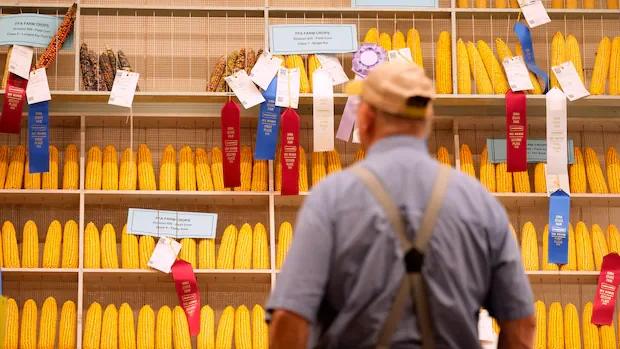
This weekend, hundreds of thousands of people are attending the Iowa State Fair — a major attraction featuring several days of entertainment, a rodeo and even a life-size butter cow that's been carved every year since 1911.
Much like the Calgary Stampede in Canada, the Iowa State Fair is a crucial stop for politicians to meet voters, making it a hotbed for political debates — especially when U.S. midterms are coming up.
And this year, one of the topics on Iowans' minds is U.S. President Donald Trump's trade war.
"This policy has been very chaotic, and our farmers have struggled to figure out what's going on," said Aaron Lehman, a fifth-generation family farmer and president of the Iowa Farmers Union.
"If we were getting to a situation that meant fairer trade eventually for farmers, I think farmers would understand that sometimes it's necessary to go through some pain. But we're not seeing us getting any closer.
"We've lost many international customers of ours who no longer see us as reliable trade partners and they're going to countries where they have a more predictable trade policy, more reasonable trade policy."
For farmers like Lehman, that economic pain may reach another level in just a few days. Canada is Iowa's largest export market, accounting for 30 per cent of the state's total goods exports in 2025, according to the U.S. government.
But that key trading relationship could be upended on Aug. 19, if Trump imposes his threatened 50 per cent tariffs on hundreds of Canadian goods. The two countries are working over the weekend to secure a trade deal, but it so far remains out of reach.
Lehman told CBC News he's trying to bring his son into his farm's operations, but with so much economic chaos it's difficult to plan any kind of succession. Instead, he's had to hunker down and focus on getting the next crop planted and harvested.
"So it's a scary time for our farm," Lehman said.
Trump 'pushed a lot of people away'
Other farmers who spoke to CBC News in Iowa also expressed concern about Trump's economic agenda, especially toward Canada.
Jack Ploen, who farms about 80 hectares in Avoca, Iowa, said Canada is "our most valuable partner in the world and in the trading sector."
"I'm a Republican, but I think Donald went too far in some of the things he does," Ploen said. "And he's pushed a lot of people away. A lot of countries are standoffish with us because of his policies. I support some of what he does, but not everything."
WATCH | U.S. Trade Representative Jamieson Greer on irritants with Canada:Lehman said Trump's economic policies are damaging his relationship with Iowa farmers, and it's showing up in political polling ahead of the midterm elections in November.
During the last gubernatorial race in 2022, the Republican candidate Kim Reynolds beat the Democratic challenger by more than 200,000 votes. In the 2024 presidential election, Trump won the state by a similar margin — a huge victory.
But in 2026, polling suggests Democrats are either in the lead or very competitive in key races, such as the ones for Iowa governor or U.S. senator.
"All indications are that conditions are extremely difficult," Lehman said. "Farmers, ordinary families are all struggling to get by, and so our races are very, very competitive for the first time in a number of years."
Trump official in Iowa defends tariff tactics
On Friday, at a manufacturing facility in Iowa, U.S. Trade Representative Jamieson Greer touted Trump's economic strategy and said the U.S. government is committed to making American industry competitive with tariffs and tax cuts.
"We're seeing a transition from an economy that was focused on government spending, government jobs, subsidies for all these different programs… to an economy that's focused on American workers," Greer said.
Iowan Republicans serving in the U.S. House and Senate have tried to straddle the line on Trump's tariffs. In February, all four House representatives voted to uphold Trump’s tariff authority, but one of the four — Zach Nunn — said he could see himself breaking ranks on the issue.
Ashley Hinson, the Republican nominee in the 2026 U.S. Senate election in Iowa, has previously said the Canada-U.S.-Mexico Agreement should be renewed but some changes should be made for fairer market access.
On Friday, Iowa Sen. Chuck Grassley told The Canadian Press that Trump is likely using his tariff threat against Canada as a lever, and the Canadian government should view his moves as a wake-up call to make changes.
Grassley said there's nothing wrong with Canada and the U.S. having tough negotiations, but they can't be allowed to undermine the trilateral trade agreement known as CUSMA.
"These negotiations cannot be used as a way of destroying [CUSMA]," Grassley said.
Where Canada-U.S. talks stand
Despite a flurry of negotiations toward a tariff deal this past week that were expected to stretch into this weekend, sources tell CBC News that Canada and the U.S. remain far apart as Trump's deadline looms.
The sources said the federal government does not believe a tariff deal is imminent because there are still major disagreements between the two sides.
One source with knowledge of the talks said optimism on the Canadian side is eroding and the Americans are not budging from their latest offer.
That offer includes a proposal that could see the sectoral tariffs on autos halved to 12.5 per cent, an offer that the Canadian side believes is not good enough, the source said.
On Friday, Canada-U.S. Trade Minister Dominic LeBlanc briefed his provincial and territorial counterparts on the state of the negotiations. He also held a separate briefing with members of the prime minister’s advisory committee on Canada-U.S. economic relations. The sources are familiar with the briefings but were not authorized to speak publicly.
The federal government has told the provinces to be ready as soon as possible to put American alcohol back on the shelves in case a tariff deal is reached, sources said.
WATCH | Former Conservative leader Erin O'Toole on Canada-U.S. trade talks:In addition, the federal government has also asked provinces and territories to be prepared to drop retaliatory procurement rules that favour Canadian suppliers in case a deal is made, the sources said.
Trump cited complaints about provincial booze bans, dairy import quotas and the auto tariffs in threatening the new tariffs.
Industry sources previously told CBC News that Canadian negotiators have aggressively made it clear they see the Aug. 19 date as a cliff-type moment, meaning there would be no political appetite among Canadians to keep talks going if the 50 per cent tariffs come into force.
With files from Kate McKenna, Kory Siegers, Phillip Ling and The Canadian Press