Letting go of prized possessions can be tough. Let the professionals help, experts say
People want to find someone who will truly appreciate the items they're parting ways with, experts say
The struggles of downsizing and finding new homes for precious items
When Susan Masi sold her Surrey, B.C., townhouse earlier this year to move in with her son and grandchildren, she knew she’d have to get rid of some things precious to her.
Like the China cabinet her mother gave her when she got married. Or the mahogany dining table she inherited from her great-grandmother that is believed to be at least 126 years old.
Parting ways with items that hold so many memories is difficult, Masi says.
“We sat 12 people around that table. It breaks my heart to let it go, but this is the house I'm living in now. There's no way that it fits,” the 79-year old widow told The Current guest host Rebecca Zandbergen.
Masi says she had to let go of a lot of things like furniture, dinnerware and knickknacks.
“I ended up with hardly any of it. Now I’m in a modern house with two small children,” she said.
Choosing to give away something you own can be a difficult and emotional decision, says June Cotte. The Western University marketing professor says it can feel like throwing away part of your identity.
“Getting rid of a cherished object is getting rid of what someone thought defined them and was important to them,” said Cotte, who studies consumer behaviour and is a former president of the Association for Consumer Research.
Canada’s aging population means more people could find themselves in a similar position. According to a 2024 Statistics Canada report, about one in four Canadians will be 65 or older by 2030. A RE/MAX survey this spring found that among Canadian respondents aged 65 or older, 16 per cent said they plan to downsize their home within the next 10 years.
Cotte says people usually first turn to family or friends to take their precious items, which can lead to difficult conversations.** **
Often people hold on to items they could give away because they haven't found a worthy recipient, Cotte says.
“They don't think that anybody will appreciate it, so they hold on and defer the decision until it's actually too late."
Hiring help to clear out
Cotte says some turn to agents to help them find new homes for their objects.
Masi hired Vancouver-based company Estate Sales by Christine Caroline to help her deal with her belongings. The company’s founder, Christine Valk, has been in the business for 15 years.
Together they determined which items were valuable enough to be auctioned off and what needed to be discarded. Masi says the company also made an effort to figure out what could be recycled or donated so those items could get a second life.
Cotte says it’s important to have a strategy for downsizing, especially when it comes to larger items. She recommends people start giving things away while they’re still alive or before a move.
Younger generations are set to inherit an unprecedented amount of stuff, but Cotte says older Canadians may be surprised by how little people are willing to pay for their precious items.
It’s one of the challenges some older Canadians face when downsizing, she says.
“I think the younger generations are more aware that spending money on life experiences is probably going to be more happiness than buying more and more stuff,” Cotte said.
The resale market
Yet some of these cherished items will find new owners — it just takes a few steps to connect them with the right buyers, says Christopher Reid, CEO of MaxSold, an online auction platform used for estate sales and downsizing, based in Waterloo, Ont.
He says vintage buyers are interested in things from a different time that have history.
“They might not sell how they would’ve sold when those styles were very prevalent in North America, but they still sell and go on to have another life,” Reid said.
For example, Reid pointed to the rising popularity of things like CDs, vinyl records and old school radios.
However, Reid says a lot of people don’t have the time or desire to take steps, such as getting items evaluated and authenticated, preparing auction listings and taking photographs, so they turn to companies like his.
A chance to look back
Masi says she knows some of her possessions will have to be thrown away, but she didn’t have the heart to do so herself.
“This has all been quite traumatic to make this move at this time stage in my life,” she said.
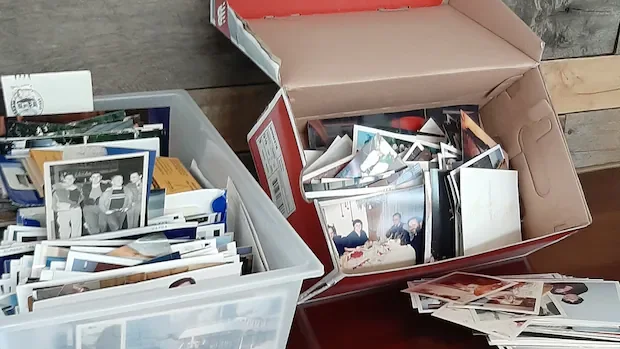
Masi says she’s spent a lot of time deciding what means something to her and what she’s OK to let go. But it’s been almost impossible to figure out which photos — of family gatherings and dinners — to part with.
“I don't know what I'm going to do with them, but I can't let them go,” Masi said.
Despite the emotional toll of the work, Masi says it’s special to be able to look back at 56 years worth of memories.
“I'm blessed really when I think about it and all the people that sat around that table and the fun we had."
Interviews produced by Enza Uda and Ines Colabrese