Patch Notes is a weekly newsletter bringing you the best of Polygon, sent on Fridays and published on the site on Sundays. You can subscribe here.
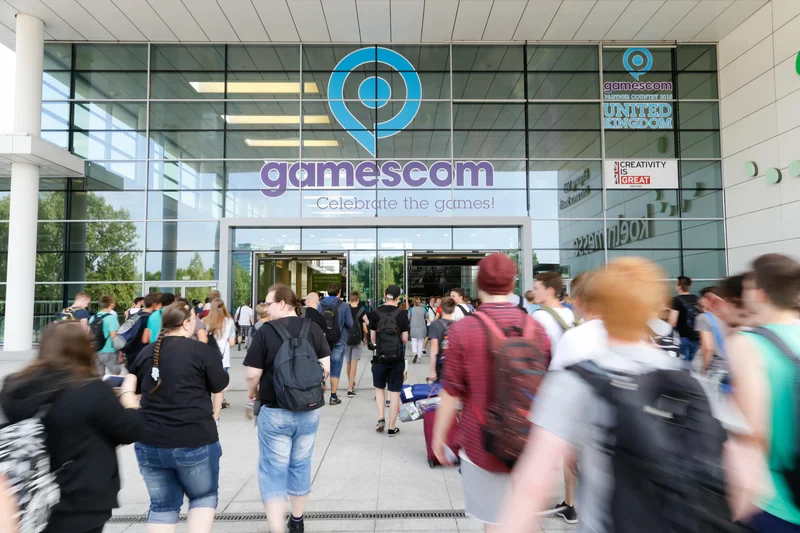
Gamescom is just around the corner, which means previews of video games due in the late summer and fall are now coming thick and fast. This is a different moment in the video game year to the trailer-focused hype-fest of the early summer. We're getting to the business end of things, and it's all about tangible prospects and playable code. That's where Gamescom, the German gaming convention, has always excelled — and one reason it's still standing after E3 has fallen by the wayside.
More about that after the jump, but first, check out these two meaty previews based on big chunks of time with two particularly exciting tactics games.
The fall of E3, and what came after
When E3 collapsed — in fact, a little bit before it did — Geoff Keighley swooped in to replace it with Summer Game Fest. Just like E3, Keighley's show takes place in June, in Los Angeles. Just like E3, it acts as a hub for game companies to organize their big summer showcases around, albeit much more loosely. There's an in-person event where journalists can preview games (on a much smaller scale than E3) and Keighley organizes his own showcase where publishers and developers can debut their trailers for a fee.
From a certain viewpoint, Summer Game Fest seems to fill E3's shoes satisfactorily. There's hype, there's conversation, there's a lot of trailers. The effect is more diffuse and draw-out than it was in E3's heyday, but the early-summer date still works perfectly for most publishers' PR plans. As a place to debut new games, it's only rivalled by Keighley's own Game Awards in December.
Viewed from within the industry, though, Summer Game Fest is almost a non-event – because it is, in the literal sense, not much of an event. There is scant reason to travel to L.A. for it, especially for those outside the media. It is mostly virtual and transactional — a giant advertising billboard, and not much more.
This is exactly what E3's critics used to say about that show, and there was a grain of truth to it. But E3, before its dismal final years, was still a real convention, too — a big one, and a pretty good one. Everybody was there. The media blitz was backed by thousands of real meetings between real people, some planned weeks or months in advance, some on the hoof, some totally by happenstance. The industry got together, made connections, had conversations, and authored a narrative about itself. That's still promotion, but it's of more substance than a mere ad reel.
The rise of Gamescom
All of this still happens — at the end of August, at Gamescom in Cologne, Germany. Gamescom isn't quite what E3 was. It's actually much bigger, in terms of attendees, because it's open to the public. There is a showcase event (Opening Night Live, hosted by Keighley, again), but there aren't as many new game reveals as in June. If E3 and Summer Game Fest are about exciting glimpses of distant prospects, Gamescom is all about concrete stuff, playable code, much of it for games releasing in the next two or three months.
Gamescom doesn't register on the internet hype scale in the same way. But for the industry, it has become the main attraction. Gamescom has survived COVID and the general events-industry meltdown that followed in remarkably good health, partly because it was in much better shape than E3 before the pandemic hit.
Well-organized and undisturbed by the industry politics that sunk E3, Gamescom was regularly attended by all the industry heavyweights — Sony, Microsoft, Nintendo, EA, Activision — long after some of them turned their backs on E3 or made only conditional commitments to it. That remains true now, and gives it a credibility no other gaming convention can match.
It helps that Gamescom's focus on PC gaming, seen as niche during the Peak Console (and Peak E3) years of the 2000s, has moved it closer to gaming's cultural epicenter in the years since. The show is always well-supported by massive PC gaming companies, like Riot and Blizzard, who scarcely touched E3 with a bargepole.
The latest and perhaps most remarkable chapter in Gamescom's rise is that it is beginning to edge out the increasingly confused Game Developers Conference as a place to do business. A contact at a major publisher tells me that Gamescom is now a much nicer and more fruitful place to take meetings than the San Francisco convention.
The hype cycle may exist primarily on the internet now, but that's only one part of a convention's job. The other is to give the industry and community a place to meet, to take each others' temperatures, to celebrate a shared passion, and to form an image of themselves that can then be broadcast to the rest of the world. That can only be done in person. And, right now, for video games, there's only one place to do it: in Cologne, the week after next. See you in Germany.