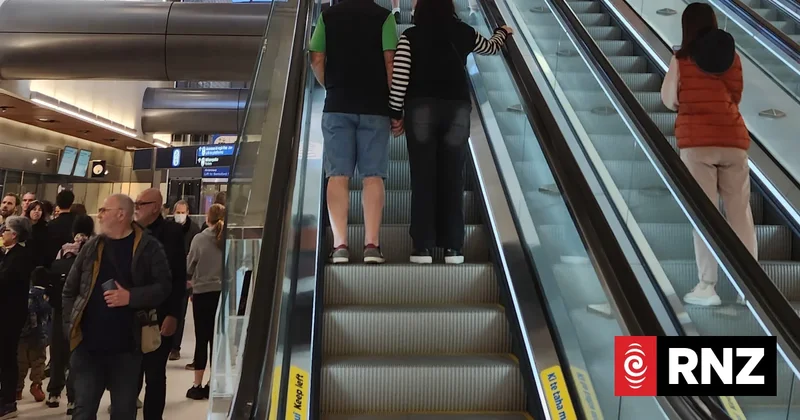
A transport advocate says Auckland risks not making the most of its multi-billion-dollar City Rail Link investment because of an ongoing trial to allow more cars in the city centre.
Since April this year, Auckland Transport has been trialling allowing cars on Queen Street, beween Wakefield and Wellesley Street, from 7pm to 7am.
Heart of the City pushed for the change and said banning cars on Queen Street was hurting economic recovery for businesses in the area post-Covid.
But others said keeping the area car-free would make it more inviting for the influx of pedestrians the new Te Waihorotiu station was expected to bring.
Connor Sharp, from urban advocacy charity Greater Auckland, is really excited about the soon-to-open City Rail Link.
"I mean, I'm wearing a shirt that says all the station names, so yeah I'm super excited. People are going to be really happy, and I think they're going to be asking 'what's next?'"
The $5.5 billion project will open on Sunday, 13 September, and bring two completely new underground stations to Auckland's rail network.
One of the stations is Te Waihorotiu, which has entrances on Victoria Street and Wellesley Street.
Sharp feared AT's trial put the benefits of CRL at risk in that area.
"If we want to make the most out of City Rail Link, we need to reallocate space on these streets to better suit what the city will now look like," he said.
AT has also been trialling running a new bus lane on part of Wellesley Street from 7am to 7pm, instead of 24/7 as had previously been considered.
Sharp said the changes made the area less appealing for pedestrians coming out of the new CRL station, and clogged up the key Wellesley Street bus corridor.
"If you want to come to town to get a drink maybe and you want to get home, you want to know that your public transport's going to be reliable right? And since we're not operating in that evening period, it's going to be difficult to run those better services."
Across town, property developer Steve Bielby has been renovating the St James Theatre, which sits just off of Queen Street.
Bielby supported the AT trial, and said it had made the area around St James safer.
"Bringing those vehicles back actually brings thoroughfare, it brings people, it brings atmosphere... I guess when you've got those sort of nefarious activities happening, the best way to stop them is to actually shine a light on them."
The main problem with Queen Street being pedestrianised was that nothing was brought in to replace the cars, he said.
"So you just created this void, and then a whole lot of businesses closed and it becomes this self-fulfilling prophecy, and now we've got an empty tenancy problem."
Heart of the City Chief Executive Viv Beck did not want to be interviewed for this story, but said in a statement that feedback from business and visitors alike was that the Queen Street Authorised Vehicle Zone was confusing and had reduced foot traffic and spending.
Emails between Viv Beck and Auckland Transport seen by RNZ showed Heart of the City pushed strongly for the changes made in the trial.
Sharp felt voices like Heart of the City were often prioritised over others.
"Every time we have consulted on changes that give more priority to people, or give more priority to public transport, the consultation always comes back with overwhelming support."
An Auckland Transport spokesperson said it had listened to feedback from a wide range of people, businesses and community groups when developing the trial.
The spokesperson said the trial had had positive results so far, with no significant pedestrian safety concerns. AT would continue to monitor things as the City Rail Link opened.