In 2014, the Bihar Staff Selection Commission notified vacancies for various positions, including forest guards, assistant sub-inspectors, lower division clerks and stenographers. The written examination was conducted in 2018, and the results were declared only in 2022, eight years after the posts were first advertised.
Rakesh Chandan (name changed), 32, from Patna, was among those who took the examination. By the time the results were announced, he said, many successful candidates had become ineligible to join because they had crossed the age limit prescribed for recruitment.
In 2012, Prashant Pandey (name changed), 37, from a small town near Dehradun in Uttarakhand, cleared the written examination for the post of sub-inspector in the Indo-Tibetan Border Police (ITBP). He was found to be 2kg short of the required weight and was asked to undergo another medical examination. However, the call for the follow-up medical test never came. Three months later, he was informed that the recruitment process had been indefinitely postponed.
The experience left him devastated. He says he never found the confidence to sit for another competitive examination.
The common thread linking these two stories, separated by more than 1,000 km, is the frustration that the Congress is seeking to bring together.
The deep listening
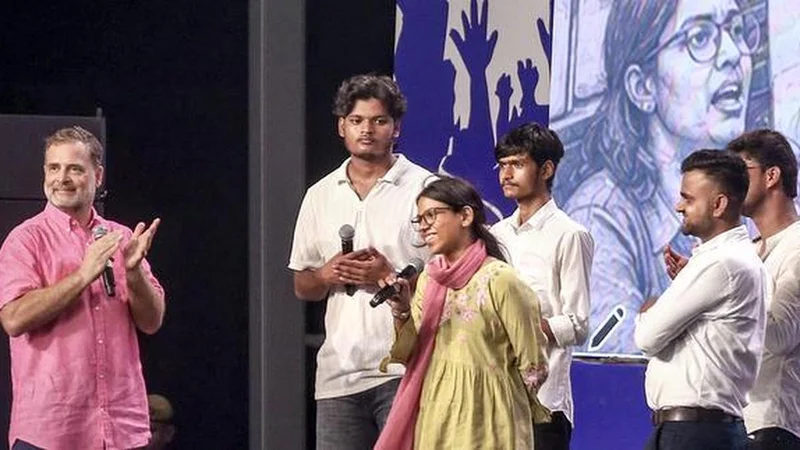
Since June, the party has been reaching out to aspirants preparing for public recruitment and educational examinations, including NEET, as part of its “Chhatron Ki Goonj” initiative. Leader of the Opposition in the Lok Sabha Rahul Gandhi has addressed three public meetings under the campaign, in Kota, Dehradun and Prayagraj. On Sunday, he announced another event in Pune on August 22 that will focus exclusively on women aspirants.
The “deep listening” that takes place during these closed-door sessions, a Congress leader said, forms the basis of Mr. Gandhi’s events. The aspirants invited to share the stage with him also emerge from these interactions.
So far, 16 focus group discussions have been conducted in Delhi, Patna and Dehradun. The decision to focus exclusively on women aspirants, for instance, the leader pointed out, emerged from these conversations, during which female candidates spoke about the greater odds they face, including a narrow window to pursue their careers owing to the “looming deadline” to get married.
A senior party leader involved in the initiative said each focus group was curated to bring together participants from different caste, class, gender and geographical backgrounds. The organisational capacity built during the 150-day “Bharat Jodo Yatra”, between September 2022 and January 2023, is now being deployed for the campaign, the leader said.
“These discussions are, in a way, an extension of the Bharat Jodo Yatra. One of Rahul Gandhi’s biggest takeaways from the yatra was that young Indians were increasingly focusing on just five professions. He has reiterated this point several times and has underlined how the system has broken down for many young people,” the leader said.
The party plans to expand the exercise to other cities, although for now, the effort will remain concentrated largely in the Hindi-speaking belt.
A familiar pattern
The discussions follow a familiar pattern. Participants speak of inheriting aspirations for government jobs from their families, the years spent preparing for examinations, the money invested in coaching centres, and the repeated setbacks caused by paper leaks and delayed recruitments. Many describe how these experiences have transformed them from hopeful aspirants into unemployed youth.
The closed-door discussions are recorded, documented and analysed, creating a catalogue of grievances.
Published - August 16, 2026 10:44 pm IST