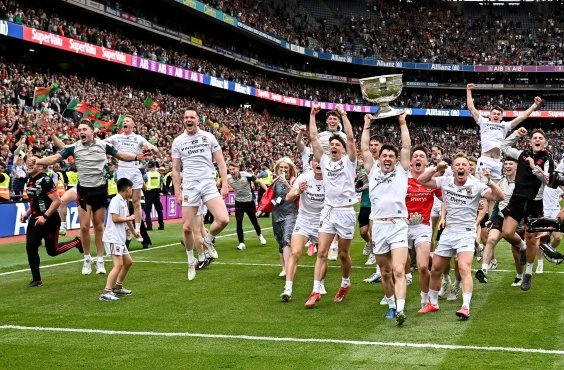
The story gods have been good to me in my decades of typing for a living. But never better than with the Mayo football tale, which has consumed all of Ireland and me since the final 45 seconds or so of the historically downtrodden team's July 26 All-Ireland championship win over supposedly unbeatable Kerry. I knew even in the moment that getting to watch Mayo end its 75-year championship drought in person was a privilege. And it's left me ruined for other sporting events for now and maybe forever.
I wore my media bracelet, saying “Croke Park 26-7-26” for a week before cutting it off because I could smell it. But I can’t let go of what took place. All I want to talk (and write) about is the match. I’m still weepy every time I watch the highlight reels or hear the Mayo fans in the stadium sing “To Win Just Once” or “The Green and Red of Mayo.” And I watch and listen a whole lot. You should too!
Here are some of the broadcast calls. Take ‘em in. You don’t need to know a dang thing about the rules or history of the game to get caught up in the euphoria and understand my “What do I do now?” state. Just click play.
“Oh my god! Oh my god! Delirium! Delirium!” yelled Stephen Grealis, a commentator for Midwest Radio, as the final seconds ticked off. “The famine!!! The famine is over!!!! The famine is over!! The curse be damned! Hit the nuclear button!!! Mayo have won the All-Ireland!!” His colleague in the booth, Martin Carney, shrieked through a hilarious comparison of Mayo’s win and Neil Armstrong’s original moon walk that he just had to get out. “He uttered the immortal phrase, ‘One small step for man, one giant step for mankind!’” said Carney. “Today this is a giant step for Mayo football! This is remarkable! A team of heroes, invincible! This is simply wonderful!” Carney started crying when his commentary was first played back for him a few days after the match. As I watch this, I’m crying too, Marty! Everybody’s crying over what Mayo did!
Grealis and Carney, who are famous now for their lunar and famine calls, are part of Mayo’s hometown broadcast, so you’d expect over-the-top euphoria. But their level of rapture was the rule, not the exception, among all commentators. “Holy God!” screamed Thomas Niblock, the wondrous lead presenter of BBC’s football programming, as the impossible became real. “Of all the things we’ve seen in our lives, has this topped the entire lot?”
Then there was Marty Morrissey on the GAA’s flagship broadcast on RTE, Ireland’s government-owned national network. “All the jokes about Mayo being losers–delete, delete, delete!” Morrissey said. “This hasn't happened in seven decades and five. Generations of Mayo people have lived and died and not seen what you are now seeing on your television screens. But wherever you are in the world right now, you are with us in Croke Park! This.. is...happening!”
Morrissey’s euphoric call was heard by essentially all of Ireland. The RTE telecast averaged a reported 82 share, meaning 82 percent of available viewers were tuned in. That’s a higher share than the 2026 Super Bowl, which according to Neilsen registered a reported 80 share in the U.S. (The great Robert Seidman, a ratings guru who founded the website TV By The Numbers, told me he’d guess that the only programming in America to ever draw a share here higher than the Mayo match got in Ireland was…coverage of Armstrong’s moon landing, though he added: “I would chalk that up mostly to pond size.”)
I’ve read and re-read all the printed write-ups of the match and its meaning, also. Their words are as over the top as the broadcasters’.
“Was Mayo winning the All-Ireland the greatest thing that ever happened?” the Irish Examiner asked its readers in a July 31 headline.
“Mayo's thrilling victory united a nation,” read the headline of an August 2 thinkpiece in the Irish Times.
From the same paper: “Mayo's win was one of the most joyful national episodes since the foundation of the Republic,” headlined another Times story. And this hyperbole isn’t coming from sports bloggers. The latter essay was written by Keith Duggan, now the U.S.-based White House correspondent for the Times. In a former life, Duggan was an acclaimed sportswriter who authored House of Pain, the 2007 book that became the definitive work on the Mayo football team’s standing as the biggest loser in Irish sports history. Mayo went winless in seven more finals matches after the book.
With every viewing and re-reading I pinch myself. What a story!
Back to me and the story gods: I got into Mayo football after being contacted by producers with the BBC in 2022 and asked if I’d be interested in working on a production about Gaelic football.
I’d been a recreational fan of GAA my whole life, and had for years subscribed to a streaming service that brought hurling and football matches around the world. (It’s still the only stream I pay for.) I still don’t know why the BBC hired me, but I figured I was going to get a trip to Ireland out of it. I learned the project was a podcast about the Mayo Curse, a legend that held the football team’s horrific losing streak was due to a spell cast on the county after their 1951 All-Ireland championship. On their way back home from Dublin, the story went, celebrating players drove through a funeral while riding in a bus or on top of a lorrie, thereby peeving a priest in the town of Foxford, who decreed that the punishment for disrespecting the dead would be that Mayo would never win a Sam Maguire for as long as any team member was alive.
Go to Mayo and look into it, said the producers. I was flying blinder than I liked when I got to Castlebar, the county town, in March of 2023. On my first night, early into a walk downtown, I came upon a supremely somber street scene, with men and women dressed in dark clothes lining both sides of a main street downtown and not saying a word. I figured it was some sort of protest or labor action, but when I asked a participant, I was told that they were all awaiting the arrival of a casket to a funeral home, and that this was a show of respect to the dead. I’d never seen any equivalent funeral rite in the U.S. and the solemnity was fascinating and new to me. All I’d ever heard about was the allegedly rowdy “Irish wake.” Given the podcast topic, I felt professionally and culturally lucky to see firsthand how seriously the Irish take funerals; now I get how a priest really could get peeved if drunk footballers made a mess of the ritual, or at least how a legend that this happened could take hold.
And I’m not any sort of spiritual dude, but the level of serendipity got a bit eerie a couple days later. Me and a podcast producer got lost while walking on those same downtown streets and carrying sound equipment. We were looking for Byrne’s Pub, the oldest bar in town, where we’d scheduled a few interviews with Mayo football knowers. I asked a guy who happened to be walking by us on the street for directions, and as he pointed us to Byrne’s he mentioned that the pub was the prime hangout in Mayo for the football team’s supporters. So I said, "Yeah, we’re actually here to work on a piece about The Curse," and that perked him up and got him explaining the origins of the spell. He said it’s all hogwash because funerals are a big holy deal in Ireland and nobody would ever disrupt a funeral the way the legend holds Mayo footballers did back in 1951.
And I said that makes sense to me now, because I’d just seen the aforementioned funeral scene on the streets of Castlebar earlier in the week, and described what I’d encountered. My tale startled him.
“That was my father’s funeral,” he said.
I think I heard horror movie music in my head at that revelation. What? And I run into you again? What are the odds? Then the sweet and friendly passerby, who I learned was a Castlebar native named Conor Waldron, got emotional telling us about growing up as a massive fan of Mayo football, just like his father, Billy Waldron, and everybody else in Ireland’s most football-obsessed county. He said the desire to win just once had been a bond always shared between him and his recently departed father. Waldron also said Dad thought The Curse was hogwash, just as he himself did. I agreed with him that of course all the curse talk is just foolish fun, ha ha! But…what’s the deal with a foreign guy looking into The Curse of Mayo randomly running into the son of somebody whose funeral he’d also randomly run into a few nights earlier and finding out everybody was bonded by Mayo football? We laughed at the coincidence binge, then we set up a microphone and interviewed Waldron on the street.
Fast forward to the fall of 2025, and I get an email from a Ruth Waldron from Castlebar. It says she’s got to tell me a story that’s been freaking her out for a few months. She had been driving in the city of Cork on the anniversary of her father’s death, thinking about and missing her father, and in hopes of getting rid of the acute sadness she turned on the radio “to distract me from the sadness of day.” She was expecting music but instead flipped to BBC radio which was airing a podcast about Mayo football, which brought her back to thinking about her father. “At about 4.30 minutes into the first episode I heard my brother Conor's voice come through the car speaker,” she said, “saying 'there's absolutely no way Irish people would disrespect a funeral.'”
Conor Waldron had never told Ruth about being on any podcast. Hearing him out of the blue talk on her car radio about funerals and Mayo football on the anniversary of her dad’s death weirded her out so much she had to pull off the road and call her brother up.
And in her email, Ruth attached a picture of her father at the 1951 All-Ireland Finals in Croke Park. That's the last time Mayo won a championship. That's the game game where The Curse originated. Me reading that email and seeing that photo was the closest I’ll ever get to that last scene in “The Shining.”
“Our dad would have loved this 'spooky' occurrence!” she wrote. “Curse or no curse, let's hope Mayo bring Sam home soon.”
And on July 26 in Dublin, in Mayo’s first appearance in an All-Ireland final since the last player from the cursed 1951 team died, that’s exactly what happened. And I was there, thinking a lot about Conor and Ruth Waldron and how much that was going to mean to them. I’ll never be the same. Thank you, story gods.