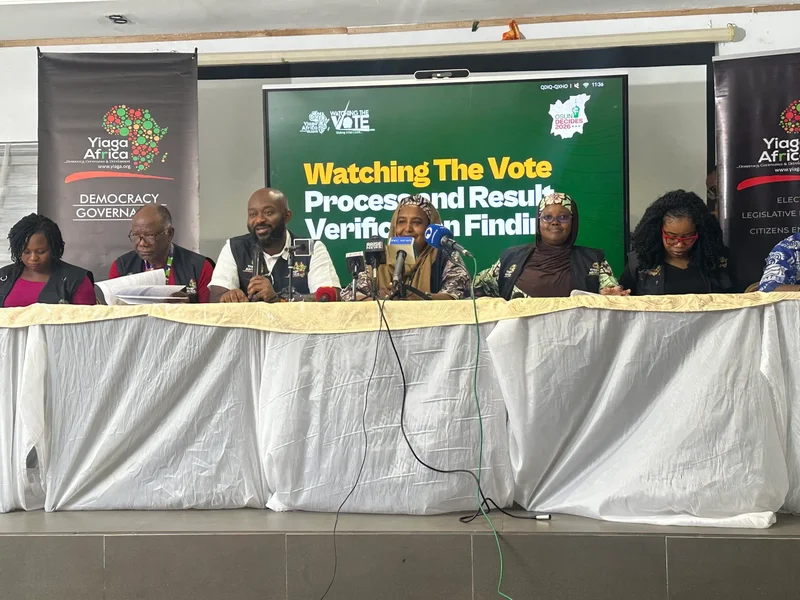
Election observer organisation, Yiaga Africa, has said the official results of the 2026 Osun State governorship election accurately reflected the ballots counted at polling units. However, widespread reports of vote buying and voter inducement raised concerns about the integrity of voters’ choices.
The organisation disclosed this on Sunday at its post-election briefing in Osogbo, hours after the Independent National Electoral Commission (INEC) declared the incumbent governor and Accord Party candidate, Ademola Adeleke, winner of Saturday’s election.
Adeleke polled 511,067 votes to defeat his closest challenger, Bola Oyebamiji of the All Progressives Congress (APC), who scored 444,815 votes. The result gave Adeleke a margin of 66,252 votes.
The governor won in 19 of the state’s 30 Local Government Areas (LGAs), while Oyebamiji won 11.
| | |
|---|
The result gave Adeleke 51.9 per cent of the votes, compared with 45.2 per cent for the APC, while Najeem Salam of the African Democratic Congress (ADC) polled 1.7 per cent.
Speaking on behalf of the organisation, the Chairperson of the Osun Election Observation Mission of Yiaga Africa, Asmau Maikudi, said the findings were based on reports from 289 of the 300 sampled polling units, representing 96 per cent of the sample.
She said Yiaga Africa’s Process and Results Verification for Transparency (PRVT) statistical analysis showed that the Accord Party should receive between 50.3 per cent and 54 per cent of the vote, the ADC between 1.4 per cent and 2.1 per cent, and the APC between 43 per cent and 46.8 per cent.
The official results announced by INEC fell within all three estimated ranges.
“Accord’s official result was 51.9 per cent, which is a match in comparison to Yiaga Africa WTV PRVT estimates,” Maikudi said.
“ADC official result was 1.7 per cent, while APC official result was 45.2 per cent, which is a match in comparison to Yiaga Africa WTV PRVT estimates.”
She added that no other political party secured more than 1.2 per cent of the vote.
According to Yiaga Africa, the consistency between its statistical estimates and INEC’s final figures indicates that the electoral commission’s announced results reflected the ballots counted at polling units.
“Had the results been significantly altered at the ward, LGA, or state collation centres, the official figures would have fallen outside Yiaga Africa’s WTV estimated ranges,” the organisation said.
It, however, cautioned that the finding should not be interpreted as an endorsement of every aspect of the election.
“The consistency of the results, therefore, speaks specifically to the accuracy of the tabulation of polling-unit results,” it said, while raising concerns over reports of vote buying and voter inducement.
How Yiaga verified results
Yiaga Africa said it deployed 300 stationary observers and 32 mobile observers across all 30 LGAs, alongside 30 LGA results collation observers, to monitor the election-day process and independently verify the results.
Its PRVT methodology uses a representative sample of polling units to assess election conduct and independently estimate the results. The organisation also used its Election Result Analysis Dashboard (ERAD) to track, aggregate and verify polling-unit results published on INEC’s Result Viewing Portal (IReV).
Yiaga Africa has previously used the methodology to independently assess whether official election results correspond with ballots counted at polling units. The organisation says PRVT is designed to provide data-driven verification of official results and strengthen public confidence in electoral outcomes.
For the Osun election, Yiaga Africa said its analysis was based on the number of registered voters, rather than the number of Permanent Voter Cards (PVCs) collected.
Logistics improved despite last-minute changes
The organisation said INEC and the security agencies largely passed the test of election-day preparedness, despite concerns that preceded the poll.
Yiaga Africa said the election was particularly important because it was the last major governorship election before the 2027 general election and one of the first major tests of the Electoral Act 2026 and the new regulatory framework governing election administration and results management.
It said INEC largely succeeded in deploying personnel and materials on time despite the disruption caused by a last-minute court order requiring the inclusion of the Social Democratic Party (SDP), which meant the commission had to reprint ballot papers and result sheets only days before the election.
According to the observer group, accreditation and voting had commenced in 48 per cent of sampled polling units by 8:30 a.m., rising to 96 per cent by 9:30 a.m.
Yiaga Africa said the performance compared favourably with the 2022 Osun governorship election, when accreditation and voting had commenced in 41 per cent of sampled polling units by 8:30 a.m. and 96 per cent by 9:30 a.m.
BVAS worked in most polling units, but biometric failures persisted
The organisation said the Bimodal Voter Accreditation System (BVAS) was deployed to all polling units it observed.
The technology functioned properly in 80 per cent of polling units and malfunctioned in 20 per cent. Yiaga Africa said the devices were eventually fixed in the affected locations.
It said the scale of the failures did not reach a level sufficient to undermine the election. However, there were cases in which the system failed to verify the biometric and facial details of elderly voters.
The organisation said 11 per cent of polling units recorded instances where voters whose PVCs had been successfully verified were denied accreditation because the BVAS could not authenticate their fingerprints or facial biometrics.
Yiaga Africa said the experience underscored the need for INEC to examine the causes of biometric authentication failures ahead of the 2027 elections.
Downloadable PVCs create fresh implementation concerns
The election also provided one of the first major tests of the use of downloadable PVCs following its introduction under the Electoral Act 2026.
Yiaga Africa said its observers saw voters presenting downloadable copies of their PVCs for accreditation in 23 per cent of sampled polling units.
While most voters who presented downloadable PVCs were successfully accredited, observers reported that some were denied accreditation in seven per cent of polling units where downloadable PVCs were presented.
The organisation also said it received a verified report from one sampled polling unit where all voters who presented downloadable PVCs were reportedly denied accreditation.
“Observers in seven per cent of polling units reported that some voters presenting downloadable PVCs were denied accreditation. Notably, Yiaga Africa received a verified report from one sampled polling unit where all voters who presented downloadable PVCs were reportedly denied accreditation,” the organisation said.
It called for binding and uniform guidance from INEC to presiding officers on the acceptance and use of downloadable PVCs.
Result transmission
Yiaga Africa also reported a high level of compliance with procedures for displaying, transmitting and publishing polling-unit results.
It said polling officials showed everyone present how every ballot paper was marked in 99 per cent of sampled polling units.
Official results were publicly displayed in 91 per cent of polling units, while presiding officers used BVAS to scan or take snapshots of Form EC&A and transmit them to IReV in 85 per cent of polling units.
In 87 per cent of polling units, results from validated Form EC&A were transferred to the electronic Form EC&A on the BVAS.
However, the organisation said IReV’s performance was not without problems.
According to Yiaga Africa, uploads stalled between 8:48 p.m. and 10 p.m. at 3,292 polling-unit results, leaving 471 results outstanding before transmission resumed at about 11:50 p.m.
It said INEC must provide a clear explanation for the prolonged interruption.
“Sustaining public confidence in IReV requires not only timely and complete uploads but also proactive disclosure whenever delays occur,” the organisation said.
Vote buying
Despite its positive assessment of the accuracy of the official results, Yiaga Africa said widespread reports of vote buying and voter inducement remained a serious threat to electoral integrity.
The organisation’s position was that accurate counting and transmission of ballots did not necessarily mean that voters had made their choices freely.
It therefore called on security agencies, the Economic and Financial Crimes Commission (EFCC), and the Independent Corrupt Practices and Other Related Offences Commission (ICPC) to extend enforcement beyond polling-unit precincts to surrounding areas where inducements often occur.
It also called for the arrest and prosecution of those involved, including party financiers and agents.
Turnout falls within Yiaga’s projection
Yiaga Africa estimated voter turnout at between 42.5 per cent and 44.8 per cent.
INEC announced an official turnout of 43 per cent at the state collation centre, placing the commission’s figure within Yiaga Africa’s statistical confidence interval.
The organisation described the turnoutt as evidence of voter resilience, considering the violence, attacks on PVC collection centres, political tensions and inflammatory rhetoric that characterised the pre-election period.
It said voters also demonstrated vigilance by staying at polling units to observe sorting, counting, and the declaration of results and, in some cases, following the results to ward and LGA collation centres.
Yiaga Africa said such citizen vigilance could help deter manipulation but stressed that citizens should not be required to “stand guard” over the integrity of the electoral system.
Security agencies largely restrained
The organisation also commended security agencies for what it described as generally professional conduct during the election.
Yiaga Africa said the relatively restrained deployment demonstrated that a robust security presence did not necessarily entail excessive interference in the electoral process.
However, it said the standard must be sustained across future elections.
“The real measure of security neutrality is consistency across elections, regardless of which political party controls the state or federal government,” it said.
Implications for 2027
For Yiaga Africa, the poll demonstrated that INEC could meet high operational standards, implement the Electoral Act 2026, and transmit results transparently when elections were adequately resourced and closely monitored.
The challenge, it said, would be reproducing that performance across the 176,000 polling units expected to be involved in the 2027 general election.
Yiaga Africa, therefore, urged INEC to turn the lessons from Osun into institutional standards, including stronger quality assurance for sensitive election materials, improved voter data management, clearer rules for downloadable PVCs, a more resilient IReV system, and prompt public communication whenever technological or operational failures occur.
It also urged security agencies to strengthen enforcement against vote-buying, intimidation, and electoral violence.
The organisation recommended that INEC conduct a comprehensive post-election technical audit of BVAS devices and publish the causes of biometric authentication failures recorded during accreditation.
It further called for improved training and supervision of ad hoc officials and uniform application of election-day procedures.
For the security agencies, Yiaga Africa recommended the joint deployment of security personnel with election officials and materials from Registration Area Centres to polling units on election day.
It also called on the Nigeria Police Force to publish a report on its deployment during the Osun election, including the number of arrests made and plans for prosecuting electoral offenders.
Political parties, it said, should train their polling agents on the Electoral Act 2026 and INEC regulations and guidelines, and strengthen voter education ahead of 2027.
Yiaga Africa said its 332 observers deployed across Osun State had completed their observation of the polling and collation processes and that a comprehensive report containing additional findings and recommendations would be released later.
The organisation said it would now begin its national deployment and preparations for the 2027 general election.