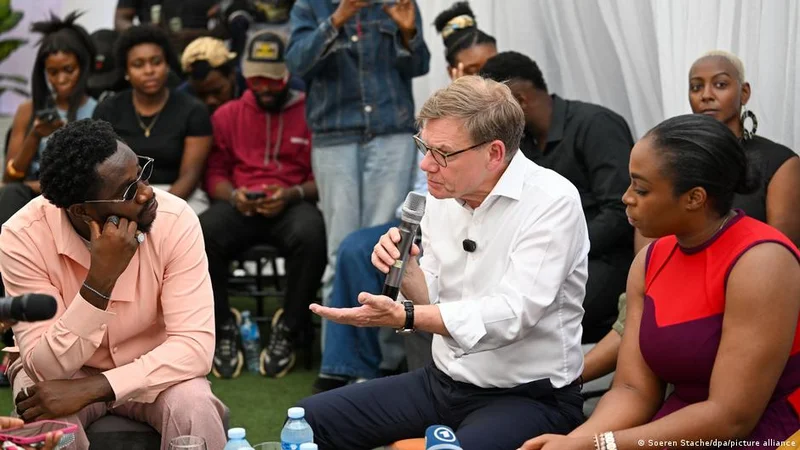
In a tent in the Nigerian metropolis of Lagos, two worlds collide: Three fashionable influencers sit on cushioned stools across from Germany's 63-year-old Foreign Minister Johann Wadephul. For half an hour, the senior politician meets Africa's young creative scene.
These young people are among the stars of Nigeria's creative industry — in a country with a population of around 240 million and a median age of just under 18. Wadephul wants to understand what moves the younger generation. What issues are on their minds? How do they view Germany? And what do they expect from a collaboration?
After a brief hesitation, they reply: Germany and Europe listen to their music, view their art, and want to collaborate with them. But anyone who wants to travel to the German capital for Fashion Week or the Berlinale film festival can hardly get a visa, says a young man in the audience.
A conversation gets underway; everyone enjoys the exchange and subsequently uploads upbeat videos to social media platforms — to the influencers' channels as well as those of the Federal Foreign Office. This is how German diplomacy seeks a direct line of communication with Africa's younger generation.
Nigeria as a Valuable Energy Supplier
There is good reason for the Foreign Minister to be promoting Germany in Nigeria. "The country is an economic powerhouse and, as Africa's largest domestic market, also a key destination for German exports," he says. Nigeria is sub-Saharan Africa's second-largest economy and already imports machinery, chemicals, and food products "Made in Germany."
However, Nigeria's raw materials account for the largest share of the trade balance. They have become even more important since the blockade of the Strait of Hormuz. "In June, 25% of jet fuel shipments to Europe came from Nigeria. But we can do significantly more," emphasizes Wadephul.
Vital infrastructure support
Wadephul is accompanied by a business delegation on his third trip to Africa. The group includes major corporations like Siemens as well as small and medium-sized enterprises. One of these is VIDA, a Munich-based AI company that is finalizing a multi-million-euro contract with the Nigerian government. The focus is on AI-driven infrastructure planning.
"Our solutions help identify and evaluate new locations. AI allows us to determine much more quickly the economic potential of a site, as well as the local conditions regarding security, climate trends, and other key factors," explains VIDA founder Tobias Engelmeier. His company is already implementing projects in 20 African countries.
German support for infrastructure development is in demand in many places. Since the European Union launched a €290 million ($330 mio) package as part of its Global Gateway strategy, hopes have been rising — both in Africa and among European companies — for faster progress in expanding transport, energy, and utility networks. The Nigerian government is also actively lobbying for German investment to modernize its power supply.
Foreign Minister Johann Wadephul and President of the ECOWAS Commission Omar Touray attended the Nigerian-German business roundtableImage: Soeren Stache/dpa/picture alliance
Underestimated economic and political significance
Yet Germany has long underestimated Nigeria's economic and political importance. Given the potential of what is Germany's second-most important trading partner in sub-Saharan Africa, the presence of around 100 German companies is comparatively small. Siemens is involved in expanding the power grid, while Bayer is planning pharmaceutical production facilities together with regional partners. Small and medium-sized enterprises (SMEs) are also increasingly entering the market, though many complain about a lack of transparency in market and decision-making structures.
"It is a challenging market with high operating costs. That is why local partners who understand the diverse structures across the 36 states are essential," says Sabine Dal'Omo, Managing Director of Siemens Sub-Saharan Africa and Chairwoman of the German-African Business Association.
Renewable energy provider Enertrag is among the companies taking a wait-and-see approach. "For us, Nigeria holds great potential — there is strong domestic demand and favorable conditions for exporting green energy. However, the overall framework remains too uncertain for us to commit to a long-term investment," says board member Anne Bendzulla.
Instead, Enertrag has been successfully investing in South Africa for several years. There, the company states it is prepared to invest around €850 million in wind energy.
Missing out by arriving late
The security situation in Nigeria is a matter of concern for German business. Consequently, the Federal Government is making additional funds available for cooperation with Nigeria's police authorities.
He urges the German business community not to hesitate too long. "Anyone not present in Africa today risks missing out on crucial opportunities," Wadephul told reporters. The country, with its young population, possesses immense potential and abundant resources, he added. "It would be grossly negligent of us to overlook that."
On the final day of his third trip to Africa, Johann Wadephul is visiting South Africa — by far Germany's most important economic partner on the continent. Around 600 German companies have already invested there.
This article has been translated from German.