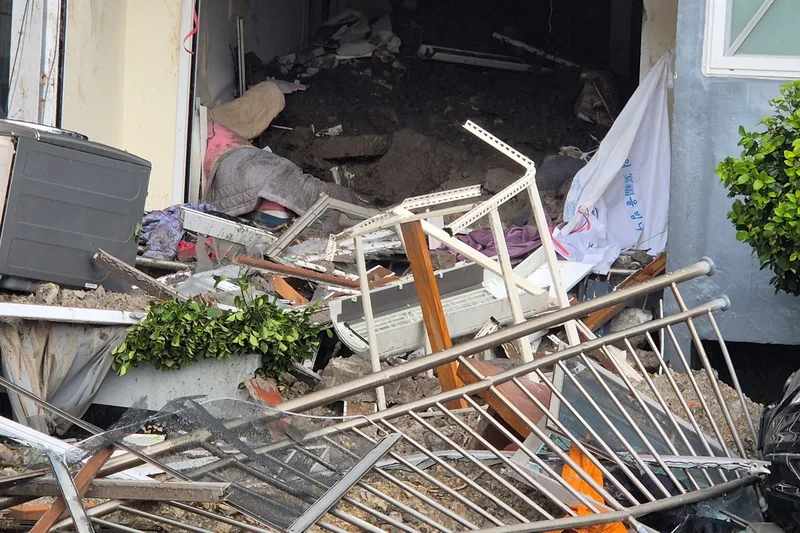
One person was killed in a landslide and two others were injured in southern South Korea after nearly 800mm of rain fell in three days on a region that was in drought a week ago.
Geoje, a coastal city near Busan, recorded 782.5mm between midnight on Saturday and 6am on Monday, according to the Korea Meteorological Administration, close to a third more than London receives in an average year.
Nearby Tongyeong had 628.9mm, Sacheon 318mm and Namhae 231.3mm.
The landslide struck an apartment building in the Okpo district of Geoje at about 4.32am on Monday (8.32pm BST on Sunday), burying the ground floor, the National Fire Agency said. Rescue workers pulled three residents out, one of whom later died in hospital. A second person was rescued after being buried by a landslide in Tongyeong shortly after 5am.
Roads across the region were cut, including National Route 33 in Goseong, and flooding along the coast was made worse by high tide. Authorities received more than 20 reports of people trapped by water or debris, about 100 residents of Geoje were being moved out because of the risk of further slides, and rescuers were working to reach 20 people stranded there, the safety ministry said.
Residents were woken repeatedly by emergency alerts through the night.
"Overnight, I heard the loud emergency alert three times on my phone. Every time I was about to fall asleep, another alert came, warning of heavy rain and advising evacuation," a Geoje resident who gave his surname as Jeong told the Korea Herald.
"It was still raining heavily this morning, and I heard that low-lying areas were flooded and in chaos."
Public transport was suspended in parts of Geoje, and the shipbuilders Hanwha Ocean and Samsung Heavy Industries, two of the city's largest employers, told staff to stay at home.
Prime minister Han Seong Sook told the police, firefighters and other agencies to use every available resource to reach people cut off by the water.
"Please make every effort to provide emergency support so that evacuees face no inconvenience, including by operating temporary shelters," she said, adding that officials should also ensure the safety of rescue workers.
South Gyeongsang province received 141.8mm between 1 July and 15 August, 19 per cent of the average for the period, a drought that affected about 5,700 households and 2,100 hectares of farmland, with crops withering in the fields.
Between 80mm and 150mm more rain was forecast for Monday, with heavy rain warnings in force for Geoje, Tongyeong, Sacheon, Namhae and Goseong, and advisories for Gimhae, Yangsan and Changwon.
Yangsan, in the same province, reached 42.5C on 2 August, the highest temperature measured in South Korea since observations began in 1904, in a heatwave the disease control agency has linked to at least 31 deaths nationwide.
In Japan, four people died on Friday and about 7,000 travellers were stranded overnight at Tokyo's Narita airport after more than 360mm of rain fell in 24 hours in Chiba prefecture, where the weather agency issued its highest rain warning for the first time. Weeks earlier, temperatures passed 40C at several locations and three lions died of suspected heatstroke at a Tokyo zoo.