Your support helps us to tell the story
From reproductive rights to climate change to Big Tech, The Independent is on the ground when the story is developing. Whether it's investigating the financials of Elon Musk's pro-Trump PAC or producing our latest documentary, 'The A Word', which shines a light on the American women fighting for reproductive rights, we know how important it is to parse out the facts from the messaging.
At such a critical moment in US history, we need reporters on the ground. Your donation allows us to keep sending journalists to speak to both sides of the story.
The Independent is trusted by Americans across the entire political spectrum. And unlike many other quality news outlets, we choose not to lock Americans out of our reporting and analysis with paywalls. We believe quality journalism should be available to everyone, paid for by those who can afford it.
Your support makes all the difference.
Read more
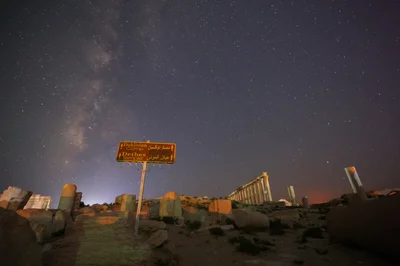
Our Milky Way galaxy might have “flipped” on its side, astronomers have said.
Researchers believe that the galaxy underwent a dramatic transformation during its history, where its orientation changed by more than 90 degrees.
The finding could help explain one of our galaxy’s deepest mysteries: why the sparse “stellar halo” of stars that were pulled into our galaxy is rotating very slowly.
The findings come after researchers from Durham University used supercomputer simulations of galaxies like our own Milky Way. They found that those with such slowly rotating stellar haloes are more likely to have seen a “disc flip”, where the part at its centre changes its orientation dramatically.
They looked at 25 galaxies like our own, following as they changed over billions of years. They found that those with particularly slowly rotating haloes had two particular features: they had collided head-on with another galaxy, and that they had undergone this kind of flip.
"We already know that the Milky Way had a massive head-on collision in the past with a galaxy known as Gaia-Sausage-Enceladus (often simply called the Gaia Sausage),” said Kirill Batrakov, who led the work. “So, we think that the Milky Way disc likely flipped in the past.”
About 10 or 11 billion years ago, the massive dwarf galaxy known as Gaia-Sausage-Enceladus smashed into the Milky Way, and absorbed it. It was the most significant event in our galaxy’s early history, reshaping it and leaving behind billions of stars that orbit in long, sausage-shaped paths.
"A disc flip also means most of the Milky Way's stars once moved on very different trajectories than they do today – possibly even our own Sun, meaning our 'stable' spot in the galaxy might not have been so stable for the Solar System's whole lifetime," Batrakov said.
Scientists hope that the findings can explain the peculiar nature of our own galaxy. But they also say that understanding the Milky Way gives us a better insight into other, similar facilities, by working as a nearby “testbed”.
"Finding that its disc flipped adds a new chapter to that story, one we must account for when placing the Milky Way in a broader context of other galaxies,” said Batrakov. “What excites me the most is that this complex history can be reconstructed just from present-day observations."