‘Like a battlefield’: How Yemen’s Mocha went from a town of fishermen to a city of fighters
In Yemen’s coastal city of Mocha, the dominant dialect is no longer that of the native fishermen who grew up relying on the sea. Instead, it is the dialect of fighters who fled Houthi-controlled areas.
Once a small fishing town, Mocha has transformed into a bustling hub where almost all essential services are available, largely because fighters have settled here with their families.
Mocha is a centuries‑old trading city located on the country's southwestern coast along the Red Sea, in the Taiz governorate. Historically, the Port of Mocha was world-famous for exporting Yemeni coffee.
However, due to the civil war that erupted in 2014 between the Houthis and the internationally recognised government, the port was closed in 2015. It reopened in 2021 after being rehabilitated by the leadership of the Republican Guard, a faction of Yemen’s former elite military units led by Tareq Saleh and backed by the UAE.
Saleh initially fought alongside the Houthis. However, after his uncle, former President Ali Abdullah Saleh, was killed by the group in December 2017, he fled Sanaa and began establishing his own forces in Mocha.
Since then, Mocha has served as the headquarters of the Republican Guard. Drawn by the higher salaries paid in Saudi Riyals, many Yemenis fleeing Houthi-controlled areas have joined the Republican Guard in Mocha.
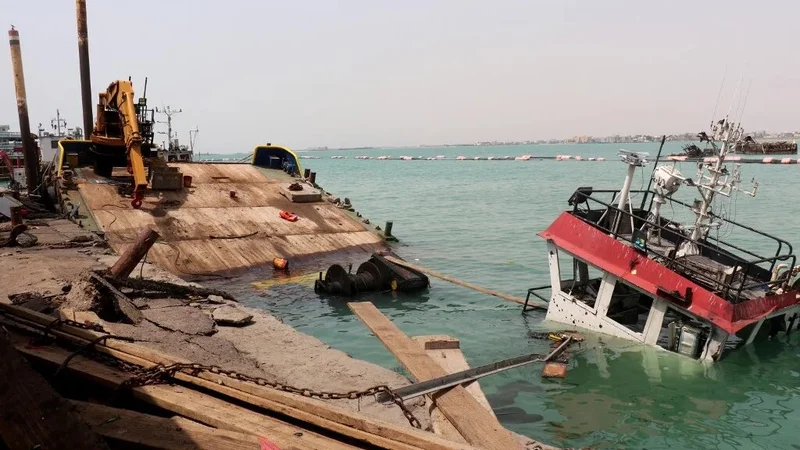
Located approximately 60km from the Bab al-Mandab Strait, Mocha holds a highly strategic position on the Red Sea. As a result, the Houthis have targeted the city repeatedly in the last fortnight. Over the past week, more than 25 Houthi attacks have struck the Port of Mocha.
While the Houthis claimed to target military reinforcements and positions, government officials confirmed that 16 civilians were killed and 22 others were injured in Friday's strikes alone.
Families should be safe
Ibrahim Salem, who is in his 40s, originally comes from Dhamar governorate, around 300km north of Mocha. He joined the Republican Guards in Mocha just seven months ago after managing to flee Houthi-controlled areas, where he had previously served as a Houthi fighter.
“The Houthis don’t differentiate between military targets and civilians, so it is better not to keep our families in Mocha. That's why I opted to rent a home for my family in this safe village,” Salem told Middle East Eye as he stood with his three children outside a grocery store in a village located in Taiz’s al-Maafer district, around 100km east of Mocha.
‘The Houthis don’t differentiate between military targets and civilians, so it is better not to keep our families in Mocha’
- Ibrahim Salem, Republic Guards fighter
Salem praised the village residents for their warm reception, noting that many other fighters have similarly moved their families to rural areas in the Taiz and Lahj governorates, further east.
“It is always better to keep our families far from the frontlines and targeted areas. I initially brought them to Mocha because it was quiet, and there was no fierce fighting in Mocha or surrounding regions,” he added.
Yemen has experienced a truce-like status since the UN-mediated ceasefire in April 2022. However, earlier this month, the Houthis resumed attacks against Yemeni forces and critical infrastructure across the Hadhramaut, Marib, Taiz, Al-Dhalea and Hodeidah governorates.
Salem acknowledged that Mocha has become a well-known destination for fighters escaping Houthi-controlled areas.
“When I walk through Mocha, I sometimes feel like I'm still in Dhamar because I run into so many familiar faces. It makes me forget how far I am from home - though families still need to stay safe, which means staying out of Mocha.”
This marks the second time Salem’s family has been displaced: first from Dhamar to Mocha, and now from Mocha to a rural locality. Although life in the village lacks the modern services found in Mocha, Salem said that because his family originally comes from a rural background, they easily adapt to village life.
Ramez, 38, another fighter with the Republican Guards who joined two years ago, told MEE he rented a home for his family in a village away from Mocha from day one. He noted that Mocha's reputation as a gathering hub for fighters made him feel the Houthis could target it at any moment.
“Villages or cities far from Mocha are safe for families, but we prefer villages because the rent is cheaper than in the cities,” he said.
“Nowadays, most of those who have their families in Mocha are scrambling to find homes in villages all at once, as they didn't anticipate the situation becoming so dangerous earlier on.”
When visiting some villages in the Taiz governorate, MEE could see many families of fighters now reside there, playing a major role in driving up local house rents.
Ramez, who has over 15 years of military experience, said that housing fighters' families should be treated as a key security consideration before anyone even joins a military camp. He noted that bringing families close to active zones is a serious mistake.
“Not only in Mocha, but anywhere there is a war, soldiers' families shouldn't stay in the same city or area as military camps; they should remain far away in safe areas,” he added.
“I think the majority don't keep their families in Mocha; it's only a few.”
‘We miss the life we used to have’
The situation in Mocha is increasingly difficult, and local fishermen are no longer allowed to sail due to the ongoing escalation. As a result, many of them believe that choosing Mocha as the headquarters of the Republican Guards has stripped them of their livelihood.
“Since the beginning of this war in 2015, we have been going from one crisis to another, and fishermen are always the most vulnerable victims,” Akram, a fisherman in his 40s who asked to use only his first name, told MEE.
‘The truth is that these fighters have ruined our town, and they are the main reason we lost our jobs’
- Akram, fisherman
“The Houthis know that Mocha is full of fighters, and that is why they are targeting us every day,” he added.
“The truth is that these fighters have ruined our town, and they are the main reason we lost our jobs.”
Speaking with visible frustration, Akram said all residents in Mocha are suffering today.
“Before the war, most residents here worked as fishermen and enjoyed a peaceful life. Since those fighters arrived in the city promising us a better life, we haven't seen anything improve; instead, we just miss the life we used to have.”
Akram noted that some fishermen have abandoned their trade to join the Republican Guards because the fighters receive their salaries in Saudi Riyals - an income up to four times what a fisherman typically earns.
“I only believe in peace and civilian jobs. What we need is peace, but there are some who only care about money and don't think about the future of our area or the next generation,” he added.
“The sea used to be our primary source of income, but today it feels more like a battlefield.”
Akram hopes this escalation will end soon so that locals can resume their regular lives at sea: sailing freely to catch the best fish, sell to local markets and export to neighbouring countries.
Another Mocha resident, Zaher, 46, who asked not to use his real name, works as a driver for an international humanitarian organisation. While he is glad to see Mocha growing every day, attracting aid groups and new investments, he believes the city's safety must come first.
“Anyone would be happy to see new opportunities coming to their city, but our biggest challenge today is that we don’t feel safe,” he told MEE.
“All we need is security, and I hope the Houthis avoid targeting civilian infrastructure because we just want to live.”
As Houthi attacks on Mocha have continued unabated, operations at the seaport have ground to a halt, leaving more than 1,500 port workers without a livelihood.