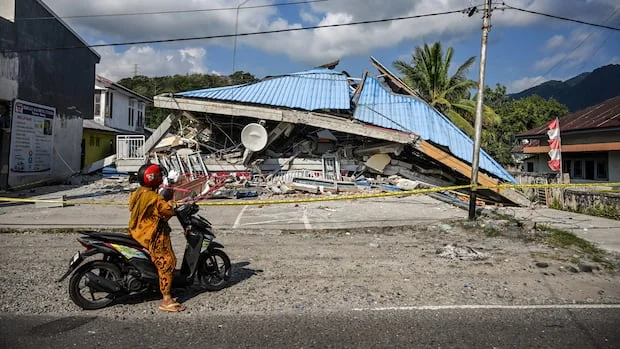
Indonesia quake death toll rises to 68, thousands left homeless
Over 1,500 aftershocks recorded since Saturday in country prone to earthquakes
Thousands of people were still waiting for aid on the Indonesian island of Flores on Monday, days after a powerful earthquake killed at least 68 people, injured more than 200 others and damaged hundreds of homes and other buildings.
Many residents on Flores island in East Nusa Tenggara province spent the day mourning victims and waiting for aid to arrive to communities still cut off by the deadly quake.
During Indonesia's Independence Day ceremony in the capital Jakarta, President Prabowo Subianto asked participants to pray for people affected by disasters in East Nusa Tenggara and other parts of the country, while leading a nationwide moment of silence honouring the nation's independence heroes.
More than 1,300 homes were damaged when the quake struck with a depth of 10 kilometres in East Nusa Tenggara province just before 6 a.m. Saturday. Some 5,000 people were forced into temporary shelters and 213 people were injured, according to the National Disaster Management Agency or BNPB.
Authorities have since recorded 1,576 aftershocks into Monday, though only a small proportion were felt by residents.
The province's governor declared a 14-day state of emergency on Sunday.
Thousands await aid amid devastation
Thousands of people on Flores camped outside collapsed homes under tarpaulin tents overnight into Monday, sleeping outside due to the danger of more aftershocks.
An Associated Press photojournalist saw widespread devastation across the island, with fallen trees blocking roads, giant boulders hurled down slopes by landslides and homes left shattered or heavily damaged. Buildings collapsed onto parked cars.
"My house is just rubble now," said Rasyid Jafar, a clothing trader in the village of Reo, the hardest-hit area in Manggarai regency. "We need food, medicine and clean water urgently."
Nearly 1,500 military and police personnel have been deployed across the disaster zone, supported by 10 aircraft to distribute 275 tonnes of aid to the area as logistical challenges have slowed deliveries to some hard-hit communities, said Abdul Muhari, the BNPB's deputy chief, in a video statement.
Authorities set up two emergency field hospitals in the worst-hit town of Ruteng to treat earthquake victims after local hospitals were damaged, with two crisis management teams overseeing a health emergency operation centre, Muhari said.
He also said rescue teams continue searching for victims in the affected areas, although no residents have reported any family members still missing.
Remote communities
Aid workers reached tiny Palue Island, one of the areas closest to the earthquake's epicentre, late Sunday, after a difficult sea and land journey through landslide-hit terrain, authorities said. Thousands of residents remained in urgent need of assistance after days of isolation.
"The roads are steep and many were blocked by landslides. It was a near-death journey," said deputy police chief of Sikka regency, Marselus Yugo Amboro, whose team was among the first to reach the island with emergency supplies.
WATCH | Search operations continue:He said initial assessments revealed extensive damage, with one villager killed, two seriously injured and nearly 150 homes destroyed.
Indonesia, an archipelago of more than 17,000 islands, is prone to earthquakes and volcanic eruptions because of its location on the Pacific "Ring of Fire," a horseshoe-shaped arc of seismic faults and volcanoes.
A powerful earthquake and tsunami struck Flores in 1992, killing about 2,500 people.
In 2004, a magnitude 9.1 quake off Sumatra unleashed a tsunami that killed about 230,000 people in a dozen countries, while a magnitude 7.5 earthquake triggered a tsunami on the island of Sulawesi that killed more than 4,400 people in 2018.