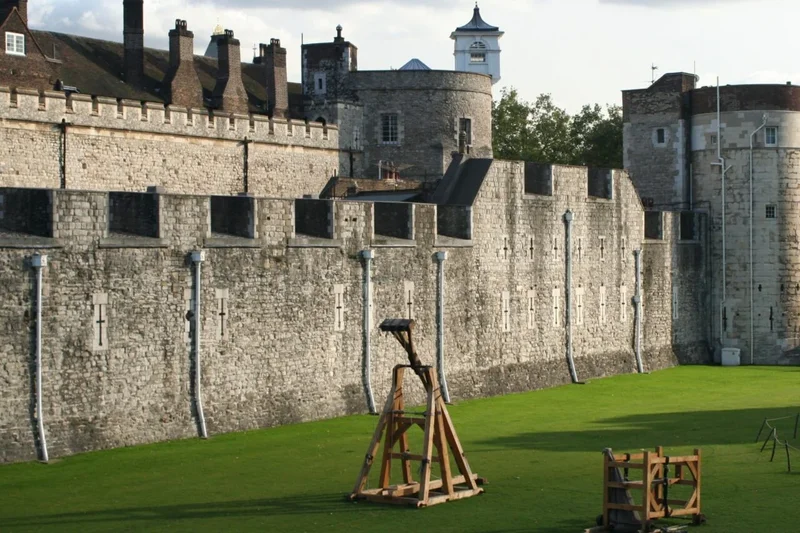
It reportedly took five master carpenters and 50 assistant laborers three months to build the âWar Wolfâ back in 1304 CE. Possibly the largest trebuchet ever built, it was a true product of the rage inside King Edward I of England as he sought to subdue what was then the last stronghold of an independent Scotland, Stirling Castle, during the First War of Scottish Independence. Historical accounts allege that the War Wolf could cast a stone through castle walls like âan arrow flying through cloth.â
But trebuchets were already devastating compared to the catapults that inspired them, capable of launching boulders over 220 pounds (100 kilograms) across multiple football fields in length. King Edward I is said to have deployed at least 17 of these killing machines against Stirling Castle during his siege. And now, over 700 years later, archaeologists have brought forward what theyâre calling the first ever confirmed evidence of a human death by trebuchet: the impressively shattered skeletal remains of a young man excavated from beneath Stirling Castleâs chapel.
Labelled Skeleton 150 by researchers, the late Scotsmanâs remains revealed over 160 separate bone-crunching injuries that were coincident with his time of death (or âperi-mortemâ), including a skull caved in along 61 different fractures.
âWhile the use of siege engines is well documented, we believe this is the first evidence of trebuchet trauma in the archaeological record,â University of Bradford archaeologist Jo Buckberry wrote ahead of her presentation to the Paleopathology Association in Berlin this August. âDetailed analysis indicates this peri-mortem trauma was all blunt-force,â according to Buckberry, who serves as head of Bradfordâs Biological Anthropology Research Centre (BARC). âIt highlights the brutality of medieval warfare.â
Bone-smashing
Skeleton 150 was once a 5-foot, 4-inch (165-centimeter) tall male between the ages of 22 and 34 years old, according to Buckberry. She relied on tools like the 3D X-ray imaging of micro-computed tomography (CT), traditional X-rays, and microscopic imaging to better assess the cause of each of the skeletonâs bone fractures.
One of the clues that most of these bone fractures occurred at the time of death, as Buckberry explained it to the docuseries History Hit last year, is how cleanly the breaks reassemble like a jigsaw puzzle. Post-mortem bone injuriesâsay, for example, those due to rodent gnawing or weather erosionâwon’t line up as neatly as these peri-mortem breaks.
âPatterning of fractures indicates that the focus of impact was around the right shoulder and the back of the cranium, with higher fragmentation in this area,â Buckberry explained. This pattern included a jagged, zig-zagging break along the shoulder and roughly 60 cracks to the skeletonâs ribs.
âComparison with known forensic cases indicates this trauma was the result of a single, high-velocity impact,â she noted, âprobably to a living individual with forearms flexed in front of the body and bearing weight through the lower limbs and feet.â
Siege-maxxing
In some ways, the new research on Skeleton 150 is a victim of its own novelty. Buckberry cautioned that the dearth of similar forensic cases documenting the physical toll on those pancaked by trebuchet projectiles leaves some room for doubt in these findings. But she voiced hope that ongoing research might focus on similar cases of blunt force trauma âalongside weapon trauma in medieval contexts.â
That said, at least one forensic osteologist who spoke to the journal Science, Lukas Waltenberger at Vilnius University, described the current state of this case as âconvincing.â
âIt seems like a high-velocity, high-force, high-speed impact in a short amount of time,â according to Waltenberger, who has investigated similar kinds of bone fractures but did not play a role in Buckberryâs project. âIn skeletons from past times you rarely see this.â