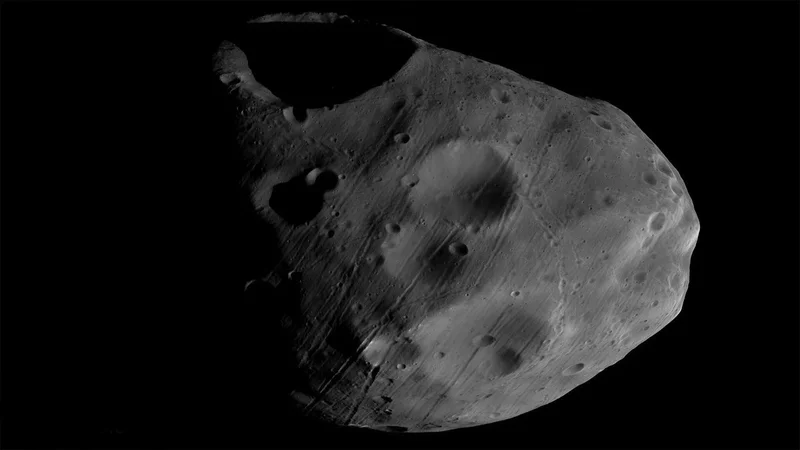
On Aug. 17, 1877, American astronomer Asaph Hall discovered Mars's moon Phobos.
Hall was working at the U.S. Naval Observatory in Washington, D.C. and looking through a 26-inch refractor telescope — which was then the largest in the world — when he first spotted the moon. Six days earlier, he had discovered another, smaller moon that he first described as "a faint star near Mars."
Upon further inspection, not only did he realize that this star was actually the Martian moon Deimos, but he also discovered a second, larger moon now known as Phobos. He announced both discoveries the following day, on Aug. 18, 1877.
Phobos is the largest moon of Mars. Its dimensions measure 10 by 14 by 11 miles (17 by 22 by 18 kilometers) across and orbits Mars three times each Martian day at a distance of about 3,700 miles (6,000 km).
Why it mattered
Over the century and a half since this discovery, there has been an enormous amount of scientific progress in the study of Mars. In addition to many decades of studying the planet from afar, we have seen a variety of different orbiters and rovers explore the Red Planet over the past few decades. We have sampled bits of Martian material, seen up-close photos of the planet and the rocks which scatter across its surface. It might be easy to take for granted how much we know about our planetary neighbor, and this 19th century discovery was groundbreaking.
As we look to the future with new technologies and new discoveries on the horizon, it is important to also look backward to see and understand the history and work that made all of this progress possible.
Hanneke Weitering is a multimedia journalist in the Pacific Northwest reporting on the future of aviation at FutureFlight.aero and Aviation International News and was previously the Editor for Spaceflight and Astronomy news here at Space.com. As an editor with over 10 years of experience in science journalism she has previously written for Scholastic Classroom Magazines, MedPage Today and The Joint Institute for Computational Sciences at Oak Ridge National Laboratory. After studying physics at the University of Tennessee in her hometown of Knoxville, she earned her graduate degree in Science, Health and Environmental Reporting (SHERP) from New York University. Hanneke joined the Space.com team in 2016 as a staff writer and producer, covering topics including spaceflight and astronomy. She currently lives in Seattle, home of the Space Needle, with her cat and two snakes. In her spare time, Hanneke enjoys exploring the Rocky Mountains, basking in nature and looking for dark skies to gaze at the cosmos.